Best AI Tools for Multi-City Trip Planning in 2026: Layla vs Mindtrip vs Odessia vs FortripAI
Layla, Mindtrip, Odessia, and FortripAI can all build you a five-city itinerary. The harder question is which one helps once you're stuck deciding whether Paris should come before Amsterdam, or whether your ChatGPT-built plan actually holds up.
What each AI travel planner actually does — and why generating an itinerary may be the least interesting part of the problem.
Last verified: August 2026. AI travel products move fast — features described here may have changed since publication.
Ask four AI travel planners to build the same two-week trip through five cities, and at first glance the results look similar: hotels, attractions, restaurants, maps, a day-by-day plan.
Multi-city travel gets difficult one layer below that. Should Paris come before Amsterdam or after it? Is the cheapest flight still cheap once baggage and an airport transfer are added? Would moving Barcelona three days later cut the hotel bill enough to justify changing the route? Does the recommended train actually leave enough time after your flight lands?
Share
Start a trip Fortrip can actually defend.
Sketch a brief. We come back with an itinerary that reads like a recommendation, not a checklist — and tell you what we’d change about it.
Every AI travel app claims it can "plan your perfect trip." Most only do the easy part — turning a prompt into an itinerary. We compared 6 tools across brainstorming, booking, organizing, and the part most of them skip: checking whether the plan is actually good.
One model makes a human travel advisor more powerful. The other puts decision-making tools directly in the traveler's hands. Here's the real difference between FortripAI and Fora Travel — and which one fits how you actually like to travel.
Those aren't itinerary-generation questions — they're travel decision problems. Layla, Mindtrip, Odessia, and FortripAI all use conversational AI to plan trips, but they lean into different parts of that problem. So instead of "which is the best AI trip planner," the more useful question is: which part of the decision do you actually need help with?
Quick Answer: Which AI Trip Planner Fits Which Job
Tool
Best fit for
Stands out for
Main limitation
Layla
Fast, visual trip creation
Maps, imagery, live travel products, human experts
Can generate a full itinerary before enough preferences are clarified
Mindtrip
An all-in-one planning workspace
Reviews, collaboration, saved places, booking
Organizes many individual choices; less focused on optimizing the trip as one system
Odessia
A polished conversational booking flow
Clean interaction, decision cards, fast path to booking
Still relatively lightweight for complex multi-city reasoning; in preview
FortripAI
Deciding how an already-chosen trip should actually work
Less visual inspiration; booking is less central to the product than the decision layer
There's no universal winner — these products are increasingly solving different problems within the same category.
Why Multi-City Planning Is a Different Kind of AI Problem
One weekend in Rome is mostly a recommendation problem. Rome → Florence → Venice → Vienna → Prague is partly a combinatorial one — each added city creates new possible orders, flight and train combinations, hotel-date pairings, arrival/departure airports, and pacing trade-offs. Change one variable and several others move with it, which is why an itinerary that reads perfectly in a chat window can still be a poor trip.
This difficulty isn't just a product-design opinion — it's been studied directly. The TravelPlanner benchmark was built specifically to test how well AI agents handle realistic travel planning, which requires gathering information, reasoning across multiple interacting constraints, and keeping a final plan internally consistent — and it found today's language-agent systems still struggle to satisfy all of them at once.
That distinction maps onto three different questions: itinerary generation ("what could my trip look like?"), optimization ("which version of the trips I could take makes the most sense?"), and validation ("before I spend money, does this plan actually work?"). Different products in this comparison emphasize different layers of that stack.
1. Layla: Strong Visual Discovery, Fast Trip Creation
Layla combines conversational planning with hotels, flights, activities, maps, and travel inspiration, plus a Multi-Destination Route Map, road-trip planning, live travel-product comparisons, and access to human travel experts.
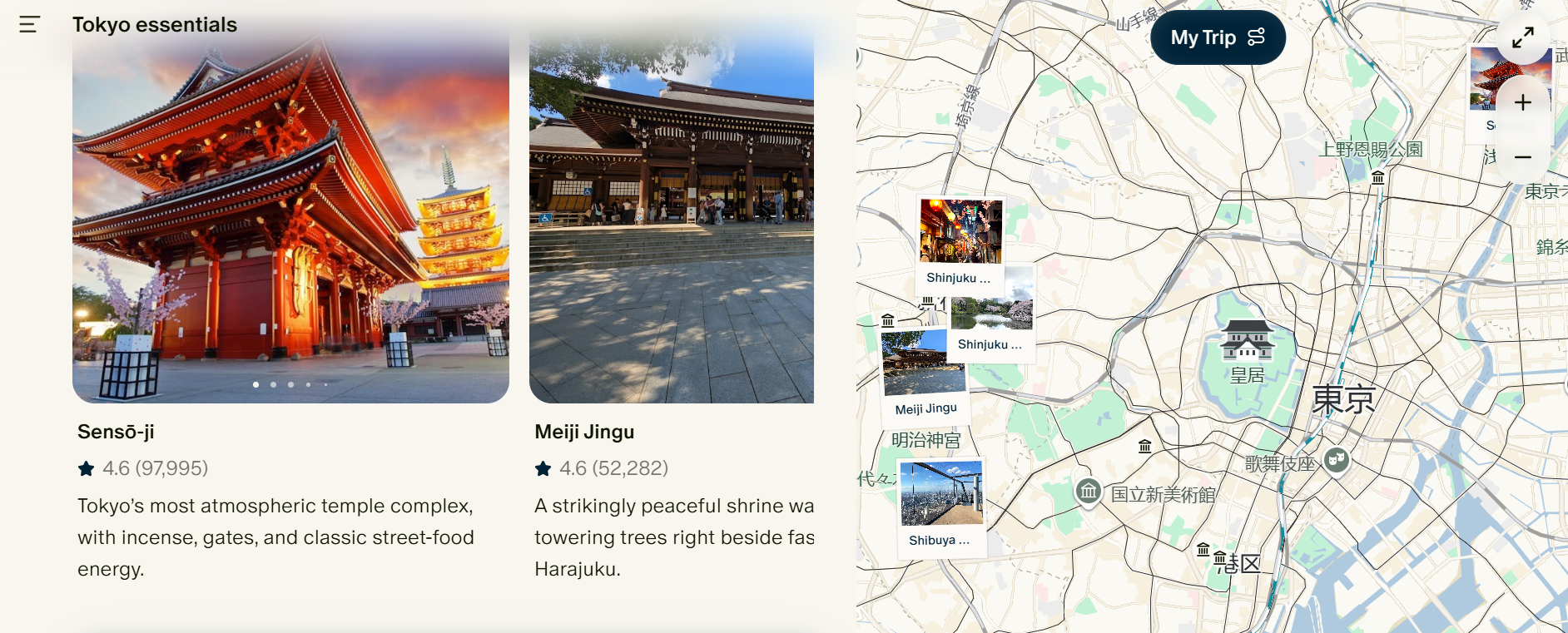
What it does well: Travel is an unusually visual purchase — you don't pick Kyoto because a database row scored it highly, you want to see the place, and Layla's maps and imagery make planning feel closer to exploring than filling out a form. It's also fast at solving the blank-page problem: give it a destination and a few parameters and you get something tangible almost immediately, which works well if your goal is "give me a starting point I'll edit myself." Recommendations connect fairly directly to bookable flights, hotels, and transfers, narrowing the gap between "this looks nice" and "I can book this."
Where it falls short: The itinerary can appear too quickly. Ask for "12 days in Japan" and there are dozens of open questions — first trip or repeat visitor, five cities or three explored deeply, nightlife versus quiet neighborhoods, tolerance for changing hotels — that a fast Tokyo → Kyoto → Osaka output can quietly skip past. We also found the conversational space fairly constrained for deeper planning, with some follow-up questions left hanging if not answered immediately. None of that makes Layla a poor planner — it just means the product optimizes for speed and visual momentum over exhaustively clarifying intent first.
Good fit if: you want visual inspiration, a quick first draft, interactive routing, and a short path to booking.
2. Mindtrip: Possibly the Strongest General Planning Workspace
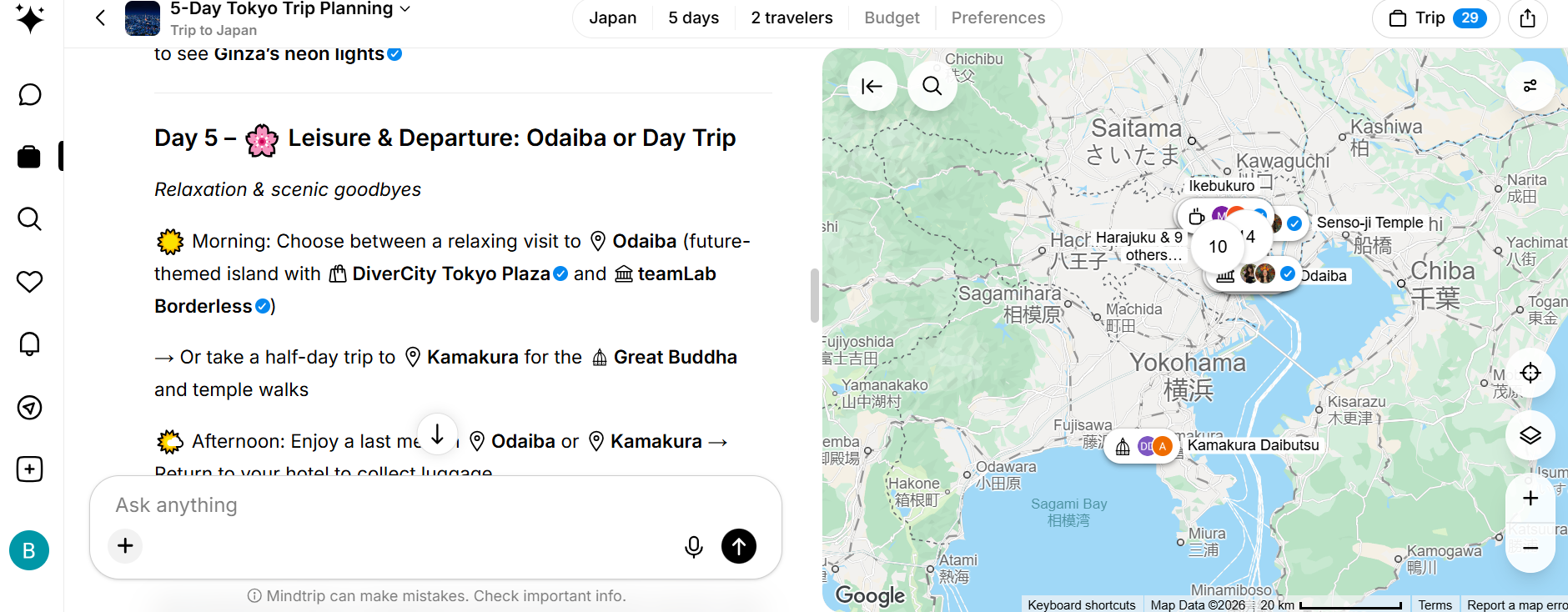
Mindtrip functions less like a chatbot with an itinerary attached and more like a full travel workspace — customizable itineraries, photos, maps, reviews, Google Maps saved-place imports, collections, and real-time group collaboration, with hotels, flights, restaurants, and experiences inside the same ecosystem.
What it does well: The UI treats different kinds of trip information (places, dates, reservations, opinions, prices) as needing different displays rather than dumping everything into chat text — a genuinely underrated design choice. Recommendations come with surrounding context rather than a bare "stay here," and folding in real traveler reviews gives you evidence beyond a hotel's factual attributes. Collaboration is unusually strong, addressing something a lot of travel AI overlooks: the person prompting the AI isn't always the only person deciding.
Where it falls short: There's a real difference between organizing several cities and optimizing the relationship between them. Tokyo → Kyoto → Osaka → Seoul can look completely reasonable while missing that Kyoto hotels spike on your exact dates, that a different city order unlocks a cheaper international flight, or that moving Seoul forward saves on airfare but adds four hours of transport. In our testing, Mindtrip felt more built around planning, organizing, and booking individual travel products than around repeatedly stress-testing the whole multi-city system.
Good fit if: you want one polished place for inspiration, maps, reviews, collaboration, and booking together.
3. Odessia: A New Conversational Agent Focused on Planning and Booking
Launched in 2026 and currently in preview, Odessia positions itself as a travel concierge that plans and books an entire trip within one conversation, with hotels and homes, flights, things to do, and destination discovery front and center.
What it does well: It has one of the clearest visual identities of the four — travel planning is partly emotional, and a well-designed interface can make exploration feel less like filtering a database. Odessia also leans into decision cards over paragraph-by-paragraph chat output (Beach / Mountains / Food / Culture, pick one, and the AI interprets from there), which we think is the right instinct: users shouldn't always have to write the perfect prompt. Booking feels like a natural continuation of the conversation rather than a separate product bolted on.
Where it falls short: The trade-off is depth. Interactions we tested were elegant but relatively short, which feels refreshing for simple decisions but leaves a complex multi-country trip needing more context than the product currently gathers. We also found comparatively limited depth on multi-city transfer alternatives. Odessia is still in preview, so this may well change.
Good fit if: you want a visually polished, simple conversational path from discovery through booking.
4. FortripAI: Built Around the Decision Layer, Not Just the Itinerary
FortripAI (our own product, disclosed here) started from the same premise most AI travel tools do — planning takes too long, so AI should generate trips faster — and then moved away from it after talking to enough travelers who described the real friction differently: not "planning takes too long" but "I don't know if the plan I have is actually right." Is this itinerary realistic? Am I paying more because my hotels landed on the wrong dates? Is there a better city order I haven't considered?
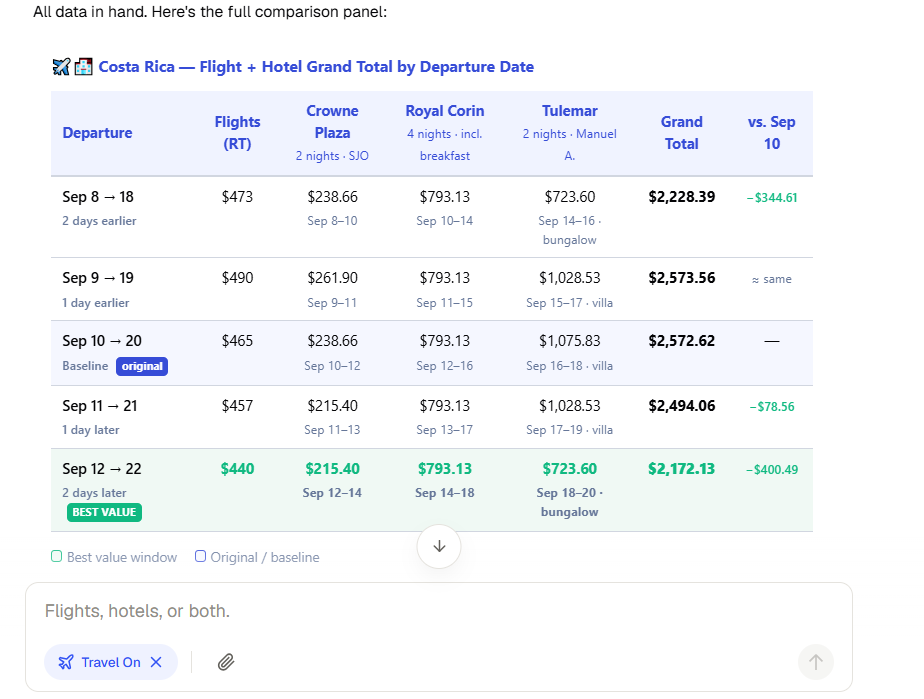
What it does well: Two agents sit underneath the planner. The Transport Optimization Agent treats city sequence itself as a pricing variable — instead of only answering "how do I get from Paris to Amsterdam," it asks whether Paris should come before Amsterdam at all, comparing route order, transportation cost, and hotel-date combinations together rather than one at a time. The Validator takes an existing itinerary — from FortripAI, ChatGPT, a travel agent, or a spreadsheet — and checks it for backtracking, unrealistic connections, and pacing problems, rather than generating a new plan from scratch. Recommendations are also built to explain why: what information drove the suggestion, what trade-off it makes, and what would change the answer — closer to "I'd pick Shinjuku because you're a first-time visitor who wants train convenience over quiet streets" than a bare "stay in Shinjuku."
Where it falls short: Visual inspiration is the clearest gap — destination imagery and content are less rich and varied than Layla, Mindtrip, or Odessia currently offer. Booking is also less central to the product experience than the decision-making layer sitting above it; travelers coming from a "show me pretty places and let me book in two taps" mindset may find the multi-turn clarifying questions slower than they want, especially compared to Odessia's fast decision-card flow. Some of that is intentional prioritization, but it's a real trade-off, not a hidden strength.
Good fit if: you already roughly know where you're going and need help deciding the order, dates, and hotel combination — or you have an itinerary from somewhere else and want it checked before booking.
A Shared Framework: Planning, Optimizing, and Validating Are Different Jobs
This distinction is useful past any single product. When picking an AI travel tool, ask which problem you actually have:
AI Trip Planner — "Where should I go? What should I do? What would a seven-day itinerary look like?" A generation and recommendation problem. Layla, Mindtrip, and Odessia all sit primarily here, alongside FortripAI's own planning layer.
AI Travel Optimizer — "Which city comes first? Which dates produce the cheapest hotel combination? What happens to the total if I change the order?" An optimization problem across variables that move together. This is where FortripAI's Transport Optimization Agent is purpose-built, and where the other three tools currently offer comparatively less depth.
AI Itinerary Validator — "Is this connection realistic? Am I backtracking? Did I underestimate transfer time?" A verification problem, applicable regardless of which tool (or human) built the original plan.
A single product can occupy more than one layer — but knowing which layer you actually need help with narrows the choice faster than a generic "best AI trip planner" search does.
Why Human-in-the-Loop Interfaces Matter Here
Two routes: Option A is $180 cheaper with four more hours of transport and an extra hotel change; Option B costs more but has easier connections and a slower pace. There's no universally correct answer — the AI can calculate the difference, but the traveler has to decide what it's worth. This is why both Odessia and FortripAI increasingly lean on selectable interface components (cards, comparisons, trade-off summaries) instead of requiring every decision to happen through open-ended text — a pattern worth watching for in any AI travel tool you evaluate, not just these four.
So Which Should You Use?
Choose Layla if you want visual inspiration, a fast first draft, interactive routing, and a short path to booking or a human expert.
Choose Mindtrip if you want a polished workspace combining itineraries, maps, reviews, collaboration, and reservations in one place.
Choose Odessia if you want a simple, aesthetically strong conversational flow from discovery to booking, and don't need deep multi-city reasoning.
Choose FortripAI if you're asking things like: what's the best order for these five cities, should I shift my dates to cut hotel costs, can I compare flights and hotels together, or is my ChatGPT itinerary actually realistic before I book it.
Which is better for multi-city travel, Layla or FortripAI?
Layla is stronger for fast, visual itinerary creation and travel inspiration. FortripAI is built more specifically around optimizing city order, hotel dates, and route combinations once you already know roughly where you're going — pick based on whether you need a first draft or a decision layer on top of one.
Is Mindtrip or FortripAI better for planning several cities together?
Mindtrip is stronger as an all-in-one workspace for organizing, researching, and collaborating on a multi-city trip. FortripAI focuses more narrowly on comparing route orders and hotel-date combinations against each other to find the lowest-cost or most efficient version of a trip you've already outlined.
Can AI optimize the order of cities in a multi-city trip?
Yes. A multi-city optimizer compares alternative destination orders against transport time, transport cost, and hotel date availability. FortripAI's Transport Optimization Agent is built specifically around this kind of routing decision.
Does changing city order actually change hotel prices?
It can — hotels price by date, so reordering a multi-city trip changes which dates get assigned to each hotel stay, which can shift the total cost even with identical hotels and nights.
Can AI check an itinerary that ChatGPT or another planner already built?
Yes. An itinerary validator reviews an existing plan rather than generating a new one — FortripAI's Validator checks connections, transit times, pacing, and routing logic regardless of which tool produced the original itinerary.
What's the difference between an AI trip planner and an AI travel optimizer?
A planner generates a trip from your preferences and constraints. An optimizer compares multiple valid versions of a trip you've already outlined — different orders, dates, or combinations — to find which performs best on cost, time, or feasibility.
Is AI travel planning worth using if I actually enjoy planning trips myself?
Often yes, for a different reason than speed — optimization and validation tools can check your own plan for backtracking or pricing mistakes without replacing the parts of planning you enjoy, like destination research or building the day-by-day flow yourself.
Speed alone doesn't answer whether a trip is actually a good one. The more useful question, across any of these four tools, is whether you're confident enough in the plan in front of you to actually book it.