Peru Multi-City Trip: Does City Order Affect Hotel Cost?
Most travelers book their Peru hotels city by city, in whatever order feels logical. But for a 4-city itinerary with 6 hotels, there are 24 possible orderings — and the difference between the cheapest and most expensive is $93 in hotels alone, before flights. We ran every combination through ForTripAI's Hotel Optimization Agent. Here's what the data showed, including 10 routes that were eliminated entirely due to availability, and why adding domestic flights changed the ranking in a way the hotel data alone couldn't predict.
A traveler had 6 hotels, 4 middle cities, and 24 possible orderings. Most people would have just guessed. Here's what the data actually showed.
When most people plan a multi-city trip to Peru, they think about logistics in one direction: what makes geographic sense. Lima first, then maybe Cusco because it's the most famous, then down to Puno for Lake Titicaca, across to Arequipa, up to Huaraz, and back to Lima at the end.
It feels like a plan. And it is — just not necessarily the cheapest one.
What almost no one thinks to ask is: does the order I visit these cities affect how much I pay for hotels? The answer, as one traveler discovered when they ran their Peru itinerary through ForTripAI's Hotel Optimization Agent, is yes. And the difference wasn't trivial.
Share
Start a trip Fortrip can actually defend.
Sketch a brief. We come back with an itinerary that reads like a recommendation, not a checklist — and tell you what we’d change about it.
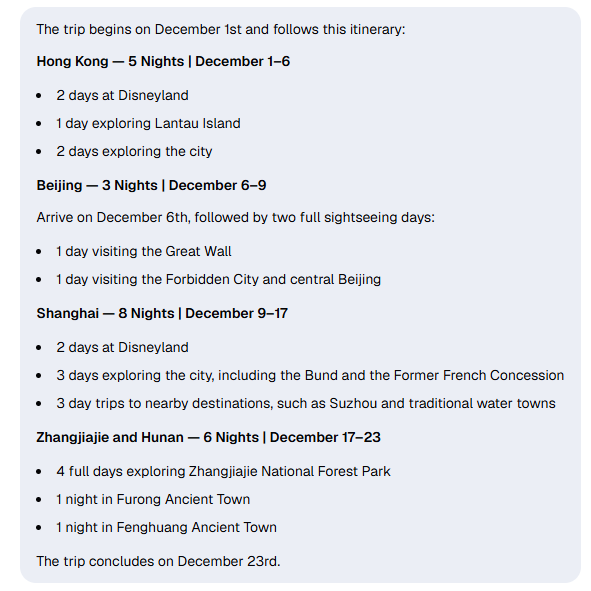
Your spreadsheet says three nights here, five nights there — everything fits neatly into a row. Then the trip begins, and by Day 5 you're no longer exploring a country, you're managing a small logistics company. Use this 10-point reality check (plus a full 23-day China itinerary case study) to spot rushed pacing, risky connections, and overplanned days before you book.
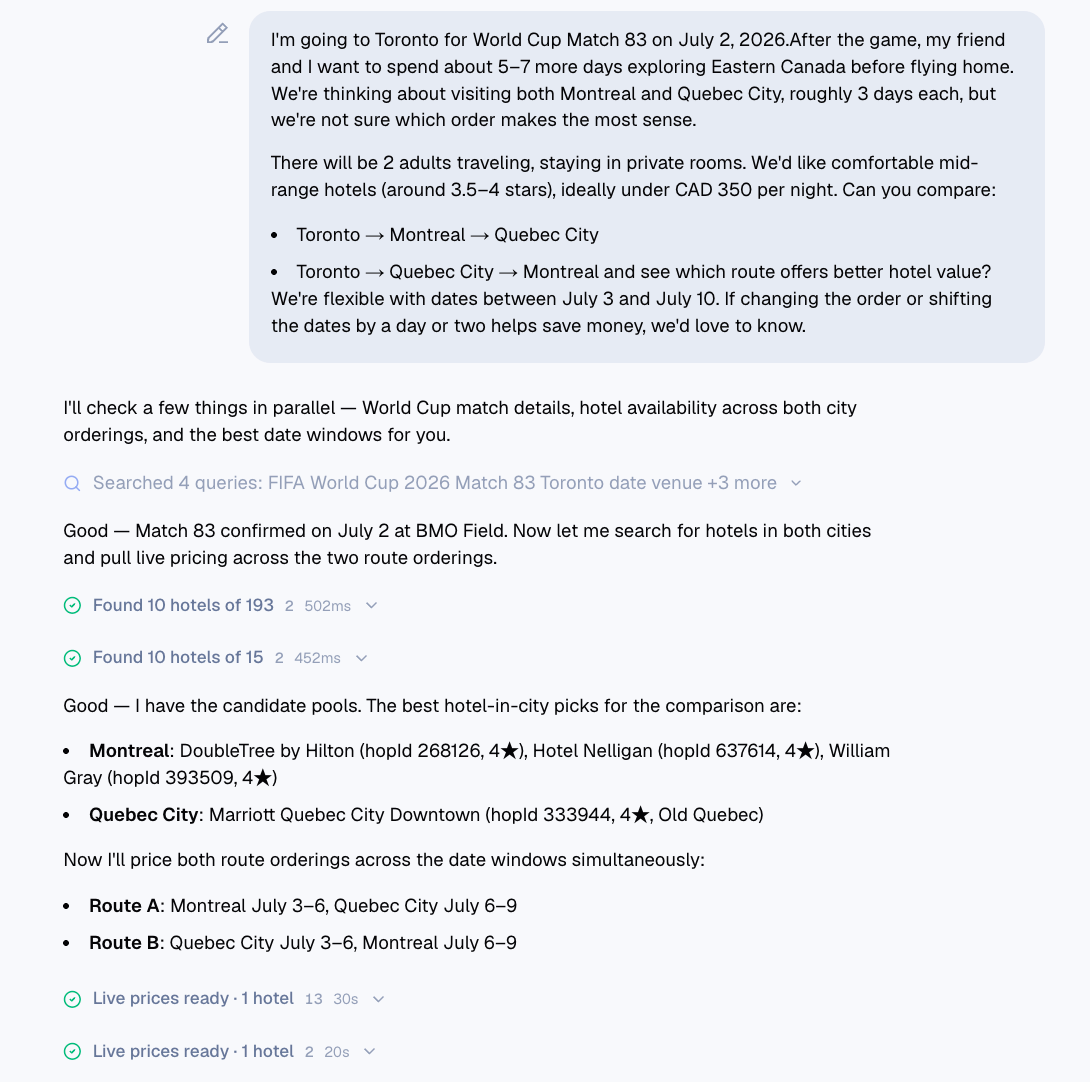
After the 2026 World Cup in Toronto, we compared two Eastern Canada routes and found that simply changing city order and stay dates can cut hotel costs by over CAD 200—without downgrading hotel quality.
A solo traveler planning a 16-night Peru trip in October 2026 had already chosen their hotels:
Holiday Inn Lima Airport — Lima, 1 night (Oct 1–2, fixed arrival)
Hilton Garden Inn Cusco — Cusco, 4 nights
Sonesta Posada del Inca Puno — Lake Titicaca/Puno, 3 nights
Hampton by Hilton Arequipa — Arequipa, 3 nights
San Sebastian Hotel Boutique — Huaraz, 3 nights
Dazzler by Wyndham Lima Miraflores — Lima, 2 nights (fixed final stop)
Lima was fixed at both ends. The 4 middle cities — Cusco, Puno, Arequipa, Huaraz — could theoretically be visited in any order. That's 4! = 24 possible permutations.
Most travelers would pick one ordering based on instinct and book it. This traveler asked the Hotel Optimization Agent to price all 24.
What 24 Permutations Actually Revealed
The agent ran all 24 orderings simultaneously, pulling live hotel rates for each city at each possible date slot across the October window.
First finding: 10 of the 24 routes were immediately eliminated. The Sonesta Posada del Inca in Puno had no available inventory for any 3-night stay starting October 9–12. Every route that placed Puno third or fourth in the sequence was unavailable — not just expensive, completely off the table. This is the kind of constraint that's invisible when you're booking city by city, and only surfaces when you run the combinations.
That left 14 viable routes. Here's what the pricing showed:
Route (middle cities)
Hotel Total
Cusco → Puno → Arequipa → Huaraz
$2,506 ✅ Cheapest
Puno → Cusco → Arequipa → Huaraz
$2,506 ✅ Tied cheapest
Cusco → Puno → Huaraz → Arequipa
$2,551
Cusco → Arequipa → Puno → Huaraz
$2,557
Puno → Cusco → Huaraz → Arequipa
$2,557
Arequipa → Cusco → Puno → Huaraz
$2,557
(8 further routes ranging up to $2,599)
Spread between cheapest and most expensive viable route: $93.
The Single Biggest Price Driver
Here's the insight that explains most of the spread: the Hilton Garden Inn Cusco is the only hotel whose price changes meaningfully by date.
Cusco check-in Oct 2–5: $1,042 total for 4 nights
Cusco check-in Oct 8 or later: $1,093 total for 4 nights
Difference: $51
Puno, Arequipa, and Huaraz rates were essentially flat regardless of when in October you stayed. Cusco was the only variable. That means the entire optimization question collapsed into one decision: get to Cusco first.
Every route that started the middle circuit in Cusco came out cheaper. The traveler's original instinct — which happened to put Cusco first — turned out to be correct, but for a reason they didn't know.
Then Flights Changed the Picture Slightly
When the traveler added domestic flights into the analysis (all flights hub-and-spoke through Lima, since that's how Peru's domestic network works), the ranking shifted slightly.
The hotel-only tie between Cusco → Puno → Arequipa → Huaraz and Puno → Cusco → Arequipa → Huaraz was broken by flight pricing. The Lima → Cusco fare on October 2 came in at just $27 — an unusually cheap date. Lima → Juliaca (Puno's airport) ran ~$44 on any available date. Starting with Cusco therefore became clearly cheaper once flights were included, moving the Puno-first route from a tie to third place.
Final all-in ranking (hotels + domestic flights):
Route
Total (Hotels + Flights)
Cusco → Puno → Arequipa → Huaraz
$2,830 ✅ Cheapest
Cusco → Puno → Huaraz → Arequipa
$2,875
Puno → Cusco → Arequipa → Huaraz
$2,875
The winner held. But only because the agent ran the flights too — otherwise the tie would have been left unbroken, and the traveler might have chosen the slightly more expensive Puno-first route without knowing.
The Anomalies You'd Never Catch Manually
Beyond the city ordering, the agent flagged two pricing anomalies that are worth noting — because they're the kind of details that simply don't surface when you're booking hotel by hotel:
Hampton by Hilton Arequipa: Only one room type available. The refundable rate ($284.92) was dramatically cheaper than the non-refundable rate ($536.78). In most hotels, non-refundable is cheaper. Here it's the opposite. Book refundable.
Sonesta Posada del Inca Puno: The breakfast-included rate was cheaper than the room-only rate. Breakfast is effectively free — it's already priced in lower.
These aren't rare anomalies. Hotel pricing databases are full of them. The difference is whether you have a tool that surfaces them, or whether you're just clicking through a booking page that shows you one rate and calls it a day.
What This Means for Every Multi-City Trip
The Peru itinerary had 24 possible orderings. 10 were unavailable. Of the remaining 14, the spread between cheapest and most expensive was $93 on hotels alone — and flights added another layer of variation on top.
None of this is information you'd ever have if you booked the trip the normal way: city by city, in whatever order felt logical, using a standard OTA.
The traveler who ran this through ForTripAI's Hotel Optimization Agent didn't change their hotels. They didn't change their travel dates. They didn't do anything differently except ask the question: is the order I'm planning the cheapest one?
That question, asked on most multi-city trips, has a non-trivial answer. Usually somewhere between $50 and $200 is sitting in the gap between your first instinct and the optimized ordering. It doesn't feel like a mistake. It doesn't show up anywhere as a missed saving. It just quietly adds to your bill every time.
How the Hotel Optimization Agent Works
ForTripAI's Hotel Optimization Agent is built for exactly this kind of problem. Here's what it does:
Runs all combinations simultaneously. For 4 middle cities, that's 24 permutations. For 5 cities, it's 120. The agent prices every viable route at real dates with live hotel rates — not estimates.
Flags availability constraints automatically. Like the Puno inventory block in this case, constraints that eliminate entire route families surface immediately rather than after you've already committed to a booking.
Includes flights in the ranking. Domestic flight costs are date-sensitive. The agent incorporates them into the total so you're optimizing the real all-in cost, not just hotel nightly rates.
Surfaces pricing anomalies. Rate inversions, breakfast-included anomalies, and refundable-vs-non-refundable oddities are flagged as part of the output, not buried in fine print.
The result: a ranked list of every viable ordering, with real total costs, so you can make an informed decision in minutes rather than spending hours (or never thinking about it at all).
Try It on Your Peru Itinerary
Planning a trip to Peru with multiple stops? The cheapest ordering of your cities depends on your specific hotels, your specific dates, and live inventory — not general rules of thumb.
Run your itinerary through ForTripAI's Hotel Optimization Agent and find out what your best ordering actually is.
→ Plan your Peru trip with the Hotel Optimization Agent
Already know your hotels? Input your cities, dates, and hotel picks, and get a full cost comparison across every viable ordering in minutes.
All hotel prices are real rates pulled for the listed properties for October 2026, 1 adult. Domestic flight prices sourced from available inventory at time of search. Rates fluctuate — run your own search for current pricing.