Does the Order You Visit Tokyo, Osaka, and Kyoto Actually Affect Hotel Prices? We Tested All 6 Combinations.
A real July 2026 Japan case study shows how simply reordering Tokyo, Kyoto, and Osaka can cut hotel spend by up to $334 ($175 vs the traveler’s original plan) with the same hotels and same number of nights.
Same hotels. Same number of nights. Just a different order. The difference: $175.
Most travelers spend hours finding the right hotels. Comparing reviews, checking locations, reading through cancellation policies. And then, once they've locked in their picks, they book them in whatever order feels natural — usually the order they're visiting the cities.
That last step, the one that takes about three seconds, is quietly costing you money on every trip.
Share
Start a trip Fortrip can actually defend.
Sketch a brief. We come back with an itinerary that reads like a recommendation, not a checklist — and tell you what we’d change about it.
Three days, two nights, $230 total including flights, hotel, food, and entry fees — and it felt more restorative than a night at a beach resort. A full Sukhothai guide covering ancient ruins with zero crowds, sunrise at a hilltop Buddha, and exactly how to get there.
Same trip, same cities — but move the departure date and one October flight window swings $142, while a single hotel's date slot swings $333. Worse, four of six possible city orders weren't even bookable. Here's why flights and hotels have to be priced together, and what happens when they aren't.
Not because you chose bad hotels. Not because you missed a sale. But because hotel prices for the same property fluctuate significantly depending on which specific dates you stay — and most booking platforms never show you that.
We have a real example to show you exactly how much.
A Real Trip. Real Hotels. Real Numbers.
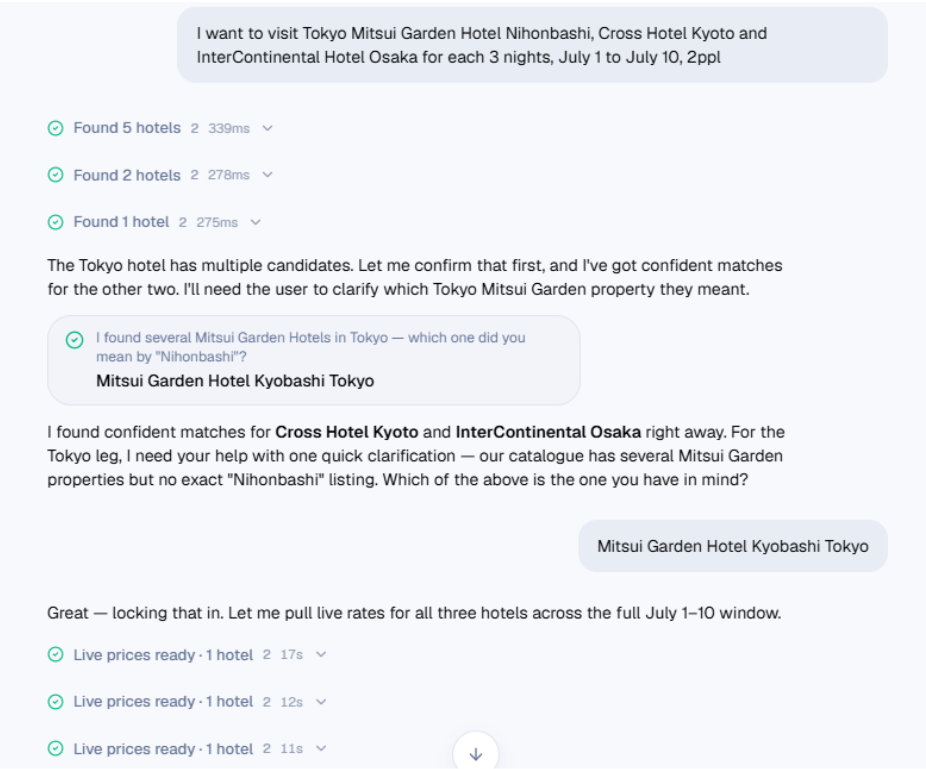
A traveler planning a 9-night Japan trip in July 2026 had already chosen their hotels:
Mitsui Garden Hotel Kyobashi — Tokyo, 3 nights
Cross Hotel Kyoto — Kyoto, 3 nights
InterContinental Osaka — Osaka, 3 nights
Good choices across the board. The question was simple: does the order matter?
They asked ForTripAI's Hotel Optimization Agent to run every possible city ordering across their July 1–10 window. The agent priced all 6 permutations simultaneously, pulling live rates for each hotel at each date slot.
Here's what came back.
The Full Pricing Breakdown
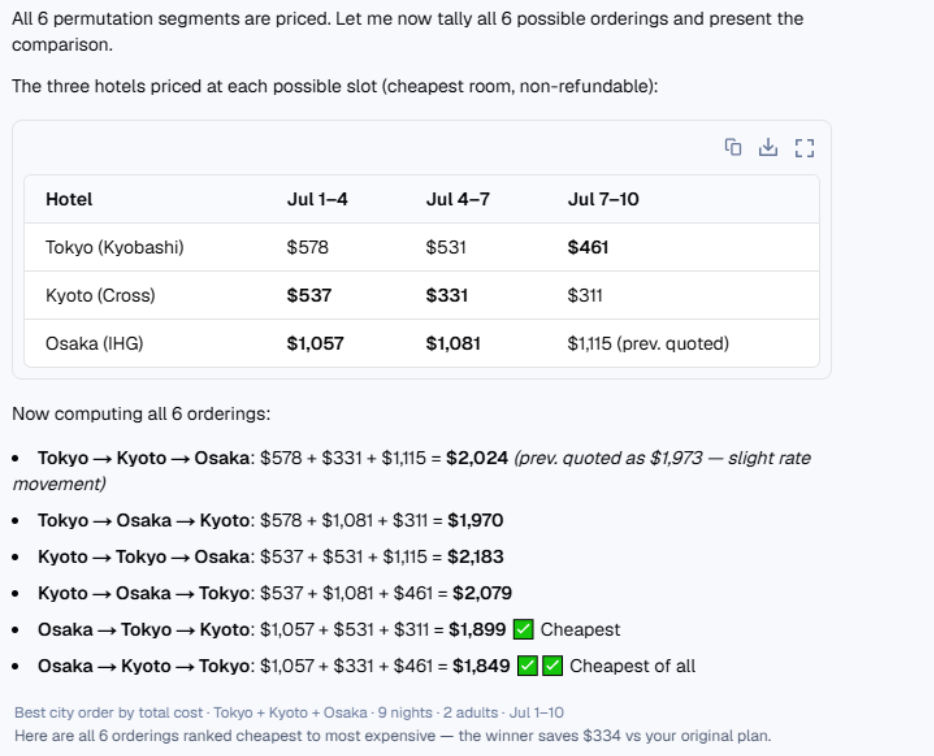
Each hotel's price varied depending on which date slot (Jul 1–4, Jul 4–7, or Jul 7–10) it was placed in:
Hotel
Jul 1–4
Jul 4–7
Jul 7–10
Mitsui Garden Hotel Kyobashi (Tokyo)
$578
$531
$461
Cross Hotel Kyoto
$537
$331
$311
InterContinental Osaka
$1,057
$1,081
$1,115
Same hotels. Same room type. Same 3 nights each. The price changes purely because of when in the trip you stay there.
Now here's every possible ordering, totaled up:
Order
Route
Total (3 hotels, 9 nights)
1
Tokyo → Kyoto → Osaka
$2,024
2
Tokyo → Osaka → Kyoto
$1,970
3
Kyoto → Tokyo → Osaka
$2,183 ❌ Most expensive
4
Kyoto → Osaka → Tokyo
$2,079
5
Osaka → Tokyo → Kyoto
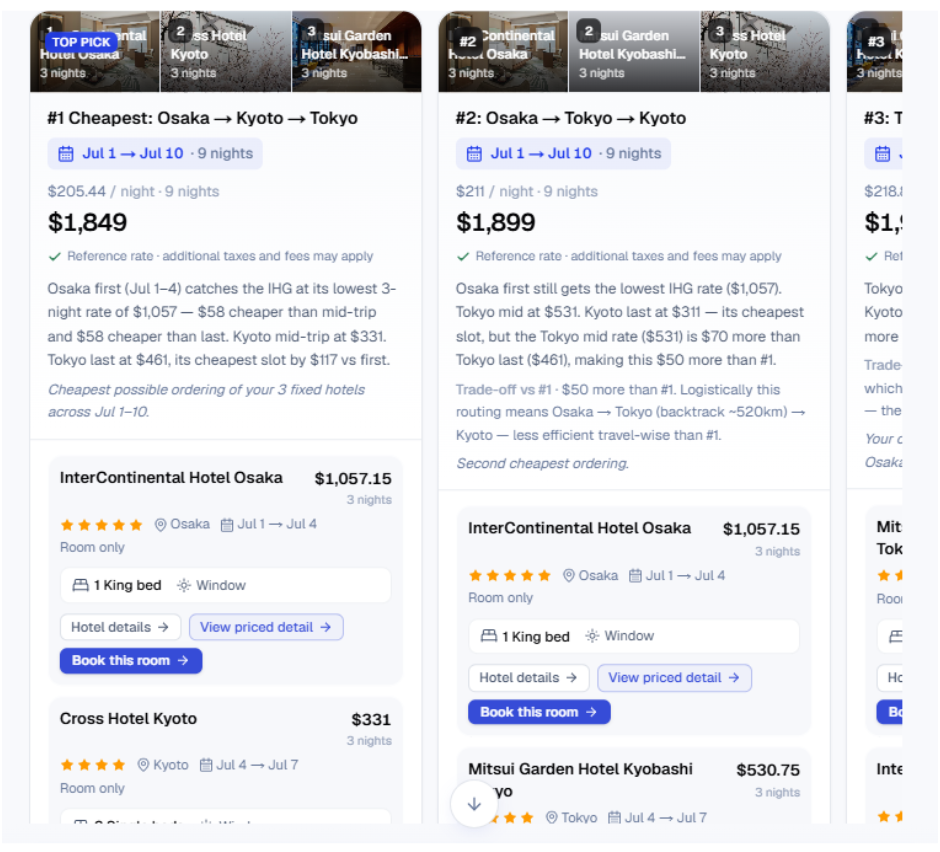
$1,899
6
Osaka → Kyoto → Tokyo
$1,849 ✅ Cheapest
The cheapest ordering saves $334 compared to the most expensive one.
Versus the traveler's original instinct — Tokyo first, which is how most people approach Japan — the saving is $175.
$175 that would have been spent without anyone realizing it. No bad decisions. No missed deals. Just an unconsidered ordering.
Why Does the Order Make Such a Difference?
This isn't random. Once you see the pattern in the data, it's logical.
The InterContinental Osaka gets more expensive as July progresses. At $1,057 for Jul 1–4, it's $58 cheaper than the same hotel for Jul 7–10 ($1,115). That's a meaningful difference for a single hotel. The implication: book Osaka first.
The Mitsui Garden Tokyo gets cheaper later in the month. At $461 for Jul 7–10, it's $117 cheaper than the same hotel for Jul 1–4 ($578). That's a substantial swing. The implication: save Tokyo for last.
Kyoto is affordable throughout, so it absorbs the middle slot efficiently. Cross Hotel Kyoto ranges from $311 to $537 depending on dates — a wide range, but since it's sandwiched between the Osaka and Tokyo constraints, the middle slot ($331) is nearly the cheapest available anyway.
The result: Osaka → Kyoto → Tokyo lines up each hotel at its lowest price point, producing the cheapest total without changing a single hotel choice.
One more thing worth noting from the original quote: the InterContinental Osaka's breakfast-included rate ($1,064) was actually cheaper than the room-only rate ($1,115) for those specific dates. These are the kinds of anomalies that exist in hotel pricing all the time — and that are nearly impossible to catch when you're booking manually.
The Problem No One Talks About
Here's the uncomfortable reality of how most people book multi-city trips:
They find good hotels. They book them. They don't think about whether a different order would have cost less, because it genuinely doesn't occur to them that it would matter.
And why would it? Every hotel platform shows you prices for the dates you've already decided. None of them say: "you could save $175 by visiting these cities in a different order." That's not what they're built for.
So the overpayment happens quietly, every trip, to travelers who are doing everything else right. Good research. Good hotels. Just an unconsidered variable.
The worst part: you'd never know. You book, you travel, you have a great trip. The $175 extra simply disappears into your travel budget and you move on.
What Smart Hotel Planning Actually Looks Like
The traveler in this example didn't do anything wrong. They just didn't have a tool that could show them what they were missing.
With ForTripAI's Hotel Optimization Agent, the process looks like this:
Tell the agent which hotels you want and your general travel window
The agent pulls live rates for every hotel across every date slot simultaneously
It runs all possible city orderings and night-split combinations
You see a ranked table of every option, with total costs, so you can pick the one that fits your priorities — cheapest overall, most flexibility, or specific dates you need to be somewhere
For this Japan trip, that process took under 2 minutes and surfaced a $175 saving on a ~$2,000 hotel budget — roughly a 9% reduction, without changing a single hotel.
On a longer trip or a higher hotel tier, the savings scale further.
Try it on your next multi-city trip → [ForTripAI Hotel Optimization Agent]
What This Means for Your Next Trip
If you're planning any trip that involves more than one city, the order you visit them is a financial variable — not just a logistical one. Most travelers never treat it that way.
A few questions worth asking before you finalize your next itinerary:
Is there a city ordering that keeps your total hotel cost lower?
Are there specific date slots where your most expensive hotel gets meaningfully cheaper?
Could shifting your trip by 2–3 days change the total significantly?
These aren't complicated questions. But they require running numbers across multiple combinations simultaneously — which is exactly what no one does manually, and exactly what the Hotel Optimization Agent is built for.
The $175 in this example was sitting there, unclaimed, on a perfectly well-planned trip. On your next trip, there's almost certainly a version of the same thing.
Prices in this article are real rates pulled for Mitsui Garden Hotel Kyobashi, Cross Hotel Kyoto, and InterContinental Osaka for July 1–10, 2026, for 2 guests. Rates reflect non-refundable room-only pricing unless noted. Hotel prices fluctuate; run your own search for current rates.