How to Validate Your Travel Itinerary Before You Go (And Avoid Costly Mistakes)
Planning a trip is fun. Wanting your itinerary to actually work is another. Here's how to pressure-test an itinerary across 10+ dimensions before you leave home — and what we found when we ran a real 16-day Japan trip through it.
Generative AI has made itinerary generation nearly instant — but speed was never the hard part of travel planning. The harder part is the decision-making underneath it: trade-offs between cities, hotels, and pace that no traveler can fully specify upfront. This piece argues that the next real opportunity in travel AI isn’t prettier itineraries, but helping travelers understand the choices behind them.
Three days, two nights, $230 total including flights, hotel, food, and entry fees — and it felt more restorative than a night at a beach resort. A full Sukhothai guide covering ancient ruins with zero crowds, sunrise at a hilltop Buddha, and exactly how to get there.
Most people actually enjoy planning a trip. Researching a destination, learning about its culture, imagining yourself there — that part is fun. Spending hours on travel blogs and opening 30 browser tabs doesn't feel like a chore when you're excited about where you're going.
But here's the thing: enjoying the planning process is one thing. Wanting your itinerary to actually work is another.
Because no matter how much research you do, it's surprisingly easy to end up with an itinerary that looks great on paper and falls apart on the ground — an impossible connection time, a hotel that's nowhere near anything you planned to do, or a packed schedule that leaves you exhausted by day three.
That's exactly why we built Trip Validator.
What is Trip Validator?
Trip Validator analyzes your itinerary across 10+ dimensions — including your timeline, budget, route logic, travel pace, accommodation, and personal preferences — to surface every potential issue before you leave home.
Think of it as a pre-flight check for your travel plans.
What can Trip Validator catch?
Itinerary too packed — are you trying to do too much in too little time?
Inefficient routing — are you doubling back or zigzagging when you don't need to?
Hotel value analysis — is your accommodation actually worth what you're paying, given the location?
Solo travel suitability — is this trip well-suited for a solo traveler?
Best time to visit — are you going in the right season for what you want to do?
Attraction closures — are any of your planned spots closed on the days you're visiting?
Budget allocation issues — are you under- or over-budgeting for certain parts of the trip?
Missing must-sees — are there highly-rated attractions that match your interests that you've overlooked?
Unbalanced day distribution — are you spending too long in one place and rushing through another?
Transportation gaps — are your connections realistic? Are there better or cheaper ways to get between stops?
Here's an example: a 16-day Japan itinerary
Here's the kind of itinerary travelers paste into Trip Validator — detailed, ambitious, and full of small assumptions that are surprisingly easy to get wrong.
Day 1 — Tokyo (Arrival)
3:00 PM: arrive at HND
Check-in at hotel in Toranomon, freshen up
Explore Shibuya
7:00 PM: Shibuya Sky (okay with missing sunset)
9:00 PM: Dinner in Hiroo
Day 2 — Tokyo (Ginza and Akihabara)
Spa at hotel
Hie Shrine (10-minute walk from hotel)
12:00 PM: Lunch in Ginza
Walk around Ginza
Akihabara, Kanda Myojin
5:00 PM: Dinner in Hongo
Day 3 — Tokyo (Shinjuku to Omotesando)
Horin-ji
Shinjuku Gyoen
1:00 PM: Lunch near Shinjuku Gyoen
Meiji Jingu
Harajuku (e.g., Cat Street)
Omotesando
Nezu Museum (if time permits)
8:30 PM: Dinner in Ebisu
Day 4 — Tokyo (Asakusa and Ueno)
Senso-ji Temple
10:00 AM: Breakfast in Asakusa
Nezu Shrine
Tokyo National Museum
Ueno Park
Ameya-yokocho (if time)
7:30 PM: Dinner in Azabudai
Day 5 — Tokyo → Kurobe Alpine Route
Luggage forward to Kanazawa
8:33 AM: Shinkansen from Tokyo to Nagano
10:30 AM: Shuttle to Ogizawa, start Kurobe Alpine Route
4:00 PM: Arrive and check-in at Hotel Tateyama (halfway through the route)
Explore area around hotel
~7:00 PM: Dinner at hotel
Day 6 — Kurobe Alpine Route → Kanazawa
Finish second half of Kurobe Alpine Route
Shinkansen to Kanazawa, arriving ~2:00 PM
Check in at hotel near Kanazawa Station
Nagamachi Samurai District
Myoryuji
Nishi Chaya
7:30 PM: Dinner near Kanazawa Castle
Day 7 — Kanazawa
Omicho Market
Oyama Shrine
Kanazawa Castle
Kenroku-en Garden
Higashi Chaya
6:00 PM: Dinner near Kanazawa Castle
Day 8 — Kanazawa → Shirakawa-go → Takayama
Luggage forward to Kyoto
8:10 AM: Bus to Shirakawa-go
Explore Shirakawa-go, lunch
12:35 PM: Bus to Takayama, check-in to ryokan near old town
Hida Kokubunji Temple
Explore old town Takayama
Hie Shrine
6:00 PM: Ryokan dinner
Day 9 — Takayama → Kyoto
Miyagawa morning market
Takayama Jinya
Showa Era Museum
Lunch nearby
Higashiyama walking course
3:34 PM: Non-stop Hida to Kyoto Station (arriving 7:20 PM)
Check in to hotel in Higashiyama
9:00 PM: Dinner in Higashiyama
Day 10 — Kyoto (teamLab, Fushimi Inari)
11:00 AM: teamLab Biovortex
Tofuku-ji
Back path from Tofuku-ji up to Fushimi Inari (Kyoto Trail Station 4), then descend the normal route
Either explore north of Yasaka (Nanzen-ji, Heian Jingu, etc.) or downtown (Kiyamachi, Pontocho, etc.)
7:00 PM: Dinner in Higashiyama
Day 13 — Kyoto → Nara → Kyoto
11:00 AM: Lunch in Nara
Start near Kasuga Taisha Shrine and walk back toward the station, stopping along the way (Todai-ji, Kofukuji, Ukimido)
Take it easy for the rest of the day
8:30 PM: Dinner in Higashiyama
Day 14 — Kyoto → Himeji → Kobe → Osaka
Same-day luggage forward to Osaka
Shinkansen to Himeji
Himeji Castle
Koko-en
Engryo-ji (if time)
Shinkansen to Kobe
Briefly explore Kobe (maybe Herb Garden or Chinatown)
8:45 PM: Dinner in Kobe
Shinkansen to Osaka, check-in at hotel near Umeda Station
Day 15 — Osaka
Spa at hotel
12:00 PM: Lunch near hotel
Maishima Seaside Park for Nemophila Festival
Osaka Aquarium
8:30 PM: Dinner near Dotonbori
Explore Dotonbori at night
Day 16 — Osaka → Home
Explore around Namba (Kitchen Street, Denden Town, etc.)
1:00 PM: Lunch in Namba
It's a careful, well-researched plan. It still hides issues that will only surface in-country if you don't catch them first.
How to use Trip Validator
Step 1: Head to the homepage and select Validation mode.
Step 2: Paste your full itinerary in — the more detail, the better.
The validator works with whatever level of detail you have. Day-by-day bullet lists like the Japan example above are ideal. Times, locations, and specific attraction names give it more to check against.
Step 3: Answer a few quick questions about your trip.
These are the constraints the validator can't infer from the itinerary alone — who's traveling, your rough budget, any non-negotiables.
Step 4: We'll analyze your itinerary and surface any potential issues.
For the Japan itinerary above, two of the issues Trip Validator flagged were:
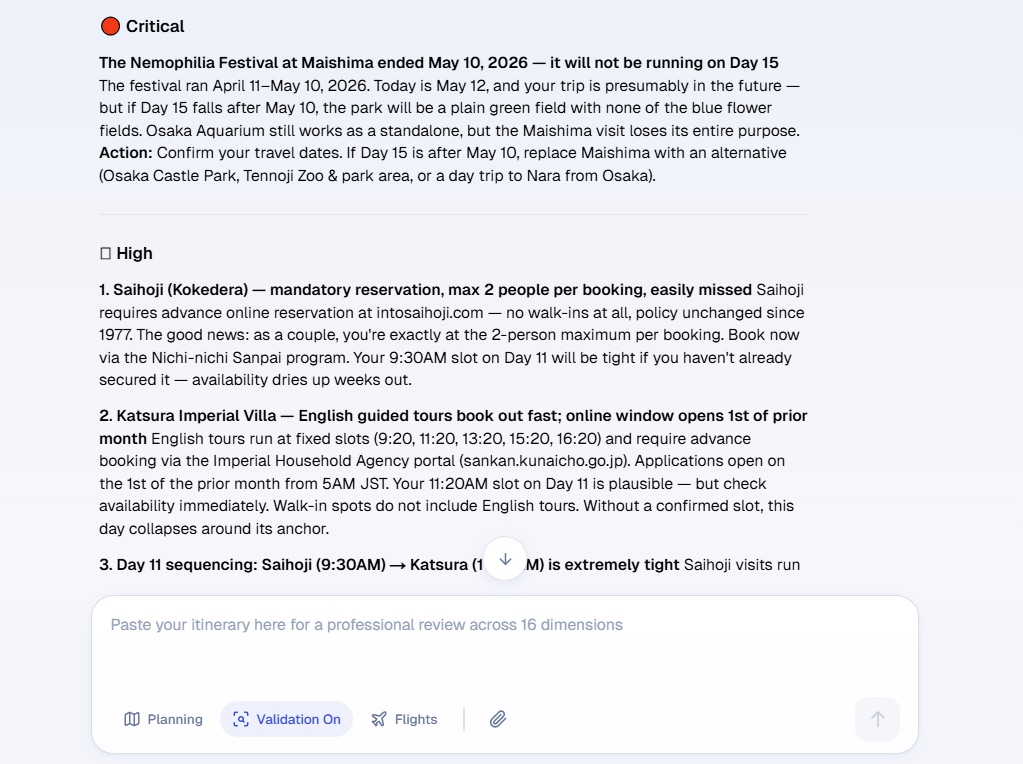
Critical: The Nemophila Festival at Maishima Seaside Park ends May 10, 2026 — but the trip plans to visit it on Day 15. By that date, the festival is over and the field will be a plain green field with no display of blue flowers. Suggested action: replace with an alternative seasonal attraction, or move the trip earlier in the calendar.
High: Saihoji (mandatory reservation) and Katsura Imperial Villa (limited guided tours that fill within minutes of opening, often months ahead) both require advance booking. The Day 11 plan has both on the same morning, with Katsura at 11:20 AM. Without confirmed reservations and a buffer for the Saihoji moss-garden ritual, the day collapses.
These aren't issues you'd catch by reading travel blogs. They're the kind of thing that only surfaces when something or someone actually checks your plan against the live state of the world.
Step 5: Review the findings and adjust your itinerary accordingly.
The validator doesn't rewrite your trip for you. It points at what's broken so you can decide what to change. That might mean shifting a date, swapping a hotel, dropping an attraction, or rerouting a day. The goal is to make the changes before money and PTO are on the line — not after.
Try it before your next trip
It's completely free. Paste your itinerary, get the full check across 10+ dimensions, and decide what to fix before you book anything.
A bad transfer or a wrong-season festival caught at the planning stage costs nothing to fix. Caught on the ground, it can cost a day, a budget, or the trip.
Share
Frequently asked questions
What is the best way to validate a travel itinerary?+
Run it through a structured check across timeline, budget, route logic, travel pace, accommodation value, attraction closures, transportation gaps, and seasonal fit. Fortrip's Trip Validator covers 10+ dimensions in a single pass. The 30-second version: door-to-door transfer times (not just train durations), one validation pass before booking flights and hotels, and a check that nothing critical on your list is closed on the day you plan to visit.
Is Trip Validator free?+
Yes — Trip Validator is completely free. Paste your itinerary at fortrip.ai/itinerary-validator and get the full analysis with no signup required for the check itself.
What does Trip Validator check?+
Trip Validator surfaces issues across 10+ dimensions: itinerary density (too packed days), inefficient routing (zigzagging between sites), hotel value vs location, solo travel suitability, best season for your goals, attraction closures on your specific dates, budget allocation, missing must-sees that match your interests, unbalanced day distribution, and transportation gaps including realistic connection times.
Why do travel itineraries fail in practice?+
Most failures come from four blind spots: treating transfer time as free time (a 2-hour train is rarely 2 hours door-to-door), overpacking every day with no buffer for delays or fatigue, choosing hotels before validating the route, and underestimating budget categories beyond flights and hotels (local transport, timed-entry tickets, schedule-pressure spend).
How many days do I need for a Japan trip?+
It depends on the route. For first-time multi-city Japan, 7-10 days usually fits 2-3 cities (typically Tokyo + Kyoto/Osaka with day trips). 11-14 days fits 3-4 cities. 15+ days fits 4-5 cities if transfers are efficient. The 16-day route we validated in this post — Tokyo, Kurobe Alpine, Kanazawa, Shirakawa-go, Takayama, Kyoto, Nara, Himeji, Kobe, Osaka — uses the upper end of that range.
Start a trip Fortrip can actually defend.
Sketch a brief. We come back with an itinerary that reads like a recommendation, not a checklist — and tell you what we’d change about it.