City Order Isn't Just Logistics — It's a Pricing Variable (A Real Japan Trip Breakdown)
Swapping which city you fly into first — same cities, same dates — shifted one real Japan itinerary's total cost by hundreds of dollars. Here's why sequencing is a pricing lever most travelers never touch.
Meta description: Does the order you visit cities in change your total trip cost? We tested it on a real Osaka–Kyoto–Tokyo itinerary and found swapping the route order shifted flight and Shinkansen costs by hundreds of dollars. Here's what happened, and how to check your own route with FortripAI's Optimization Agent.
The question nobody asks when planning a multi-city trip
When people plan a multi-city itinerary — say, a Japan trip through Osaka, Kyoto, and Tokyo — they usually ask three questions: how many days per city, what to see, and how to get between them. Almost nobody asks a fourth question: does the order I visit these cities in actually change the price?
It turns out it does. Not by a rounding error, either — by enough to fund a few extra nights at a nicer hotel.
Share
Start a trip Fortrip can actually defend.
Sketch a brief. We come back with an itinerary that reads like a recommendation, not a checklist — and tell you what we’d change about it.
Same trip, same cities — but move the departure date and one October flight window swings $142, while a single hotel's date slot swings $333. Worse, four of six possible city orders weren't even bookable. Here's why flights and hotels have to be priced together, and what happens when they aren't.
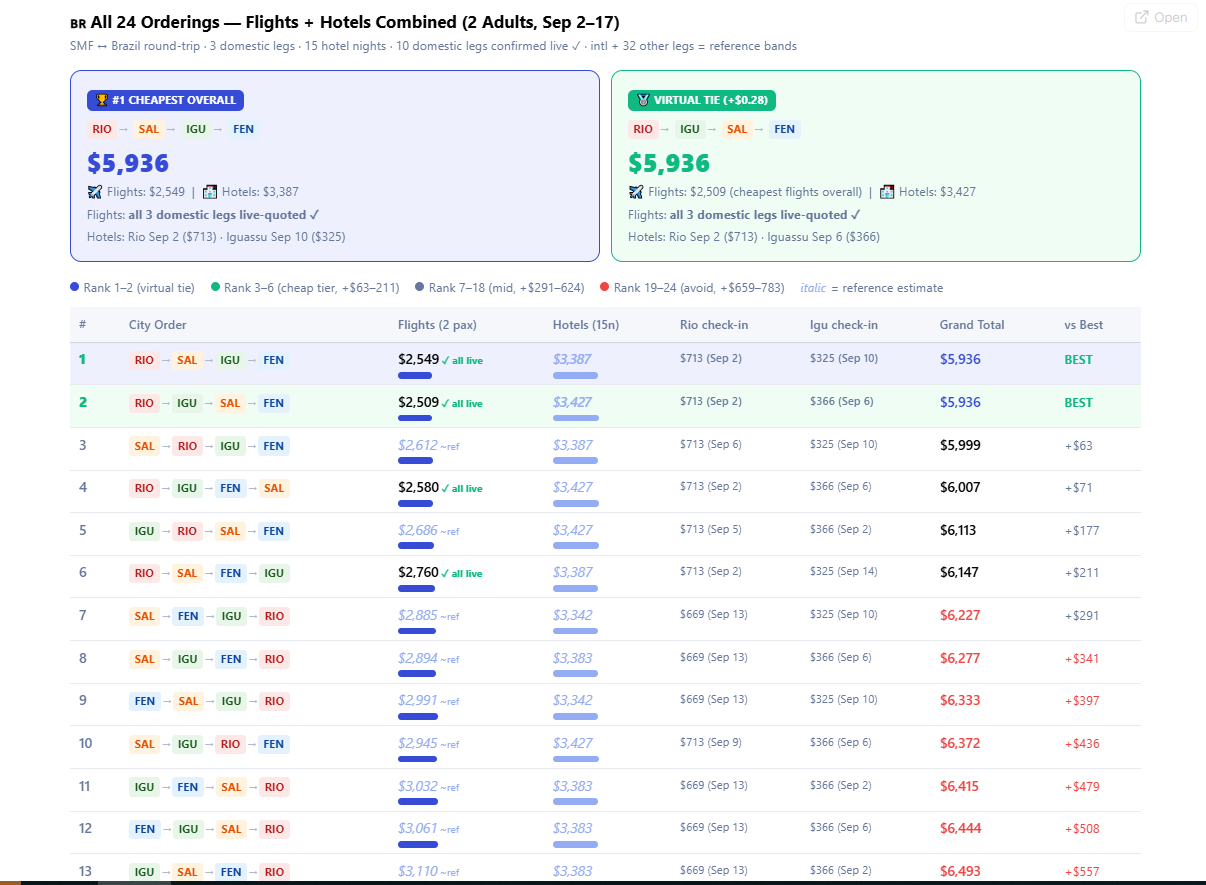
The cheapest hotel arrangement on a 15-night Brazil trip saved $85 on rooms and cost $376 more in flights. A nine-day date shift in Peru made three components pricier and one cheaper. Two airports 80km apart broke a China itinerary that looked perfect on paper. Here's what siloed planning actually costs.
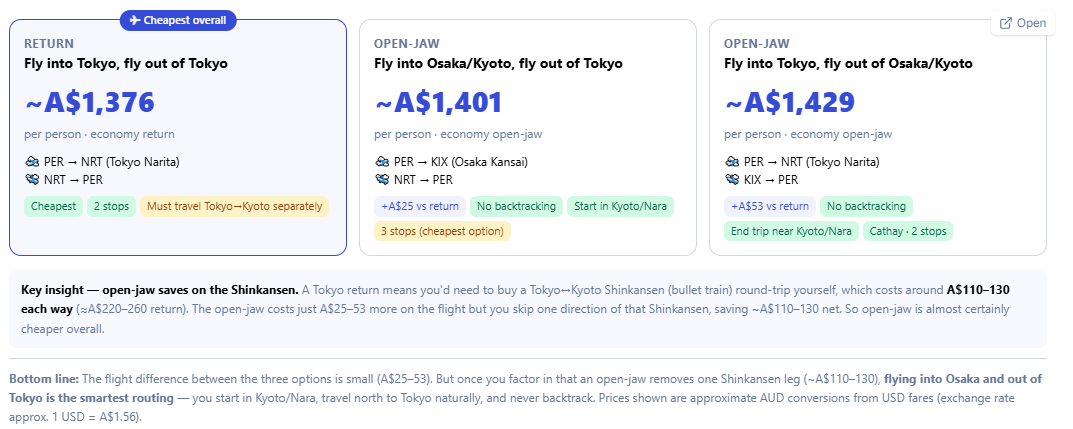
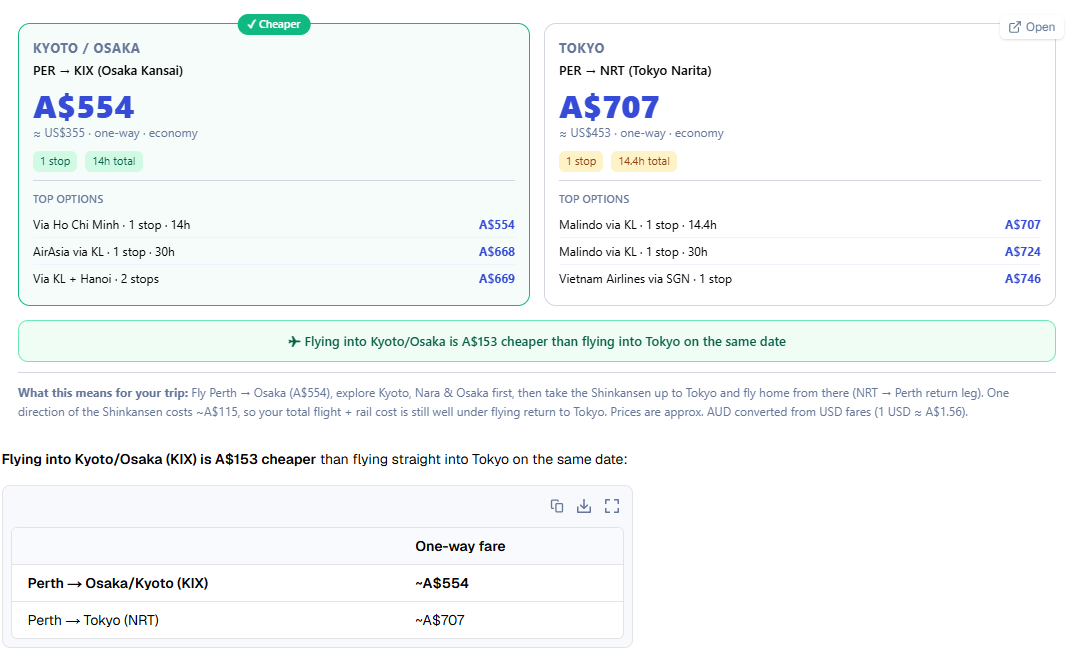
This started with a simple open-jaw flight comparison for an 11-day Japan trip: fly into Osaka's Kansai Airport (KIX), fly out of Tokyo's Narita (NRT), versus flying round-trip through a single airport. For one set of travel dates, flying open-jaw into Osaka and out of Tokyo was clearly cheaper — the flight premium was small, and skipping a return Shinkansen leg saved more than it cost. Case closed, or so it seemed.
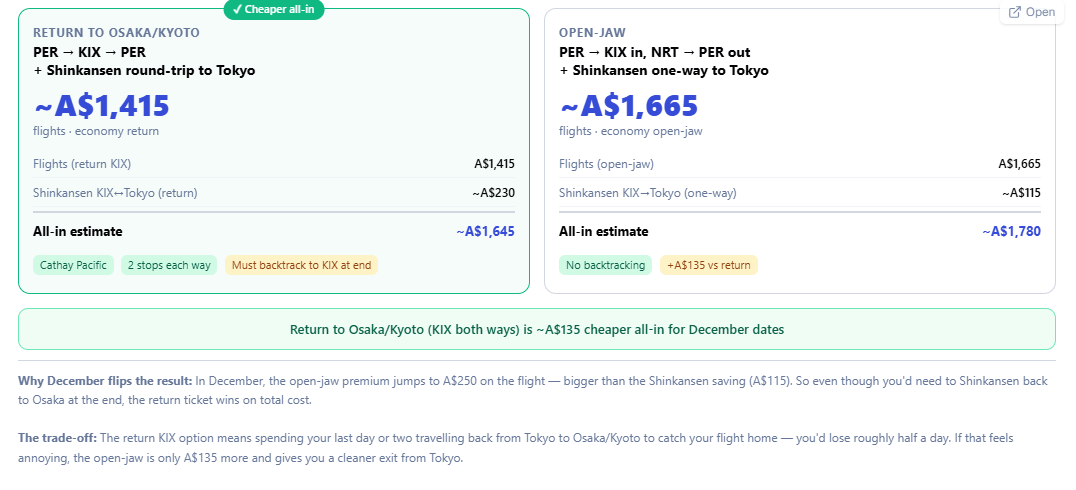
Then the dates shifted by a few weeks, and the entire conclusion flipped. Suddenly the round-trip option into Osaka was noticeably cheaper than the open-jaw route — the opposite of what worked before. Reverse the direction (fly into Tokyo, out of Osaka, instead of the other way around) and the gap nearly disappeared entirely, down to a few dollars.
Same three cities. Same rough dates. Completely different "correct" answer depending on the exact sequencing and direction. That's the part that doesn't show up in any generic "Japan itinerary" blog post — because the answer isn't generic. It's specific to your dates, your route direction, and the live pricing on the day you search.
Why sequencing changes the price (it's not random)
A few forces are stacking on top of each other, and most travelers only ever see one of them at a time:
1. Open-jaw vs. round-trip flight pricing isn't fixed.
Airlines price one-way and open-jaw itineraries independently of round-trip fares, and that pricing shifts with demand, season, and even day-of-week. An open-jaw route (fly into city A, out of city B) can be a bargain on one travel date and a premium on another — the same route, priced weeks apart, can swing by hundreds of dollars in either direction.
2. Ground transport isn't a fixed add-on — it's a variable you're trading against the flight.
Every leg you save by flying open-jaw is a Shinkansen or domestic flight leg you're not paying for and not spending hours on. But that saved leg only "counts" if the open-jaw premium is smaller than the ground-transport cost it replaces. Sometimes it is. Sometimes the open-jaw premium is larger than the train ticket, and the "avoid backtracking" route actually costs more overall.
3. Direction matters as much as sequence.
"Osaka in, Tokyo out" and "Tokyo in, Osaka out" are not mirror images priced the same. Depending on which direction has stronger seasonal demand (say, everyone flying into Tokyo for a specific week), one direction can carry a real premium over the other — even though the cities and total distance are identical.
4. Rail passes only pay for themselves at certain city counts.
Multi-day rail passes (like Japan's JR Pass) are priced as a bet: unlimited travel for a flat fee. That bet only pays off if you're covering enough long-haul legs. Add a single-country, out-of-the-way excursion — a ski resort, a lesser-visited city — and the math on whether the pass is worth it can flip completely, sometimes tipping toward not buying it and just paying for individual tickets instead.
Stack all four of these together, and you get what actually happened in this case: a $300+ swing in total trip cost, achieved by nothing more than reordering which city came first and which came last — no different sights, no different number of days, just a different sequence.
The pattern shows up beyond flights, too
The same principle turned up again on the hotel side. When testing hotel booking order across the same three-city route — Tokyo, Osaka, and Kyoto — running every possible ordering of the three cities revealed a pricing spread of over $300 between the cheapest and most expensive sequence, using otherwise identical hotel categories and dates. The cities didn't change. The nights didn't change. Only the order in which they were booked did.
This is the part that's easy to miss when you're planning manually: most people lock in a route based on geography or narrative flow ("we'll do temples first, then the big city") and then search flights and hotels after the order is already decided. But the order should be a variable you test, not a starting assumption.
How to actually check this for your own trip
Manually, this means re-running flight searches for every plausible direction and every plausible date shift, then re-running hotel searches for every ordering of your cities, then comparing rail-pass math against itemized ticket costs — for every combination. That's not a weekend project; that's a spreadsheet with dozens of tabs.
This is exactly the gap FortripAI's Optimization Agent is built to close. Instead of manually toggling flight directions and hotel booking orders one at a time, you give it your cities, your date range, and your must-see stops, and it runs the permutations for you — checking:
Open-jaw vs. round-trip pricing across your actual travel dates
Which city-visiting direction is cheaper for your specific route
Whether a multi-day rail pass or individual tickets work out cheaper for your itinerary
Hotel order permutations across your city list, flagging the cheapest valid sequence
Instead of discovering after the fact that you booked the more expensive direction, the Optimization Agent surfaces the price gap before you commit — so the $100–$300 difference goes toward extra nights, a nicer ryokan, or a ski day trip, instead of quietly disappearing into a suboptimal booking order.
FAQ: multi-city trip order and pricing
Does the order I visit cities in really affect flight prices?
Yes. Open-jaw flight pricing (flying into one city, out of another) moves independently of round-trip pricing and can favor either direction depending on season, demand, and specific travel dates — sometimes by hundreds of dollars for the same set of cities.
Is flying open-jaw always cheaper than round-trip for a multi-city itinerary?
No. It depends on your dates. In one comparison, open-jaw was clearly cheaper for one travel window and then became the more expensive option a few weeks later for the same cities and route.
Should I buy a multi-day rail pass like the JR Pass?
Only if your itinerary includes enough long-distance legs to outweigh the flat cost. For shorter, more localized routes, buying individual point-to-point tickets can come out cheaper than a pass.
Does hotel booking order affect total trip cost?
Yes — testing every ordering of a three-city route with otherwise identical hotel categories and dates showed a total spread of over $300 between the cheapest and most expensive sequence.
What's the easiest way to find the cheapest city order for my trip?
Rather than manually re-searching every flight direction and hotel order combination, FortripAI's Optimization Agent runs the comparisons automatically and flags the cheapest valid sequence for your specific dates and cities.
Planning a multi-city trip and not sure which order actually saves money? Try FortripAI's Optimization Agent — plug in your cities and dates, and let it test the routes so you don't have to.