How to Optimize Flights and Hotels Together for a Multi-City Trip
Same trip, same cities — but move the departure date and one October flight window swings $142, while a single hotel's date slot swings $333. Worse, four of six possible city orders weren't even bookable. Here's why flights and hotels have to be priced together, and what happens when they aren't.
Short answer: on a multi-city trip, the order you visit cities in and the exact dates you assign to each stop change your total cost — often by 5–15% — because hotels price by date and flights price by date and by airport pair. Booking flights first and hotels second locks in a sequence before you know what that sequence costs. The fix is to price every workable order and date slot at once, then book.
Most travelers plan a multi-city trip in a fixed order: pick the cities, pick the order that "makes sense," book the flights, then find hotels around them. That order feels natural. It also quietly decides your total price before you've compared a single number.
This post breaks down why sequence and dates move the total, using real pricing data from multi-city trips planned on FortripAI, and shows how to run the comparison yourself with the Optimization Agent.
Share
Start a trip Fortrip can actually defend.
Sketch a brief. We come back with an itinerary that reads like a recommendation, not a checklist — and tell you what we’d change about it.
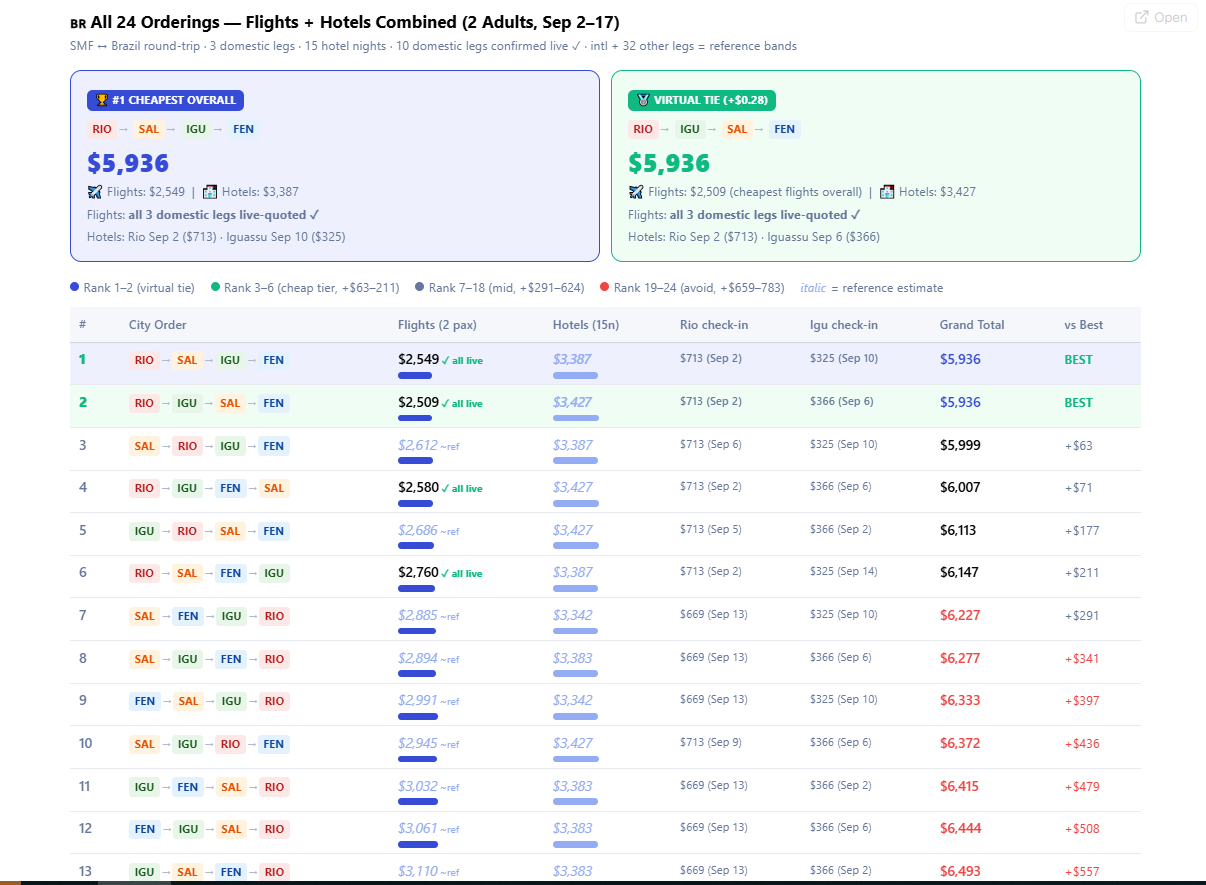
The cheapest hotel arrangement on a 15-night Brazil trip saved $85 on rooms and cost $376 more in flights. A nine-day date shift in Peru made three components pricier and one cheaper. Two airports 80km apart broke a China itinerary that looked perfect on paper. Here's what siloed planning actually costs.
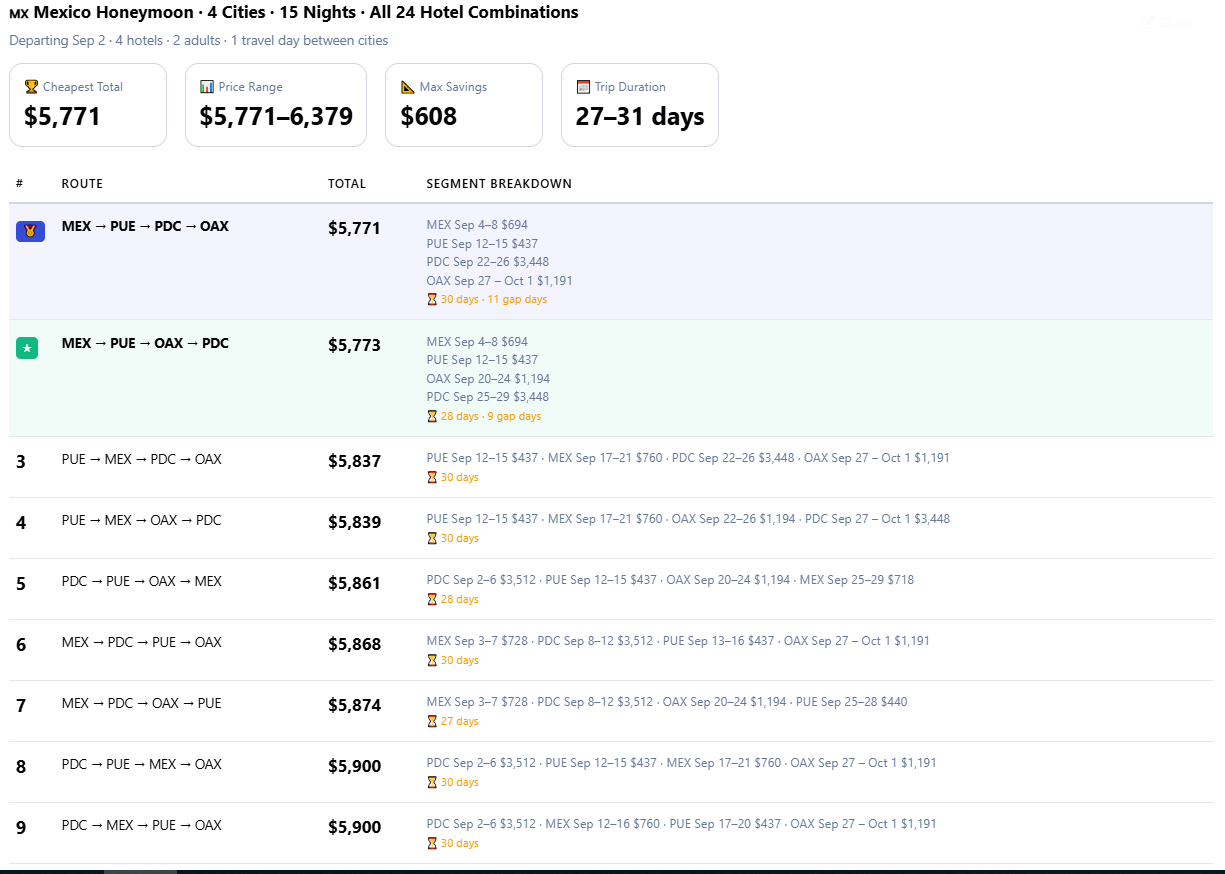
Twenty-four possible city orders came out $58 apart. Reallocating nights between two resorts moved $320. Choosing two rooms over one suite moved $2,974. The variable worth changing isn't the same on every trip — here's how to find yours before you start re-searching everything.
All examples below use live rates pulled at the time of planning. Traveler details have been anonymized; prices are unedited.
Why the order of cities changes the price of a multi-city trip
There are three separate pricing systems running at once, and they don't move together.
Hotels price by date, not by city
A hotel rate is a function of which nights you're there, not how far into your trip the city falls. Move a four-night stay from the last week of August to the first week of September and the same room can shift by hundreds of dollars — conference weeks, local holidays, weekend surcharges, and minimum-stay rules all fire on specific dates.
That means the moment you change the order of your cities, you change every hotel's dates simultaneously. Six possible orders across three cities means six different total hotel bills.
Flights price by date and by airport pair
Flight fares respond to the same calendar pressures, plus one hotels don't have: which airport you leave from. On a multi-city trip your final city determines your return airport. Change the order, and you may be pricing a completely different route home.
Room categories disappear before hotels do
This is the part most travelers never see. A hotel doesn't simply get more expensive on high-demand dates — its cheapest room categories sell out first. On the wrong dates you're not paying more for the same room; you're paying for a room you didn't want. The property still shows as "available," so nothing looks wrong. We traced a $401 swing on a Costa Rica trip almost entirely back to this one mechanism in Shifting Your Departure Date by Two Days Saved $400 on This Costa Rica Trip.
Case study 1: A $142 flight swing from moving the departure date (Vancouver → Tokyo → Kyoto)
A traveler wanted a 13–15 day Japan trip: into Tokyo, home from Kyoto, sometime in October, maximum one stop per leg and no layover over 22 hours.
Two things came out of scanning the whole month rather than a single date.
First, Kyoto has no international airport. Flights "from Kyoto" actually leave from Osaka Kansai (KIX), sometimes Nagoya (NGO). A traveler searching Vancouver–Kyoto round trip on a standard flight site sees either nothing or a badly routed itinerary, and often gives up and books a round trip into Tokyo instead — adding a backtrack across Japan at the end of the trip.
Second, the departure date mattered more than the route. Scanning October departures against 13–15 night trip lengths:
Departure
Return
Nights
Price (USD)
Oct 20
Nov 3
14
$886
Oct 20
Nov 2
13
$886
Oct 28
Nov 10
13
$886
Oct 30
—
13
$899
Oct 22 / 24 / 26
—
13–14
$913–914
Oct 1 / 5 / 17
—
13–14
$941+
Oct 15
—
14
$1,028
Same route, same cabin, same one-stop constraint. The spread between the best and worst October departure was $142 per person — about 14%. Nothing about the trip itself changed; only the start date did.
Try it yourself: open FortripAI, give it your two anchor cities and a month-wide window instead of fixed dates, and let the Optimization Agent scan the window for you. Start planning →
Case study 2: When the order you chose isn't bookable at all (Osaka, Kyoto, Tokyo)
A traveler planned 4 nights each in Kyoto, Tokyo, and Osaka across Aug 25 – Sep 6, with three specific properties already chosen. The request was to price every possible order.
The result wasn't a price ranking. It was an availability wall.
One of the three hotels had live inventory in only the first date slot (Aug 25–29). That single constraint eliminated four of the six possible orders — including the order the traveler had originally written down. Only the two sequences that started in Osaka were fully bookable.
Rank
Order
Total (2 guests, 12 nights)
1
Osaka → Tokyo → Kyoto
$2,153
2
Osaka → Kyoto → Tokyo
$2,234
—
Kyoto → Tokyo → Osaka (original plan)
No availability
—
Kyoto → Osaka → Tokyo
No availability
—
Tokyo → Kyoto → Osaka
No availability
—
Tokyo → Osaka → Kyoto
No availability
There's a second finding buried in the same data, and it's the more useful one. The gap between the two bookable orders was $81. But the Tokyo hotel alone priced at $1,336 in the first date slot versus $1,003 in the second — a $333 swing on one property, driven entirely by a late-August demand spike.
The lesson: the biggest lever usually isn't the order itself. It's which date slot your most expensive hotel lands in. Order is just the mechanism that moves it there.
Case study 3: Your last city decides your airport (Korea → Japan, five segments)
A solo traveler booked a five-segment Korea–Japan loop: Seoul → Busan → Kyoto → Tokyo → Seoul, roughly a month, hotels and both international legs unbooked.
Total came to $4,812 in hotels and $372 in flights. Note the ratio: on a trip like this, hotels are 93% of the bill. Optimizing flights alone optimizes 7% of the problem.
The routing catch was sharper. On the required Korea → Japan date, the only route with live inventory departed from Gimpo (GMP), not Incheon (ICN) — and the traveler was scheduled to be in Busan the night before. That's a 2h15m KTX to Seoul on the morning of an 08:00 departure, which doesn't work. The trip was still fine; it just needed either a later flight or the Busan segment shortened by a night.
A traveler who books hotels city by city never sees this. The hotel booking for Busan and the flight out of Seoul are two separate purchases on two separate sites, and neither one knows the other exists.
A shorter version of the same problem: on a Phoenix–Anaheim trip, the convenient airport (SNA, 30 minutes from the destination) priced at $192 round trip. The cheap option was $83 — but it flew into Ontario (ONT) and home from LAX, two different airports 60 miles apart. It's a genuine $109 saving if you plan ground transport around it, and a bad surprise if you don't.
Check your own routing: paste an itinerary you've already drafted into FortripAI and the Validator will flag airport mismatches, impossible same-day connections, and transfer times that don't fit. Validate an itinerary →
What travelers miss by booking flights before hotels
The cheapest room category, not just the cheapest hotel
Covered above, and worth repeating because it's invisible: shifting dates by two or three nights often restores access to a base room at a property you were about to book a suite at.
The cheaper airport in a metro area with two or three
Kyoto/Osaka, Anaheim/LA, London, Milan, Tokyo, New York, Bangkok — in each, the "obvious" airport is frequently not the cheapest, and the cheapest often requires a different arrival city, which requires a different order.
Open-jaw pricing
Flying into one city and out of another is often cheaper than a round trip plus a domestic backtrack, but only if your sequence ends somewhere with an airport. Sequence and ticket structure are the same decision.
The entry point that rewrites the whole route
On a Calgary → London/Amsterdam/Paris/Barcelona trip, entering via London produced a $521 four-leg flight total at 13.3 hours in the air. Entering via Paris — the same four cities, a different starting point — produced $527 at 15 hours, and a completely different city order. Close on price, meaningfully different on time, and a change no traveler would think to price twice. We ran a longer version of this test — same six cities, several directions — in Can Changing City Order Reduce Both Travel Time and Cost?
The same trip surfaced two more things worth knowing: one connection was scheduled to depart before the inbound flight landed, and switching every leg to a fare that included carry-on baggage moved the total from roughly $527 to $1,007. Baggage policy isn't a footnote on a multi-leg trip; it's a line item — the same trap we broke down in Why the Cheapest Flight, Train, or Rental Car Isn't Always the Cheapest Trip.
How to optimize flights and hotels together with FortripAI
The Optimization Agent exists to run this comparison as one calculation instead of several sequential guesses.
Step 1: Give it the fixed points, not the plan
Tell it what's actually locked: cities, total trip length, number of travelers, and any dates you can't move. Leave the order open. If you hand it a finished sequence, you've removed the thing it optimizes.
Step 2: Widen the date window
"Two weeks in October" produces a far better result than "Oct 12–26." Case study 1 was a $142 difference that only appears if the window is wider than the trip.
Step 3: Name your hotels if you have them
If you've already chosen properties, say so. The agent will price each one across every date slot, which is how the availability wall in case study 2 surfaced before the traveler tried to book.
Step 4: Read the availability column, not just the price column
The cheapest order on paper is worthless if a property has no inventory on those nights. Fully bookable and cheapest are different rankings.
Step 5: Run the result through the Validator before booking
Order and price are one layer. Whether the plan physically works — this is what the Validator is for — connection times, airport transfers, check-in windows, the KTX you'd need to catch at 5am — is another. Both need to pass.
Ready to run it? Give FortripAI your cities and a flexible window, and get every workable order priced against live flight and hotel inventory. Optimize my trip →
A checklist before you book a multi-city trip
Have I priced more than one city order?
Is my date window wider than my trip length?
Does my final city have an airport, or am I adding a backtrack?
Have I checked whether my most expensive hotel is sitting in its most expensive date slot?
Is my cheapest fare using two different airports?
Do the fares include the baggage I'm actually traveling with?
Does every connection leave enough time after the previous leg lands?
FAQ
Does the order of cities really change the price of a trip?
Yes. Because hotels and flights both price by date, changing the order changes the dates assigned to every stop at once. Observed spreads across the cases above ranged from about 1% on a same-city hotel sequence to 14% on a month-wide flight window, with individual hotels swinging $333 on date placement alone.
Should I book flights or hotels first for a multi-city trip?
Neither, in isolation. Price them together across several orders, then book the flights first once the sequence is settled — flight inventory moves faster and is harder to change. On trips where hotels dominate the budget (the Korea–Japan case above was 93% hotels), letting hotel availability drive the sequence usually produces the better total — though a hotel-only comparison is a hypothesis, not an answer, as our Colombia case study showed.
How much can optimizing city order actually save?
It depends on how uneven your stops are. If all your hotels are in one city at similar rates, expect almost nothing — one Kuala Lumpur three-hotel sequence came out with essentially no price difference between orders. If one stop is a high-demand city on volatile dates, the swing is large.
What is an open-jaw flight and when is it cheaper?
An open-jaw ticket flies you into one city and home from another. It's usually cheaper than a round trip plus a separate domestic flight back to your arrival city, and it removes a travel day. It only works if your last city has, or is near, an airport.
Can AI travel planners actually check live prices?
Some can't — they generate plausible-looking itineraries from training data. FortripAI prices against live flight and hotel inventory, which is why the availability gaps in these cases showed up before booking rather than after. We wrote a full checklist for spotting the difference in Can You Trust AI Travel Recommendations?
How many cities should I visit on a multi-city trip?
As a rough guide, one city per three nights keeps the trip from turning into a sequence of transfer days. Four cities in 12 days is comfortable; six is not.
Bottom line
The order of your cities isn't a preference. It's a pricing input, and on most multi-city trips it's an input nobody prices.
Give FortripAI your cities and a flexible date window, and the Optimization Agent will price every workable order and date slot against live inventory — across stays and transport together — then the Validator will confirm the winning plan actually holds up before you book it.