Can Changing City Order Reduce Both Travel Time and Cost? We Tested the Same Trip Multiple Ways
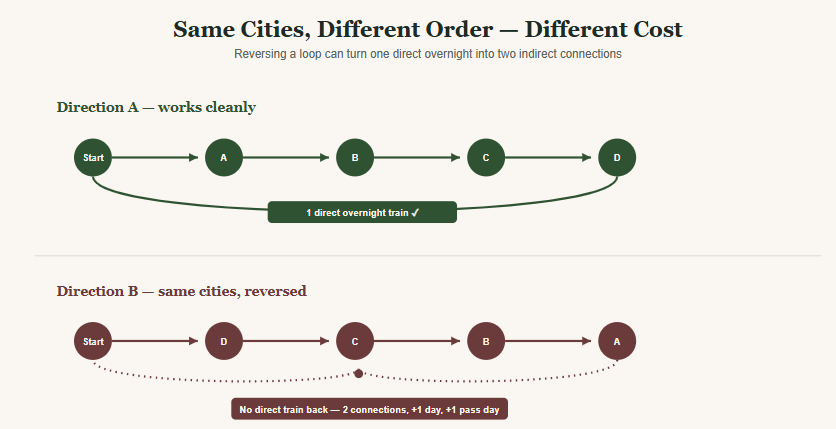
Same six cities, same total distance — one direction wrapped up with a single overnight train home, the other needed two connections and burned an extra day. We tested the same loop multiple ways to find out when reordering actually saves time or money, and when it just moves the cost around.
Quick answer: yes, and often by more than people expect — but not always for the reason you'd guess. Reordering a multi-city trip rarely saves time because the total distance changes. It saves time because transport links aren't symmetric: a night train that runs one direction on a fixed weekly schedule might not run the other way at all, and starting your loop on the wrong day of the week can cost you days you never get back.
We ran the same multi-country rail loop through several different versions — same cities, different order, different starting point — and the spread in total trip length was real: one version came out to 22 days, another came out to 17, for what looked on paper like the same trip.
Here's what actually caused that gap, and what it means for planning your own multi-city route.
Order matters more than people assume — but not for the reason you'd think
Share
Start a trip Fortrip can actually defend.
Sketch a brief. We come back with an itinerary that reads like a recommendation, not a checklist — and tell you what we’d change about it.
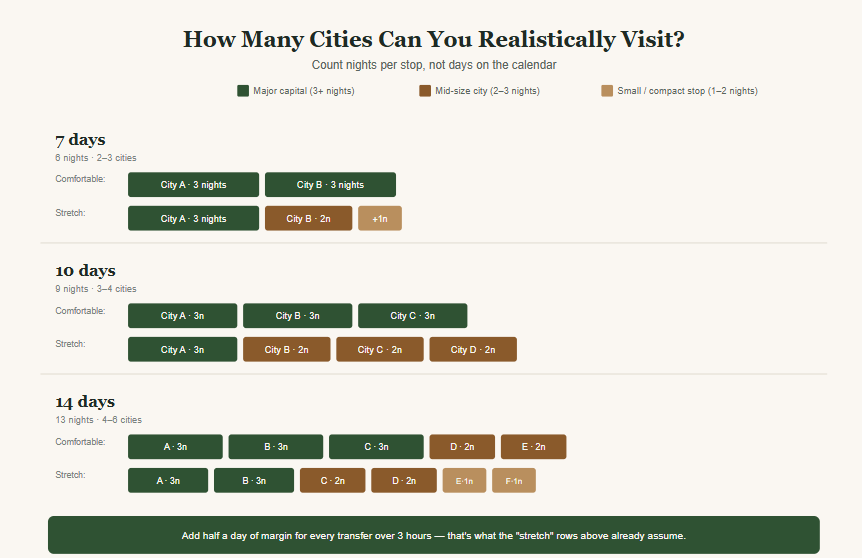
Most multi-city trips don't fall apart because of too few days — they fall apart because every stop got the same amount of time regardless of what it needed. Here's how many cities actually fit into 7, 10, or 14 days once you count nights instead of days.
Open-jaw sounds like it should cost more than a round trip. Usually it doesn't — booked right, it's priced close to half a round trip each way. Here's when that math holds, when it breaks down, and the costs people forget to add back in.
It's not about total distance, it's about which direction the transport actually runs
Most people reorder a trip assuming the math is symmetric: if A→B→C→A works, then A→C→B→A should cost about the same, just mirrored. On a multi-country rail trip, that assumption falls apart constantly, because night trains, seasonal services, and rail-pass-covered routes are frequently one-directional in practice, even when they're technically bookable both ways.
A real example: the same loop, two directions
We tested a six-stop rail loop — starting and ending in the same city, with a mix of major capitals and a couple of smaller stops — in both directions. Going one way, the trip could open with a direct overnight train straight into the first stop, no wasted time. Reversed, that same overnight train simply didn't run in the return direction on a same-day basis — getting back required two separate connections instead of one direct overnight, adding a full extra day and burning an extra day of rail pass just to undo the direction change.
Nothing about the cities changed. Nothing about the total distance changed. The order changed, and that alone added a day and a rail-pass day to the trip.
What changed when we tested the same trip multiple ways
22 days vs. 17 days for "the same" route
Here's the more surprising finding. The same six-stop loop, tested at two different times with two different start dates, came out to 22 days in one version and 17 days in another — a five-day difference, for what was nominally the identical set of cities in the identical order.
Why the gap wasn't really about the cities at all
The real driver wasn't sequencing the stops differently — it was the start date. One of the key overnight trains in the loop only runs three specific days a week. Starting the trip on a day that lines up with that schedule means every other connection down the line falls into place cleanly. Starting even a day or two off that window means either waiting around for the next available departure or rerouting around it entirely, and that ripple effect was worth several full days once it worked through the whole loop.
The lesson here isn't really "the order of cities is everything." It's that sequencing a trip well means treating the timing of fixed-schedule connections as seriously as the order of the stops — a multi-city itinerary is only as efficient as its least flexible link.
The hidden trap: adding or removing one stop can break the whole order
This is the part that's easy to get wrong by hand, and easy to miss even when you're being careful. Multi-city loops have a geographic logic to them — a route that flows cleanly in one direction usually does so because each stop sits roughly along the way to the next one. The trap shows up when you try to swap just one stop for another without re-checking the whole shape of the loop.
Drop one city from the middle of a route and add a different one, and the replacement can easily sit in the wrong geographic position relative to everything around it — genuinely easy to miss if you're just editing a list of names rather than re-checking the map each time, since two cities can sound like a clean substitution while actually sitting in completely different directions relative to the rest of the loop. Inserting a stop without checking whether it still sits along the natural path can quietly turn a clean loop into one with a backtrack buried in the middle of it, adding a transfer and a day nobody planned for.
When reordering saves money vs. when it just saves time (or neither)
Reordering tends to save real money when it eliminates a redundant leg entirely — for instance, avoiding a return trip to a city you'd already passed through, rather than doubling back to it later just because that's the order you happened to plan in.
It tends to save time without saving much money when the win is about avoiding a slow, indirect connection in favor of a direct one that only runs in a specific direction.
And it does neither, and can actively cost you both, when a reorder looks cleaner on a map but ignores which specific services are available in which direction — this is the scenario that produced the extra day and extra pass-day in the two-direction test above.
How to actually test this for your own trip
Don't just check that a reordered route visits the same cities — check that the specific transport connecting each pair of stops actually exists in the new direction, on the schedule you're planning around, not just the schedule you found for the original order. If a fixed-schedule service (a specific weekly night train, a seasonal-only route) sits anywhere in your loop, treat your start date as a variable to solve for, not an afterthought — pick the date that lines up with the least flexible link first, then build the rest of the schedule around it.
How FortripAI's Transport Optimization Agent and Validator handle this
This is exactly the kind of problem that's hard to fully check by hand, because it means re-verifying the whole shape of a route every time a single stop changes, not just checking the new stop in isolation.
The Transport Optimization Agent handles this while a multi-city route is being built — checking real connections in both directions rather than assuming symmetry, and treating the start date as part of the optimization when a fixed-schedule service is anywhere in the loop, not something to lock in before the route is actually solved.
The Validator handles it for a route you've already planned — whether you built it yourself or generated it elsewhere. Paste in your stop order, and it checks whether the sequence still holds up geographically and whether the connections between each pair of stops actually run the direction and the day you're planning around.
FAQ
Does changing the order of cities in a trip actually save time?
It can, but usually because of asymmetric transport links — a direct train or connection that only runs one direction — rather than because the total distance changed. Reversing a route's direction can turn one direct overnight connection into two indirect ones, adding a full day without changing which cities are on the list.
Can the same itinerary really take a different number of days depending on the order?
Yes. In one test, the same six-city loop came out to 22 days in one version and 17 in another, mostly driven by whether the start date aligned with a fixed-schedule overnight train rather than by the order of the stops itself.
What's the biggest mistake people make when reordering a multi-city trip?
Swapping one stop for another without re-checking whether the new stop still sits along the natural geographic path of the route — a single substitution can quietly introduce a backtrack in the middle of an otherwise clean loop.
Should I pick my cities first or my start date first when planning a multi-city trip?
If any part of your route depends on a fixed-schedule service — a specific weekly night train, a seasonal-only connection — solve for the start date around that link first, then build the rest of the order around it, rather than picking a date out of convenience and hoping the schedule cooperates.
Can an AI travel tool actually test multiple city orders and tell me which is cheaper or faster?
It can, if it's checking real connections in both directions and treating your start date as part of the optimization — rather than just reordering a list of names and assuming the trip costs the same either way.
If you've got a multi-city route and you're not sure whether the order (or the start date) is costing you time or money, run it through FortripAI's Validator before you book anything.
This post is part of our series on evaluating AI travel plans before you book them. See also: