Open-Jaw vs Round-Trip Flights for Multi-City Travel: Which Is Actually Cheaper?
Open-jaw sounds like it should cost more than a round trip. Usually it doesn't — booked right, it's priced close to half a round trip each way. Here's when that math holds, when it breaks down, and the costs people forget to add back in.
Quick answer: an open-jaw ticket — flying into one city and home from another — is usually priced close to a normal round trip, not as two separate one-way fares, as long as it's booked as a single itinerary with one airline or alliance. Where people lose money isn't the open-jaw structure itself. It's booking the two legs separately, forgetting to add back the cost of getting between the two cities, or assuming a promotional round-trip fare will stretch to cover a route it was never priced for.
Here's the mechanics behind that answer, and where the real savings or the real traps actually show up.
What "open-jaw" actually means
A round trip starts and ends in the same city. An open-jaw ticket starts in one city and ends in another — you fly into Barcelona, make your way overland to Lisbon by train or bus or a domestic flight, and fly home from Lisbon instead of backtracking to Barcelona. The "jaw" is the gap between where you flew in and where you fly out, and you cover that gap yourself, by whatever means makes sense.
Share
Start a trip Fortrip can actually defend.
Sketch a brief. We come back with an itinerary that reads like a recommendation, not a checklist — and tell you what we’d change about it.
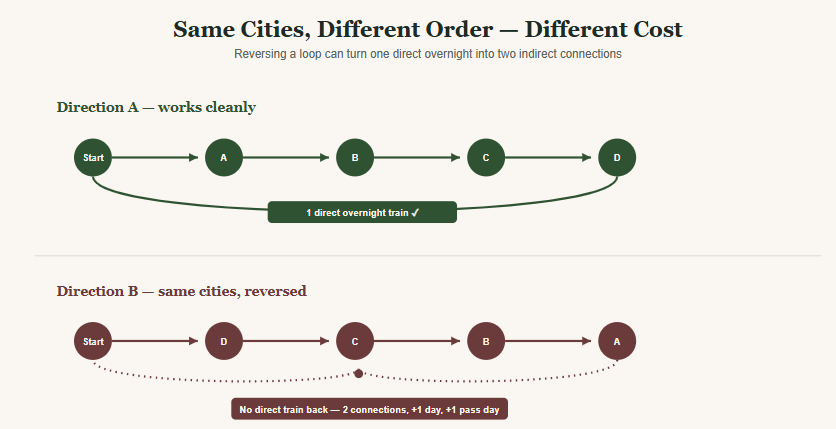
Same six cities, same total distance — one direction wrapped up with a single overnight train home, the other needed two connections and burned an extra day. We tested the same loop multiple ways to find out when reordering actually saves time or money, and when it just moves the cost around.
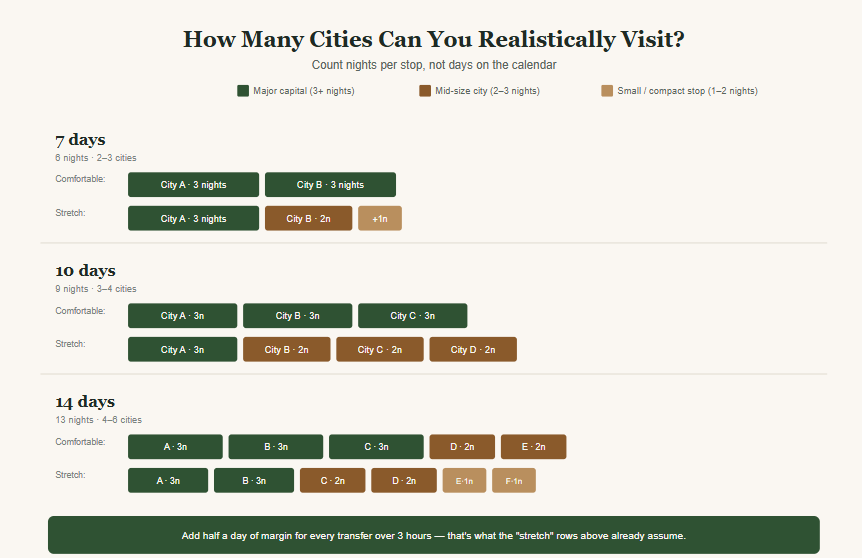
Most multi-city trips don't fall apart because of too few days — they fall apart because every stop got the same amount of time regardless of what it needed. Here's how many cities actually fit into 7, 10, or 14 days once you count nights instead of days.
It's a single ticket in most cases, not two one-ways glued together, and that distinction is exactly where the price difference comes from.
Why open-jaw is often close to round-trip price, not double
How airlines actually construct the fare
Most full-service airlines still build an open-jaw fare the way traditional round-trip fares have always worked: half the round-trip fare to your first city, half the round-trip fare home from your second city, added together. If a round trip to the region costs $900, flying in one way and out the other often lands somewhere close to that same $900, not the $1,400 or more that two independent one-way tickets would cost. People routinely assume open-jaw carries a penalty. Structured correctly, it often doesn't.
Where that logic breaks down
This pricing only holds when the trip is booked as one itinerary, typically on a single airline or within one alliance. Mix two unrelated carriers, or book each leg as a genuinely separate one-way ticket rather than one connected itinerary, and you lose the "half round trip" math entirely. You're now paying two full one-way fares, which on plenty of routes are priced well above half of the round-trip fare precisely because airlines expect one-way buyers to be less price-sensitive — last-minute business travelers, one-directional relocations, that kind of demand.
When open-jaw genuinely saves money
Skipping the backtrack
The most obvious saving isn't really about the ticket price — it's about not burning a day and a domestic flight or long train ride getting back to your entry city just to fly home from there. If your round trip would've required flying back to city A anyway, open-jaw is close to a pure win: similar airfare, minus an entire redundant leg of travel.
Avoiding a country's fee structure
Departure taxes, fuel surcharges, and airport fees vary a lot by country and even by specific airport, and they get added on top of the base fare. Choosing which city you actually depart from — not just which city is more convenient — can occasionally shift your total cost more than people expect, especially on routes touching countries with notably high departure taxes or surcharge structures. It's a smaller factor than the base fare, but it's one more reason the "half round trip" open-jaw price sometimes comes in even lower than expected.
When round-trip actually wins
Budget carriers price differently
Low-cost carriers generally don't use the "half round trip" construction at all — they price each direction independently, point to point, promotion by promotion. On these airlines, an open-jaw routing is genuinely just two one-way fares added together, with none of the traditional discount baked in. If your trip is built mostly on budget airlines, the math above doesn't apply the same way, and it's worth pricing both structures explicitly rather than assuming either one wins.
Promotional round-trip fares don't always extend
A flash sale or a promotional round-trip fare is priced for that specific route, round trip, full stop. It doesn't necessarily mean the airline will construct an equivalent open-jaw fare at a proportional discount — sometimes the promotional pricing simply doesn't apply once you change the return city, and you're quoted a very different, much higher fare for what looks like a small change.
The cost people forget to add back in
The surface segment between your two cities
The flight comparison is only half the math. Getting from city A to city B — the train, the bus, the one-way domestic flight, the rental car — is a real cost that belongs in the same comparison as the airfare saving. An open-jaw that saves $150 on flights but requires a $180 one-way regional flight between the two cities isn't actually a win; it's a wash, and sometimes a loss once you count the extra travel day too.
One-way rental car drop fees
If a rental car is part of the plan, picking up in one city and dropping off in another almost always carries a one-way drop fee, and on some routes — crossing a national border especially — that fee alone can run into the hundreds. This one is easy to forget while you're comparing flight prices, because it doesn't show up until the rental booking step, well after the flight decision already feels final.
A routing decision that wasn't just about price
Price isn't always the deciding factor, either. One multi-country trip we looked at recently — a South America route with an open-jaw structure built around entry and exit cities in two different countries — turned out to hinge on something that had nothing to do with airfare: the traveler's passport needed a visa for one of the two countries and didn't for the other. That asymmetry alone was enough to determine which city made sense as the entry point and which made sense as the exit, independent of which routing was a few dollars cheaper. A routing choice that looks purely like a pricing decision can quietly be a visa or entry-requirements decision instead, and it's worth checking before the flight price becomes the only thing you're optimizing for.
How to actually compare before you book
Price the open-jaw as a single itinerary through one airline or alliance first — that's where the real "half round trip" saving shows up, if it exists on your route. Separately, price it as two standalone one-ways, since on budget carriers or mixed-airline routings that's genuinely what you're buying. Add the cost of getting between your two cities to both totals, whatever that transport turns out to be. And check entry requirements for both cities against your actual passport before locking in which one is the arrival and which is the departure — the cheaper option on paper isn't the better option if it adds a visa you didn't need with the other routing.
How FortripAI's Transport Optimization Agent and Validator help with this
Comparing open-jaw against round-trip properly means pricing multiple routing structures, adding back the overland leg between your two cities, and checking entry requirements against your specific passport — which is a lot of manual comparison to do by hand for every possible combination.
The Transport Optimization Agent does that comparison while a multi-city trip is being built, weighing open-jaw and round-trip structures against each other with the connecting leg between your cities priced in, not left out until later — and flags nationality-specific entry requirements that might make one routing simpler than another regardless of price.
The Validator checks it after the fact, for a route you've already put together. Paste in your planned entry and exit cities, and it checks whether the routing still makes sense — price, visa requirements, and the actual cost of the leg connecting your two arrival and departure points.
FAQ
What does open-jaw mean on a flight booking?
It means flying into one city and home from a different one, instead of returning to your original departure city. You cover the gap between the two cities yourself, by train, bus, another flight, or however makes sense for the trip.
Is an open-jaw flight cheaper than a round trip?
Often close to the same price, when booked as one itinerary on a single airline or alliance — airlines typically price it as half the round-trip fare to each city. It's usually not cheaper than round-trip, but it's also usually not the expensive add-on people assume, and it saves you a redundant leg of travel back to your entry city.
Why are two one-way tickets more expensive than a round trip?
On most full-service airlines, one-way fares aren't simply half the round-trip price — they're priced for travelers who need flexibility and are willing to pay for it. Booking a trip as two independent one-ways, rather than one connected open-jaw itinerary, usually loses the round-trip discount entirely.
Does open-jaw pricing work the same way on budget airlines?
No. Low-cost carriers generally price each direction independently, so an open-jaw route on a budget airline is typically just two separate one-way fares added together, without the traditional round-trip discount.
Can an AI travel tool figure out whether open-jaw or round-trip is cheaper for my trip?
It can, if it's comparing both routing structures with the connecting leg between your cities priced in and checking entry requirements against your actual passport — rather than just quoting whichever routing you asked for first.
If you're weighing entry and exit cities for a multi-country trip, run the routing through FortripAI's Validator before you book — it's a quick way to see whether your open-jaw actually saves what you think it does, once everything is priced in.
This post is part of our series on evaluating AI travel plans before you book them. See also: