How Many European Cities Can You Realistically Visit in 7, 10, or 14 Days?
Most multi-city trips don't fall apart because of too few days — they fall apart because every stop got the same amount of time regardless of what it needed. Here's how many cities actually fit into 7, 10, or 14 days once you count nights instead of days.
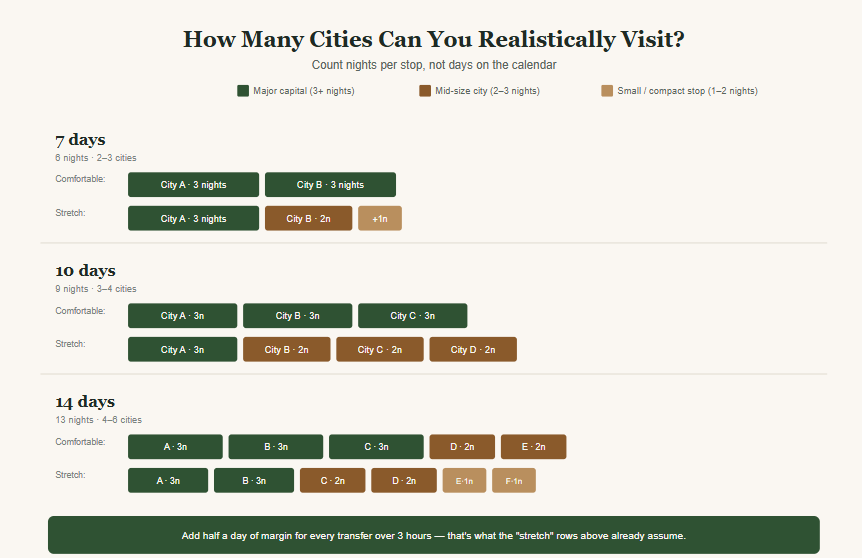
Quick answer: 2–3 cities in 7 days, 3–4 in 10 days, 4–6 in 14 days. The exact number depends less on how many days you have and more on how many nights you're willing to give each stop — and that's the part most people get wrong before they even open a map.
Here's the pattern that shows up over and over in real, detailed multi-city itineraries: the trips that feel relaxed and the trips that feel like a blur are almost never separated by how many cities were on the list. They're separated by whether each stop got enough nights to actually settle into, or got squeezed down to "arrive, photo, leave."
The real unit isn't days, it's nights per city
Why "how many days do I have" is the wrong starting question
Total trip length tells you almost nothing on its own. Fourteen days spread across four cities feels completely different from fourteen days spread across eight, even though the number of days never changed. The question that actually determines how a trip feels is: how many nights does each stop get, and does that match what the stop needs.
Share
Start a trip Fortrip can actually defend.
Sketch a brief. We come back with an itinerary that reads like a recommendation, not a checklist — and tell you what we’d change about it.
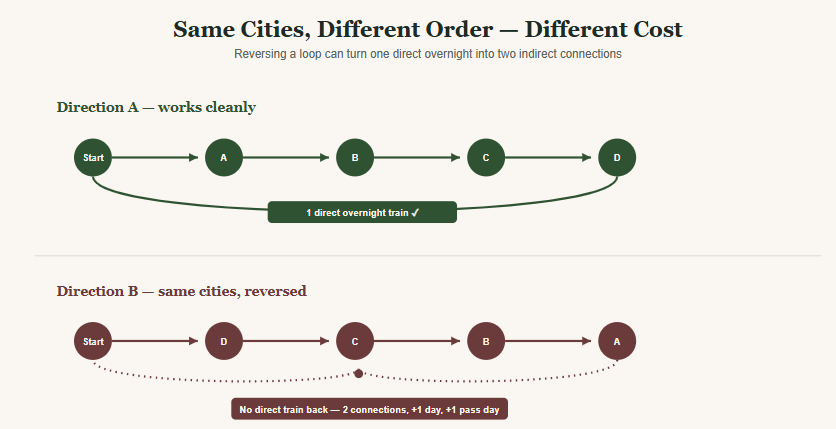
Same six cities, same total distance — one direction wrapped up with a single overnight train home, the other needed two connections and burned an extra day. We tested the same loop multiple ways to find out when reordering actually saves time or money, and when it just moves the cost around.
Open-jaw sounds like it should cost more than a round trip. Usually it doesn't — booked right, it's priced close to half a round trip each way. Here's when that math holds, when it breaks down, and the costs people forget to add back in.
The rhythm that keeps showing up in itineraries that work
One recent multi-country route we looked at — a month-long, city-hopping trip through Central and Southern Europe, a dozen stops in total — held together not because it was carefully rationed, but because almost every stop followed the same shape: arrive in the afternoon or evening, get one full uninterrupted day to actually explore, then a slow morning departure to the next train. That's roughly two nights per stop as the default unit. Bigger cities got bumped to three nights. A couple of small, compact stops got exactly one full day and nothing more, and that was still enough, because the stop itself didn't need more.
The trips that go wrong are the ones that treat every city the same regardless of size, trying to give a small town and a major capital the same one-night treatment, or worse, trying to squeeze a major capital into an afternoon because the schedule already has six other stops on it.
A rough guide to nights per stop
Type of stop
Nights worth planning for
Major capital (think Rome, Paris, London-scale)
3+ nights
Mid-size cultural city (Prague, Florence, Budapest-scale)
2–3 nights
Small town or compact stop (a lakeside village, a single-sight town)
1–2 nights, sometimes even a day trip instead of an overnight
Any intercity move over ~3 hours
Add a half day of margin, don't schedule anything major on arrival
7 days: what's realistic
Six nights to work with. That's comfortably two cities at three nights each, or two full cities plus a short add-on stop (3 + 2 + 1) if one of them is small and close to the others. Trying to fit three full-size cities into seven days means every stop gets roughly two nights, which works fine for mid-size cities but leaves a major capital feeling rushed and mostly unseen.
10 days: what's realistic
Nine nights. Three cities at three nights each is the comfortable version. Four cities is doable if at least one is a smaller, closer stop that only needs two nights rather than three. This is usually the point where people start asking whether a fourth city is worth adding, and the honest answer depends entirely on how close it is to the rest of the route — an extra city that's a quick train ride away costs you almost nothing; one that requires backtracking can eat a full extra day just in transit.
14 days: what's realistic
Thirteen nights, and this is where trips start to have real range. Four to five cities at a proper pace (3+3+3+2+2) is comfortable. Six is possible if a couple of those stops are small, close-together towns that only need a single overnight each rather than a full multi-night stay. Past six cities in fourteen days, you're generally trading "seeing a place" for "passing through it," which is a legitimate choice for some travelers and a source of regret for others — the difference is usually whether it was a deliberate call or something that happened by accident because nobody added up the travel days.
The two ways people blow the pacing
Underestimating the travel day itself
A route that looks fine city-to-city on a map can hide a transfer that eats most of a day once you account for the actual train or drive time, plus the walk to the station, plus checking in somewhere new. One multi-stop road trip we reviewed had two flagship stops that looked close together on a small-scale map; the actual drive between them turned out to be most of a full day round trip, on a week-long trip where that one leg alone accounted for close to half the total driving. Nobody had done anything wrong exactly — the map just didn't show what it actually cost.
Stacking too much into a single day
The other failure mode shows up inside a single day rather than between cities: a morning at a major museum, then a scenic swim spot, then a hilltop town, then a sunset viewpoint, all connected by real driving distance, all on one day. Individually, every stop is reasonable. Added together, it's easily five or six hours of activity time plus a couple hundred kilometers of driving squeezed into a single day that also has to include meals and the actual travel between everything. This is one of the most common patterns in itineraries that look complete on paper: nothing on the list is wrong, there's just too much of it stacked into one day instead of spread across two.
A simple way to sanity-check your own city list
Count your nights, not your days. Add them up across every stop on your list. Add roughly half a day of margin for every transfer over three hours. If the total comes out longer than your actual trip length, something has to give — either a city comes off the list, or a multi-night stop becomes a shorter one, or two nearby stops get combined into one base with day trips out. Deciding that on paper, before you book anything, is a lot less painful than discovering it on day 4 of the actual trip.
How FortripAI's Transport Optimization Agent and Validator help with this
This is a pacing problem as much as a logistics problem, which is why we built two different tools to catch it at two different points.
The Transport Optimization Agent handles it while the route is still being built — sequencing your stops with real transfer times between them, not straight-line map distance, so a leg that actually eats a full travel day gets flagged as one instead of quietly disappearing into "arrive by evening."
The Validator handles it for a trip you've already put together, whether that's one you built yourself, pulled from a blog post, or generated somewhere else. Paste it in, and it checks whether any single day has more packed into it than the actual hours and travel time allow — the kind of stacking that looks fine as a list of names and only falls apart once you add up the clock.
Together, they cover the two places this kind of trip usually breaks: not enough nights in any one city, and too much crammed into any one day.
FAQ
How many cities should I visit in a 7-day European trip?
Two cities comfortably, at three nights each. Three is possible if one of them is a smaller stop close to the others that only needs a night or two.
Is it possible to see 5 cities in 10 days in Europe?
It's possible but rushed for most travelers — that's roughly two nights per stop on average, which barely covers arrival, one day of exploring, and departure, with no room for a slow day or a travel delay anywhere in the route.
How many nights should I spend in each city?
Three or more for a major capital, two to three for a mid-size city, one to two for a small town or compact stop. Add extra margin any time the transfer to the next stop takes more than about three hours.
What's the biggest mistake people make when planning a multi-city Europe trip?
Treating every stop as needing the same amount of time, regardless of size, and underestimating how much a single travel day between cities actually costs once real transfer time is factored in.
Can an AI itinerary tool tell me if I'm trying to see too many cities?
It can, if it's checking real transfer times and daily totals rather than just listing places in order. That's the difference between a tool that generates a route and one that also validates whether the pacing is actually achievable.
If you've got a city list and a rough number of days, run it through FortripAI's Validator before you book anything — it's a fast way to find out whether your pacing actually holds up before you're standing in a train station finding out the hard way.
This post is part of our series on evaluating AI travel plans before you book them. See also: