Destination Validation: How to Know Whether a Place Fits Your Dates, Budget, and Travel Style
Two good itinerary options can both look great on paper and still be wrong for your trip. Here's how to check a destination against your actual dates, budget, and travel style — using a real Italy route comparison as the example.
"Which destination is better?" is almost always the wrong question. Two routes through Italy can both be genuinely excellent trips and still be the wrong choice for a specific traveler in a specific month with a specific budget. The better question isn't which place wins in general — it's which place fits this trip.
We saw this play out clearly with a traveler planning their first two weeks in Italy, choosing between two well-built routes. Both were well thought out. Both hit real highlights. And once you started checking them against actual travel dates, an actual budget, and what the traveler said they actually enjoyed doing, one of them stopped being a close call.
Here's how that check works, and why it matters more than picking the "objectively best" destination.
Two Good Routes, One Real Decision
Share
Start a trip Fortrip can actually defend.
Sketch a brief. We come back with an itinerary that reads like a recommendation, not a checklist — and tell you what we’d change about it.
A cheap flight and a pricier train can end up costing the same once you add baggage, transfers, and an extra hotel night. Here's how to compare the full door-to-door cost — with five real routing cases where the obvious choice wasn't actually the cheapest one.
ChatGPT can plan a Guatemala trip in seconds — but a validator caught an altitude risk, two 10+ hour transfer days, and a season the itinerary never accounted for. Here's what to check before you book.
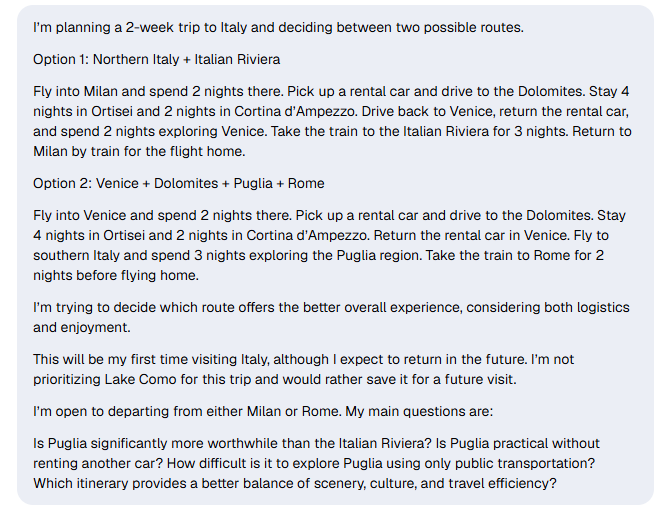
The trip: two weeks in Italy, first visit, planning to return again someday. Two route options were on the table.
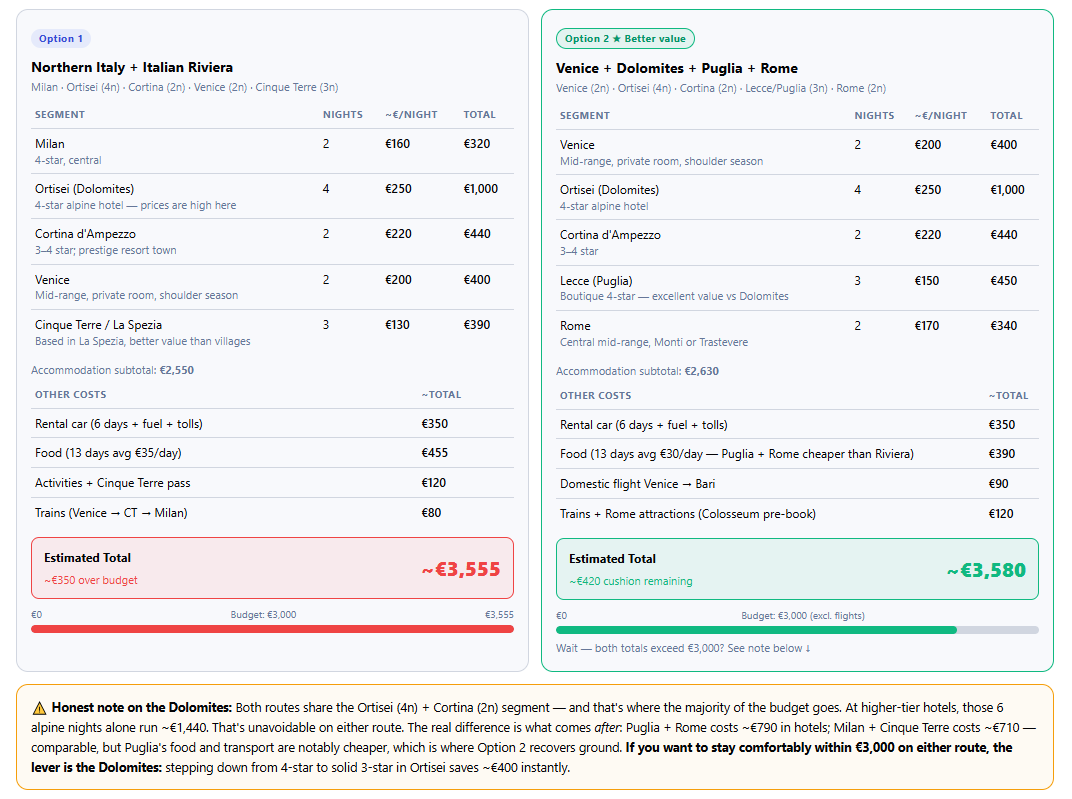
Option 1 flew into Milan, drove up to the Dolomites for six nights, came back through Venice, and finished with a few nights on the Italian Riviera before returning to Milan.
Option 2 flew into Venice, hit the same Dolomites stretch, then flew south to Puglia for a few days, and closed the trip in Rome.
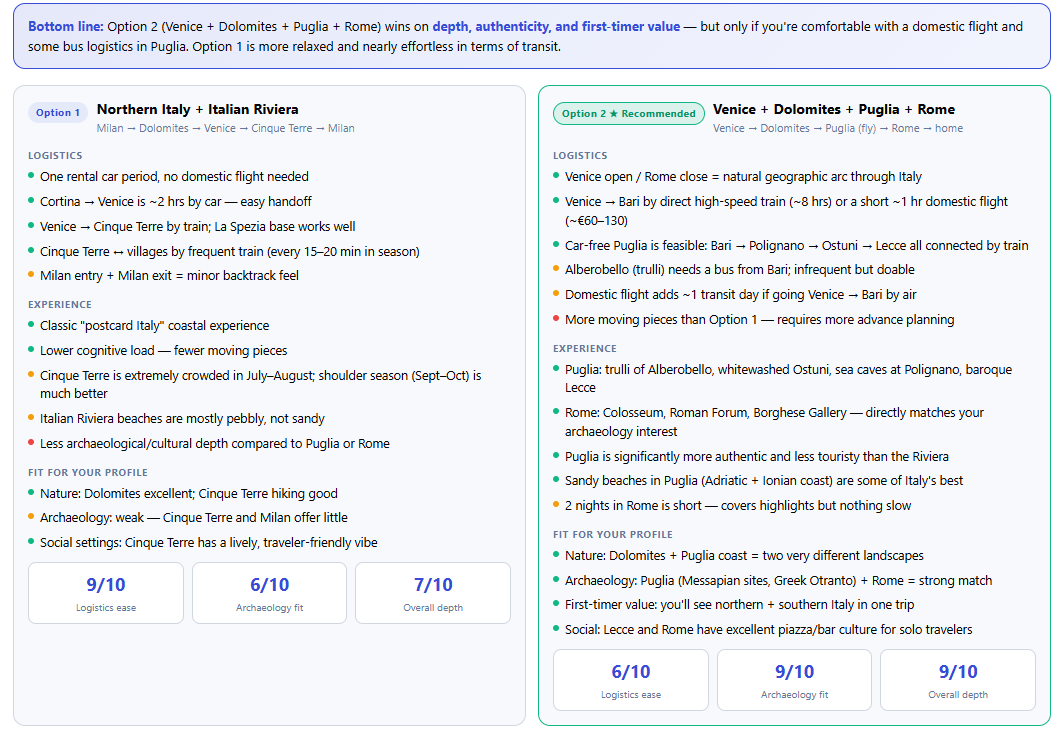
Both routes are legitimate. Neither one is a mistake. On a map, they even look similar in ambition — a mountain leg, then a very different second half. The difference only shows up once you stop comparing "Puglia vs. the Riviera" as a general question and start comparing them against the specifics of this actual trip.
Check the Destination Against Your Actual Dates
This is usually the single biggest factor, and it's the one most itineraries skip entirely — comparing a destination in the abstract instead of in the month you're actually going.
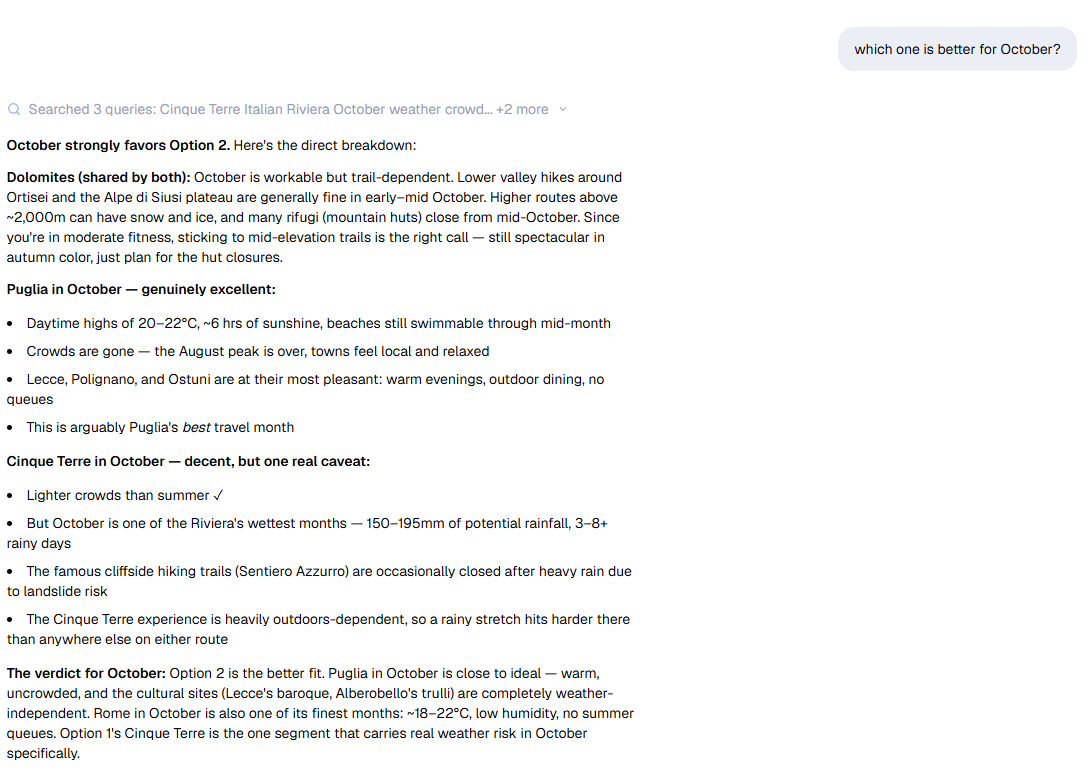
For this trip, the travel window was October, and that changed everything. The Italian Riviera in October runs into one real problem: it's one of the wettest stretches of the year there, with enough rainfall that the cliffside coastal trails occasionally close after heavy rain due to landslide risk. That's a real issue for a region whose whole appeal is outdoor walking along the coast.
Puglia in the same month is close to ideal — warm days, swimmable beaches through mid-month, and none of the August crowds. The towns that make Puglia worth visiting (Lecce, Polignano, Ostuni) don't depend on weather the way a coastal hiking trail does, so October's mixed forecast barely touches the experience.
Same two regions, same traveler, same trip — but the calendar alone flips which one makes sense. A destination that's excellent in July can be a genuine liability in October, and a good itinerary check has to look at the specific month, not just the season in general.
Check the Destination Against Your Real Budget
"Which is more expensive" is the wrong framing here too. The real question is which destination gives you more of what you actually want for the money you actually have.
With a set budget for this trip, Puglia turned out to be the more comfortable choice — not because it's universally cheaper than Northern Italy, but because a genuinely nice boutique hotel in Lecce's historic center runs roughly half what a comparable stay costs in Cortina d'Ampezzo or Venice. The Riviera, meanwhile, tends to price its beach clubs, aperitivo spots, and restaurants for the summer crowd it's built around, which pushes daily spending up regardless of season.
None of this means Puglia is "the budget option" in some generic sense. It means that for this specific combination of dates and spending limit, one route delivered a noticeably more comfortable trip for the same money — and the single biggest lever for either route turned out to be something simple: dropping one hotel night from a 4-star to a solid 3-star with breakfast included. That one change alone brought both options within budget.
Check the Destination Against Your Travel Style
This is the part that's easy to skip because it feels subjective, but it's often the most decisive factor of all.
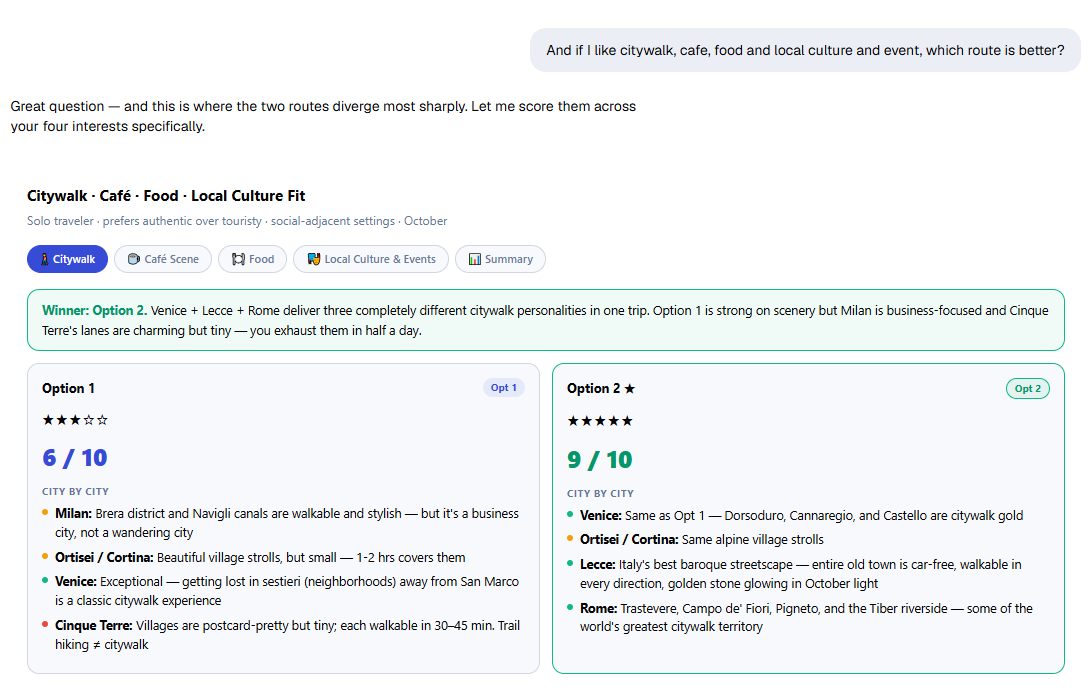
This traveler was clear about what they actually enjoy: city walking, café culture, food, and local events — not primarily scenic drives or checklist sightseeing. Once you score both routes against that specific preference, the gap widens rather than narrows. Puglia's food culture is distinct even within Italy — orecchiette, burrata, the street food scene in Lecce — and October is exactly when locals are eating and living at their most seasonal, not performing for tourists. Rome adds one of the world's great café-and-walking cities on top of that.
A route can be logistically simpler and still be the wrong fit if it doesn't match how someone actually likes to travel. The Riviera route is the easier one to execute — fewer flights, more straightforward train connections — but "easier to execute" and "better trip for this person" aren't the same thing. That gap between "easy to book" and "actually enjoyable" is the same one we dig into in 12 red flags that make a multi-city itinerary unrealistic.
Weigh the Trade-Offs Instead of Looking for a Winner
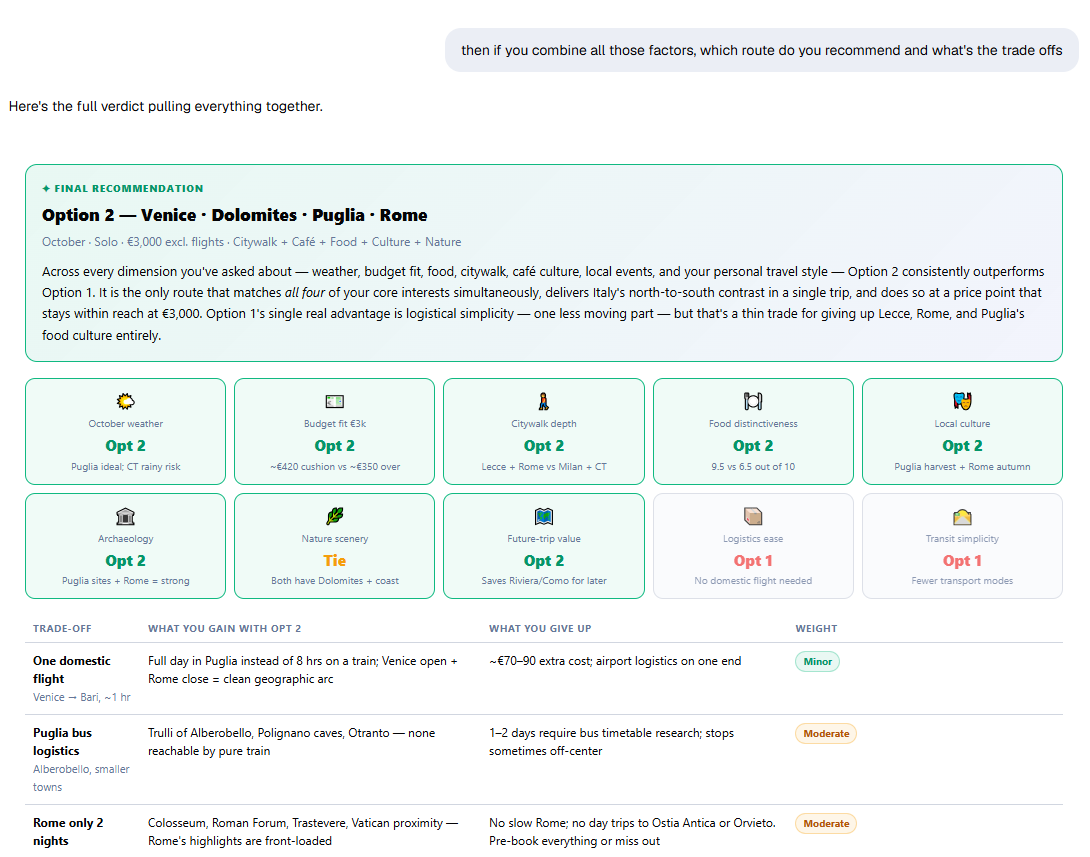
Even the stronger option here wasn't free of compromise. Fitting Rome into the back half of this trip meant only two nights there, which is genuinely tight for a city that rewards slower exploration — doable with the Colosseum and major sights pre-booked, but not a relaxed, unhurried visit.
The honest way to handle that isn't to pretend the trade-off doesn't exist. It's to decide whether it's worth accepting. For a traveler who already plans to return to Italy, two nights in Rome as a first taste — while saving Lake Como, Tuscany, the Amalfi Coast, and Sicily for a future trip — is a reasonable trade. For someone who considers this their only shot at Italy for years, the calculation might land differently.
That's the actual output of destination validation: not a verdict that one place is better, but a clear picture of what you're gaining and what you're giving up, so you can make that call knowingly instead of finding out on day nine of the trip.
A Simple Framework Before You Pick a Route
Before locking in a destination or a route between two options, run it through four checks:
Dates — Is this destination good in the specific month you're traveling, not just the general season?
Budget — Does this destination deliver more of what you want for the money, given your actual number?
Travel style — Does the pace and focus match what you actually enjoy doing, not just what looks impressive on an itinerary?
Trade-offs — What are you giving up either way, and is that trade-off one you're willing to make?
Most itinerary mistakes aren't about picking a bad destination. They're about picking a good destination that doesn't fit the trip in front of you.
Let the Validator Run This Check for You
Comparing two itineraries across dates, budget, and travel style by hand — the way we just did with the Italy example — takes real research and a fair amount of back-and-forth. Fortrip's Validator does that comparison for you: paste in your route options along with your travel dates, budget, and what you actually enjoy doing, and it checks each one against those specifics rather than giving you a generic "both are great" answer.
How do I know if a destination fits my travel dates?
Look past the general season and check the specific month. Regions can have a signature month that's excellent and a nearby month that carries real weather or crowd risk — coastal hiking regions and high-altitude trekking areas are especially sensitive to this.
Is a cheaper destination automatically the better budget choice?
Not necessarily. The better question is which destination gives you more of what you actually want for your specific budget, since prices for the same style of trip can vary significantly between regions even within one country.
What if two destinations both score well on paper?
That usually means the deciding factor is travel style, not logistics. A route that's easier to execute isn't automatically the better trip if it doesn't match how you actually like to spend your days.
Should I try to avoid every trade-off when planning a route?
No — most real itineraries involve at least one honest compromise. The goal isn't a trade-off-free plan; it's knowing what the trade-off is in advance so you can decide if it's worth it.
Can a travel itinerary validator compare two different destination options, not just check one itinerary for problems?
Yes — that's one of the more useful ways to use it. Feeding in two competing routes along with your dates, budget, and preferences lets you compare them side by side instead of relying on general reputation for each destination.