Flight, Train, Bus, or Ferry? How to Compare the True Cost Between Cities
A cheap flight and a pricier train can end up costing the same once you add baggage, transfers, and an extra hotel night. Here's how to compare the full door-to-door cost — with five real routing cases where the obvious choice wasn't actually the cheapest one.
Written by Boyuan Dong, Founder of FortripAI and former travel consultant. Reviewed internally by the FortripAI travel research team. Methodology below.
A €35 flight looks cheaper than a €70 train.
Then you add a €25 checked bag, an airport bus, a taxi before sunrise and lunch at the terminal. The flight may still win—but it is no longer a €35 journey.
This happens constantly on multi-city trips. Travelers compare the number shown on the booking page without comparing the complete journey from one hotel door to the next.
The real question is not:
Which ticket is cheapest?
Share
Start a trip Fortrip can actually defend.
Sketch a brief. We come back with an itinerary that reads like a recommendation, not a checklist — and tell you what we’d change about it.
Most multi-city trips don't fall apart from one big mistake — they fall apart from a dozen small mismatches in timing, pacing, and logistics that never got checked. Here are the 12 we see most often, and how to catch them before you book.
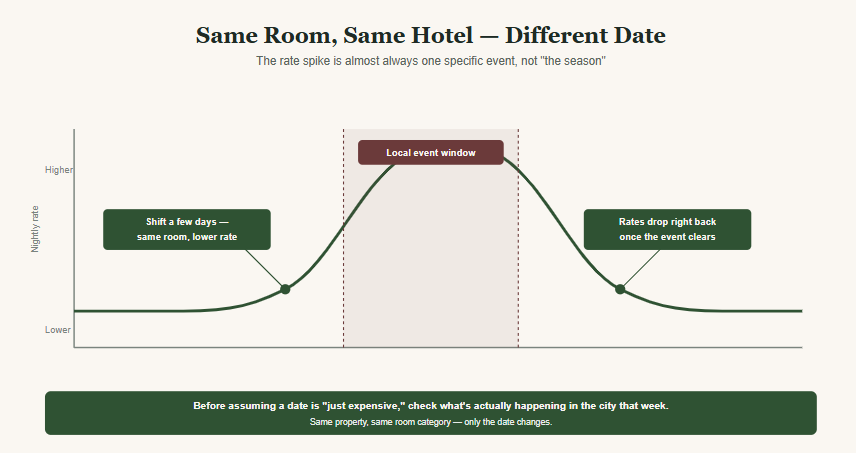
Same hotel, same room, and the price still swings a few hundred dollars depending on the date. It's rarely "high season" — it's usually one specific event, a minimum-stay rule, or a day-of-week pattern running backwards from what you'd expect. Here's how to spot which one, without touching the room category.
It is:
Which option gets me from one city to the next for the lowest total cost, with an acceptable amount of time, risk and inconvenience?
Based on anonymized travel-planning cases, here is a more reliable way to compare flights, trains, buses and ferries.
Quick answer: Add the ticket price, baggage, reservations, airport or port transfers, extra accommodation, local transport and any costs created by an awkward departure time. Then compare the full door-to-door journey—not just the time spent on board.
In short:
Ticket price alone is not the trip's real cost — baggage, transfers, reservations and extra hotel nights can change the winner
An overnight bus or ferry can be cheaper if it replaces a hotel night, but not if you lose the next day to exhaustion
Rail passes and prepaid tickets should not decide the route — compare what they actually cover against what the full journey needs
Compare every leg of a multi-city trip separately; the best route often mixes flights, trains, buses and ferries
What Is the “True Cost” of Traveling Between Cities?
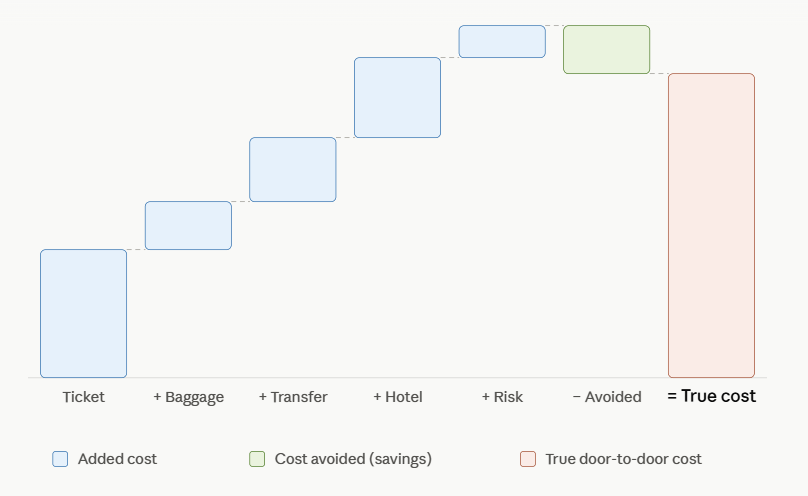
A useful calculation looks like this:
True travel cost = ticket + fees + baggage + transfers + extra accommodation + local transport + schedule risk − costs avoided
The “costs avoided” part matters.
An overnight bus might remove one hotel night. A scenic ferry might replace a separate sightseeing cruise. A city-center train could remove two airport transfers. A more expensive direct flight might save a full vacation day.
You do not need to assign a dollar value to every hour. You do need to recognize that losing six usable hours on a five-day trip is different from losing six hours during a six-month journey.
The Costs Most Transport Comparisons Miss
Airport, Station and Port Transfers
A flight search normally begins at the airport and ends at another airport.
Your trip does not.
It begins at your accommodation, home or previous destination and ends at the next hotel. A cheap flight from a distant airport may require:
A train or bus to the airport
A taxi before public transport starts
Airport parking
A second transfer after landing
Extra travel time with luggage
An overnight stay near the airport
Train stations are often more central, but not always. Ferry terminals may be far from airports or city centers. Long-distance bus stations can also be on the edge of town.
Always price the full route.
Baggage and Reservation Fees
A ticket that includes one checked bag is not directly comparable with a carry-on-only ticket.
The same applies to rail passes. A pass may cover the basic train fare but not:
High-speed train reservations
Sleeper cabins
Premium supplements
Seat reservations
Ferries
Long-distance buses
Local transport to the station
The pass is only valuable on the parts of the journey where it is actually valid.
The Extra Hotel Night
Departure time can change the cost of the entire trip.
A 6:00 a.m. flight may require a hotel near the airport or an expensive early taxi. A flight that arrives after the last train may force you into a taxi. An overnight bus can remove one hotel night, but only if you are able to sleep well enough to enjoy the following day.
In one multi-city planning case, the quoted “full trip total” covered ten London hotel nights even though the flight departed after an eleven-night stay. That missing night materially changed the total.
Before accepting any trip total, count every night between arrival and departure.
The Cost of a Fragile Connection
Separate tickets can be cheaper, but they can also transfer the risk to you.
A flight-to-ferry connection may look efficient until you consider:
Flight delays
The distance between airport and port
Ferry check-in time
Seasonal timetables
Weather cancellations
Whether the next departure is the same day
The cheapest route can become the most expensive if one delay causes you to buy a replacement ticket or stay overnight.
Real Case 1: The Cheapest Flight Was Not Necessarily the Cheapest Airport
A traveler in northern Spain wanted the cheapest flight to any airport in Ireland.
The first search focused on Madrid and several larger airports. Madrid appeared to be the obvious winner.
The traveler then asked to include two regional airports that had not been fully considered. One of them returned a direct flight at a price close to the cheapest Madrid option.
The headline fares were similar. The real decision depended on:
Distance from the traveler’s starting point
Train, fuel or parking costs
Departure time
Whether an overnight stay was needed
Baggage allowance
Direct flight versus connection
The lesson
Do not search only the largest airport.
Create an airport catchment around your actual location and compare the complete cost of reaching each airport. A fare that is €15 cheaper may not be cheaper after a two-hour airport transfer.
Long-tail questions this case answers include:
Is it cheaper to fly from a regional airport?
How do I compare nearby airports?
Should I travel to a larger airport for a cheaper flight?
Does airport transfer cost cancel out a cheap fare?
Real Case 2: A Flight-and-Ferry Combination Beat a “Free” Rail-Pass Route
Another traveler needed to travel from a Balkan city to a Greek island, followed by Istanbul.
Because the traveler already had a Eurail Pass, an overland route through another Balkan coastal city initially sounded attractive. The train portion might already be paid for.
But the proposed route still required:
A very long bus journey not covered by the pass
Additional reservations and supplements
Multiple transfers
More than a day of travel
A route that still did not connect directly to the Greek island
The more practical combination was:
Fly to Athens
Transfer from the airport to Piraeus
Take a ferry to the island
Return by ferry
Fly from Athens to Istanbul
The transport tickets came to roughly $407 in that search snapshot. But the true cost also needed to include checked baggage and the airport-to-port transfer.
The lesson
A ticket or rail pass you have already bought should not dictate the route.
Compare what the pass covers against what the complete journey requires. “Included with my pass” is not the same as “the lowest-cost route.”
Real Case 3: The Ferry Was Slower—but Replaced a Separate Experience
A traveler moving between two Rhine towns had already booked the hotels. The dates and overnight stops could not be changed.
The obvious connection was the train. It was efficient, but part of the route missed the most scenic section of the river.
The alternative was a daytime Rhine boat. It took longer, but it also passed castles, vineyards and the Loreley section of the gorge.
That changed the calculation.
The ferry was not just transportation. It replaced a separate sightseeing cruise that the traveler might otherwise have paid for later.
The train remained useful as a backup if river conditions affected the boat schedule.
The lesson
Not every extra hour is wasted time.
Ask whether the journey itself replaces another activity. A ferry, scenic train or coastal bus may cost more—or take longer—but reduce the cost of sightseeing elsewhere in the itinerary.
Real Case 4: The Overnight Bus Saved Money, but the Day Train Protected the Trip
A solo traveler planned a budget route from Berlin to Prague and then Budapest.
For the first leg, a very cheap overnight coach was available. It could also remove one accommodation night.
For the longer second leg, a daytime train offered more space, a more comfortable journey and the ability to eat, move around and arrive without losing a night of sleep.
The correct answer was not “always take the bus” or “always take the train.”
It was:
Use the overnight bus where the price saving is meaningful and the following day is flexible
Use the daytime train where sleep quality and arrival energy matter more
When does an overnight bus really save money?
It saves money when:
The fare is significantly below the train or flight
It replaces a hotel night
The arrival time is usable
Luggage is included
You can function after sleeping on a bus
It may not save money when:
You need early hotel check-in
You lose the entire arrival day to exhaustion
The bus station requires an expensive taxi
Luggage costs extra
The route has difficult border crossings or delays
Real Case 5: One Transport Mode Did Not Work for the Whole Trip
A family planned a route covering Lake Como, Pisa, Florence and Rome.
Driving the entire route seemed flexible. But a car created problems in Florence and Rome:
Restricted traffic zones
Parking costs
Little need for a car inside the cities
More stress with children
The risk of traffic fines
Taking trains for the entire trip solved the city problem but reduced flexibility around Lake Como.
The final solution was mixed:
Rent a car locally around Lake Como
Return it before continuing south
Use trains for Pisa, Florence and Rome
The lesson
Do not choose one transport mode for an entire multi-city trip simply because it works well for the first leg.
Compare every leg separately. The best trip may use a car for one day, trains for three cities, a ferry for an island and a flight for the longest distance.
Flight vs Train vs Bus vs Ferry: What Should You Compare?
Factor
Flight
Train
Bus
Ferry
Ticket price
Can look very low before extras
Often clearer but may require reservations
Frequently the lowest fare
Varies widely by cabin and season
City access
Airports may be far away
Often central
Station location varies
Ports may require transfers
Baggage
Often restricted or charged
Usually easier, but rules vary
Luggage limits vary by operator
Large luggage may be easier, but cabins cost extra
Check-in time
Longest
Usually shorter
Usually short
Can be substantial
Overnight value
Early or late flights may add a hotel
Sleeper trains may replace a hotel
Night buses may replace a hotel
Overnight ferries may replace a hotel
Comfort
Good on short direct routes
Space to move and work
Depends heavily on route and seat
Can be relaxing, but weather matters
Disruption risk
Delays, security and missed separate tickets
Strikes, reservations and missed connections
Traffic and border delays
Weather and seasonal schedules
Experience value
Usually transport only
Scenic routes can be part of the trip
Good for local scenery on some routes
Often part transport, part experience
[Insert original comparison graphic here — suggested alt text: "Flight vs train vs bus vs ferry true cost comparison." Show ticket price + baggage + transfer + hotel night + time lost = true trip cost, ideally illustrated with one of the case-study routes above rather than generic stock photos of planes or trains.]
A Simple Way to Compare Transport Between Cities
Step 1: List Every Realistic Mode
Do not stop after finding one cheap flight.
Check:
Direct and connecting flights
Day and night trains
Long-distance buses
Ferries
Mixed routes
Nearby airports, stations and ports
Step 2: Calculate Door-to-Door Time
Include:
Travel to the departure point
Check-in and waiting
Time on board
Connections
Travel to the final hotel
A one-hour flight can easily become a five-hour journey.
Step 3: Add Every Required Cost
Include:
Ticket
Baggage
Seat reservations
Airport, station or port transfer
Food during long connections
Parking or tolls
Extra hotel nights
Local transport on arrival
Step 4: Check What the Schedule Does to Your Itinerary
A cheap arrival at midnight may remove the first evening.
An early departure may remove the final morning.
An overnight bus may save a hotel but reduce the value of the following day.
Step 5: Respect What Is Already Fixed
Already booked hotels, timed tickets and non-refundable reservations can change the best route.
The cheapest theoretical route is irrelevant if it forces you to abandon a prepaid hotel.
Step 6: Compare the Whole Trip, Not One Ticket
The best individual tickets do not always create the best complete itinerary.
Changing the order of two cities may:
Remove a flight
Create a direct train
Avoid an overnight transfer
Reduce hotel changes
Make a ferry connection possible
Lower the total transport cost
When Does Each Transport Mode Usually Win?
Choose a Flight When:
The distance is long
There is a convenient direct flight
Both airports have affordable connections
Baggage is included or minimal
The flight saves a meaningful part of a travel day
Choose a Train When:
The route is city center to city center
Door-to-door time is competitive
You are traveling with luggage
You want to work, eat or move during the journey
Airport transfers would remove the airfare saving
Choose a Bus When:
Price is the main constraint
The route is direct
Train fares are unusually high
The bus station is conveniently located
An overnight journey genuinely replaces a hotel night
Choose a Ferry When:
You are connecting islands or coastal cities
The sailing replaces a sightseeing activity
An overnight cabin replaces accommodation
You have enough buffer for seasonal or weather-related changes
How FortripAI Compares the True Cost
Most booking sites compare individual tickets. That works when you already know the exact route and transport mode.
It is less useful when you are deciding between:
A direct flight and an overnight train
A nearby airport and a cheaper distant airport
A ferry and a flight to an island
A rail pass and a mixed flight-bus route
Renting a car for one section or the entire trip
Changing the order of several cities
FortripAI’s Transport Optimization Agent looks at the trip as a connected system rather than a list of separate tickets.
It can compare:
Flight, train, bus and ferry combinations
Door-to-door time
Baggage and reservation costs
Airport and port transfers
Extra hotel nights
Fixed bookings
Route order
Cost, time and comfort trade-offs
The Trip Validator can then flag connections that look possible on paper but are too fragile, tiring or inefficient in a real itinerary.
Compare Your Route Before You Book
Paste your cities, dates, fixed bookings and transport passes into FortripAI.
Instead of asking only, “Which ticket is cheapest?”, compare the question that actually matters:
Which route gives me the best complete trip?
CTA Button: Compare My Intercity Route
Secondary CTA: Validate My Existing Itinerary
More in This Series
Train vs Flight: How to Compare Door-to-Door Travel Time — /train-vs-flight-door-to-door-time/
Bus vs Train in Europe: When Is the Night Bus Really Cheaper? — /night-bus-vs-train-europe/
Ferry vs Flight to the Greek Islands — /ferry-vs-flight-greek-islands/
The Hidden Costs of Cheap Flights — /hidden-costs-of-cheap-flights/
Is a Eurail Pass Worth It for Your Route? — /is-a-eurail-pass-worth-it/
How to Compare Nearby Airports — /how-to-compare-nearby-airports/
Why a Cheap Flight Can Add an Extra Hotel Night — /cheap-flight-extra-hotel-night/
Should You Rent a Car for Part of a Multi-City Trip? — /rent-a-car-part-of-multi-city-trip/
(Slugs are placeholders — activate as real internal links once each piece is published, and link back to this page and to the Transport Optimization Agent page from each of them.)
Frequently Asked Questions
Is the train always cheaper than flying in Europe?
No. Budget flights can have a lower ticket price, especially on longer routes. The train may still cost less overall after adding baggage, airport transfers, check-in time and any extra accommodation caused by the flight schedule.
How do I calculate the real cost of a cheap flight?
Add the airfare, baggage, seat fees, airport transfers at both ends, food during the airport wait, parking or taxis and any hotel night caused by an early departure or late arrival.
Is a night bus cheaper than a train?
Often, but not automatically. A night bus may save both the fare difference and one hotel night. It may be poor value if you need early check-in, arrive far outside the city or lose the following day because you could not sleep.
Is a ferry better than a flight for island travel?
It depends on the airport and port locations, ferry duration, baggage, season and your onward route. A ferry can be better when it connects city centers, carries luggage easily or doubles as a scenic experience. A flight may be better when the sailing is long or weather-sensitive.
Should I use a Eurail Pass for every journey?
No. Use the pass where it reduces the real cost. Some buses, ferries, reservations, sleeper cabins and route supplements may not be covered. A route that uses the pass can still cost more than a direct flight or mixed transport combination.
What is the best way to compare travel between two cities?
Compare the complete door-to-door journey. Include ticket price, baggage, transfers, total travel time, hotel nights, reliability and how the schedule affects the rest of your itinerary.
Can FortripAI compare flights, trains, buses and ferries together?
FortripAI is designed to compare mixed transport routes across a multi-city trip. It can evaluate route combinations by total cost, travel time, comfort, fixed bookings and the effect each option has on the rest of the itinerary.
Editorial note: The examples in this article are anonymized from real travel-planning conversations conducted through FortripAI. Prices are rounded search snapshots and are not current quotes. Transport schedules, baggage rules and availability should always be verified before booking.