How to Find the Cheapest Dates for a Luxury Hotel Without Downgrading the Property
Same hotel, same room, and the price still swings a few hundred dollars depending on the date. It's rarely "high season" — it's usually one specific event, a minimum-stay rule, or a day-of-week pattern running backwards from what you'd expect. Here's how to spot which one, without touching the room category.
Quick answer: the same room, at the same hotel, can swing significantly in price depending on the date — and it's almost never about "high season" in general. It's usually one of three things: a local event you didn't know was happening, a minimum-stay requirement quietly locking you into the expensive window, or a day-of-week pattern that runs backwards from what you'd assume. Find the actual driver, and you can often shift a few days and keep the exact same room.
Here's how each of those actually works, and how to check for them before you assume a property is simply "too expensive on those dates."
Why the same room costs differently on different dates
It's revenue management, not randomness
Luxury hotels adjust rates constantly based on real-time demand forecasting for that specific room category on that specific date — not a blanket seasonal multiplier applied evenly across the calendar. Two nights four days apart, same room type, same property, can be priced a few hundred dollars apart because the hotel's booking system is reading different demand signals for each date, not because one date is more "in season" than the other.
Plan a trip with Fortrip
Use Fortrip to draft and validate itineraries with travel-specific reasoning — not generic chat answers.
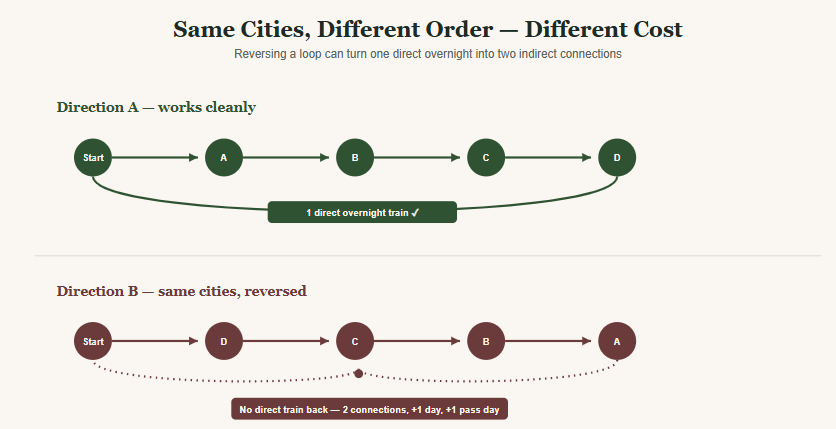
Same six cities, same total distance — one direction wrapped up with a single overnight train home, the other needed two connections and burned an extra day. We tested the same loop multiple ways to find out when reordering actually saves time or money, and when it just moves the cost around.
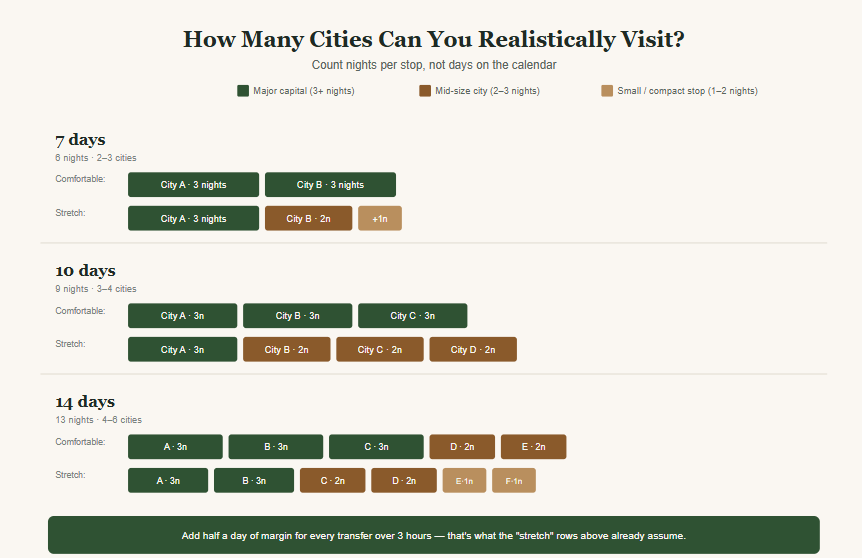
Most multi-city trips don't fall apart because of too few days — they fall apart because every stop got the same amount of time regardless of what it needed. Here's how many cities actually fit into 7, 10, or 14 days once you count nights instead of days.
What actually moves the needle: specific events, not general seasonality
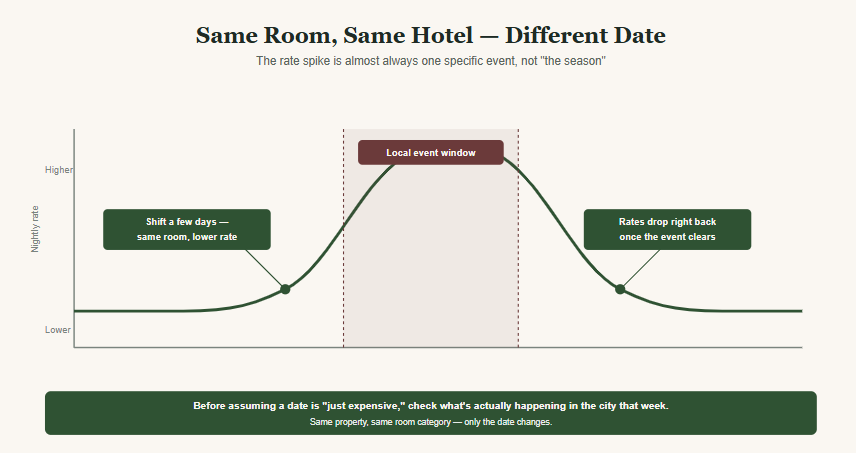
"High season" gets blamed for a lot of price spikes that are really caused by something much narrower: a conference taking over the city's convention center for four days, a festival, a major sports fixture, a long weekend tied to a local public holiday. These push rates up hard for a specific window and then rates fall right back down once the event clears — often within the same week, sometimes within days.
The trap: assuming a date is expensive because of the season, when it's really one event
This is the mistake that costs people the most money, because it leads to either overpaying for a date that only looks locked-in, or unnecessarily abandoning a great property because a general "this month is expensive" assumption never got checked against what's actually happening on the specific dates in question.
One multi-city trip we looked at recently ran into exactly this. A traveler was comparing hotel rates around a window that overlapped with what they'd heard was a major international event in that city — the assumption going in was that the whole week would be priced at a premium because of it. Checking the actual event calendar turned up something different: the event's real dates fell a few weeks later than the traveler had assumed, well outside their actual travel window. The rates on their real dates had nothing to do with that event at all — the elevated pricing they were bracing for simply didn't apply, and their planned dates turned out to be perfectly reasonably priced once the real driver was checked instead of assumed.
The lesson isn't "events make hotels expensive," which most travelers already know. It's that the specific dates of the event matter far more than the general reputation of the month, and it's worth checking the actual calendar rather than budgeting around a vague sense that "this time of year is always pricey."
Minimum-stay requirements can lock you into the expensive window
Properties often attach a minimum-stay requirement to their highest-demand dates — you can't simply book the one expensive night, you're required to book three or four nights spanning it, even if you only wanted to be there for one. This is easy to miss when you're just glancing at a nightly rate, because the rate itself doesn't announce the restriction; it shows up at checkout when the calendar won't let you select a shorter stay.
Shifting your check-in or check-out by even a day or two outside that minimum-stay window can free you from the requirement entirely — same room, same property, but suddenly bookable as a normal-length stay at the normal rate, because you're no longer inside the exact date range the restriction was built around.
Day-of-week patterns run in different directions depending on the property
A city hotel that fills up with business travelers Monday through Thursday is often measurably cheaper on Friday and Saturday nights, once that demand clears out. A beach or resort property tends to work in the opposite direction — weekends draw the leisure crowd willing to pay more, while a Tuesday or Wednesday night can be noticeably cheaper for the identical room.
Applying resort logic to a city hotel, or city logic to a resort, is a quiet way to end up checking the wrong days for a deal. The pattern depends entirely on who actually fills the property on a normal week, which is worth a moment's thought before you assume "weekends are always pricier."
How to actually check this for one specific property
Look at the same room category and the same rate plan across a date range, not just your original dates — most booking engines will let you browse a calendar view for exactly this. Separately, check whether anything is actually happening in that city or region on your dates specifically, not just what the season is generally known for. If a rate seems to jump for a narrow window and then drop right back down a few days later, that's the signature of an event driving it, and it's worth checking what that event actually is and whether its real dates match yours. And if a date range won't let you book a short stay, try shifting the edges of your stay by a day or two before assuming the property itself is simply out of budget.
How FortripAI's Optimization Agent helps with this
Checking a single room category across a date range, cross-referencing it against local event calendars, and spotting minimum-stay restrictions is the kind of comparison that's easy to skip when you're planning by hand, because it means re-checking the same property multiple times instead of just booking the first quote you see.
The Optimization Agent does that comparison directly — pricing the same room category and property across a range of dates rather than a single one, checking whether a rate spike lines up with an actual local event on those specific dates or is simply the base rate for that window, and flagging minimum-stay requirements before they turn into a booking dead end. The property and room category stay exactly what you asked for; what shifts is finding the date within your travel window where that same room actually costs less.
FAQ
Why does the same hotel room cost different amounts on different dates?
Hotels adjust rates based on real-time demand forecasting for each specific date, not a flat seasonal rate. Local events, minimum-stay requirements, and day-of-week demand patterns typically explain the swing more than general "high season" pricing does.
How do I find a cheaper date for a luxury hotel without booking a lower room category?
Compare the identical room type and rate plan across a range of dates rather than just your original one, and check whether your original dates overlap with a specific local event — conferences, festivals, and major sports fixtures usually drive short, sharp rate spikes that clear once the event ends.
Why won't a hotel let me book just one or two nights on certain dates?
High-demand dates often carry a minimum-stay requirement, forcing a longer booking window than you wanted. Shifting your check-in or check-out by a day or two outside that specific window can remove the restriction and return the rate to normal.
Are hotels always more expensive on weekends?
It depends on the type of property. City hotels that rely on business travel are often cheaper on weekends once that demand clears. Resort and leisure properties tend to run the opposite way, with weekends commanding a premium and midweek nights priced lower.
Can an AI travel tool find the cheapest dates for a specific hotel automatically?
It can, if it's comparing the same room category and rate plan across a date range and checking that range against actual local events — rather than just returning whatever rate happens to be attached to the dates you originally typed in.
If you've got a specific property in mind and want to know whether shifting your dates could save you money without changing the room, run it through FortripAI's Optimization Agent before you book.
This post is part of our series on evaluating AI travel plans before you book them. See also: