Multi-City Hotel Booking: Why Optimizing the Whole Trip Can Cost Thousands Less Than Booking City by City
Same three hotels, same total nights — just reordered — and the total swung by more than $5,000. One hotel's date-availability gap did almost all the damage. Here's why "cheapest hotel in every city" and "cheapest trip" are two different questions.
You already know exactly which hotels you want for your multi-city trip, and how many nights at each. The hotel decision feels finished.
It usually isn't.
Quick answer: even with the destinations, hotels, and total nights already fixed, the order you visit them in can still change your total accommodation cost by thousands of dollars — because changing the order changes which dates each hotel gets assigned, and hotel prices (and sometimes entire room categories) aren't flat across a date window. The cheapest hotel in every city, chosen independently, doesn't reliably add up to the cheapest trip.
Share
Start a trip Fortrip can actually defend.
Sketch a brief. We come back with an itinerary that reads like a recommendation, not a checklist — and tell you what we’d change about it.
Same trip, same cities — but move the departure date and one October flight window swings $142, while a single hotel's date slot swings $333. Worse, four of six possible city orders weren't even bookable. Here's why flights and hotels have to be priced together, and what happens when they aren't.
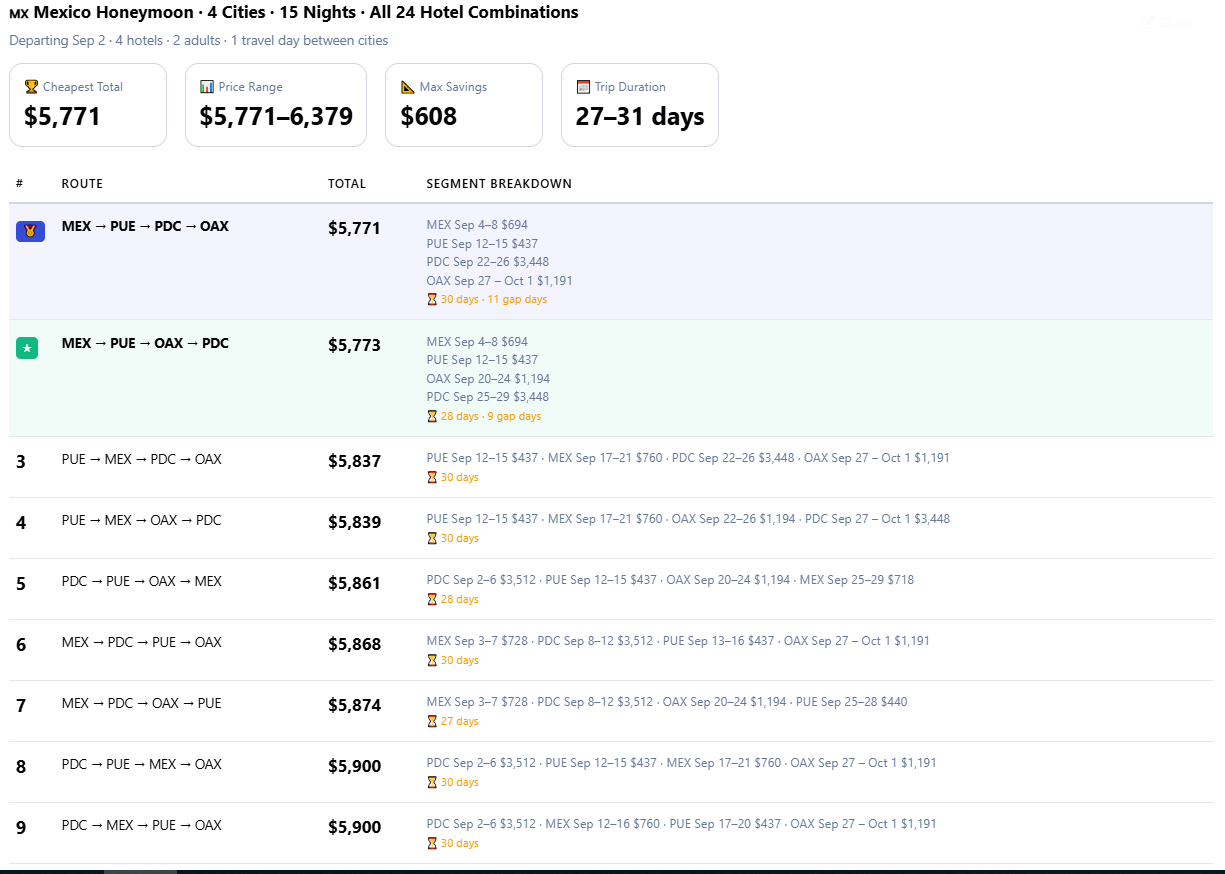
Twenty-four possible city orders came out $58 apart. Reallocating nights between two resorts moved $320. Choosing two rooms over one suite moved $2,974. The variable worth changing isn't the same on every trip — here's how to find yours before you start re-searching everything.
Case studies below are based on anonymized traveler-planning conversations, with some figures rounded for privacy. Two of the four cases below share a mechanism with posts we've published elsewhere on multi-hotel sequencing and room-strategy — where that's true, we've linked out rather than repeat the full case twice.
Cancún, Jamaica, and the Dominican Republic: Same Three Hotels, $5,000 Apart
Two travelers planning an 11-night trip had already chosen their three resorts and fixed the nights at each: four in Cancún, four in Jamaica, three in the Dominican Republic. Only the order was still open — and with three destinations, that's six possible sequences.
Rank
Sequence
Hotel total
1
Cancún → Dominican Republic → Jamaica
$6,150
2
Cancún → Jamaica → Dominican Republic
$6,431
3
Dominican Republic → Cancún → Jamaica
$6,960
4
Dominican Republic → Jamaica → Cancún
$7,116
5
Jamaica → Dominican Republic → Cancún
$11,126
6
Jamaica → Cancún → Dominican Republic
$11,179
No hotel was swapped. No destination was cut. No nights were sacrificed — the trip was simply reordered, and the total moved by more than $5,000.
Why the swing was so large: one resort's four-night rate moved gradually depending on where it landed in the trip — about $1,928 early, $2,386–2,446 mid-trip, $2,631 late. That alone accounts for a few hundred dollars of the spread. The rest came from a second resort, whose earliest date window no longer had a clean four-night stay available at all — the system had to piece together a split stay across mismatched inventory, including one unusually expensive night, pushing that window's price far above every other one it offered. Any sequence that opened with that resort inherited the whole penalty.
(This is a different mechanism from our Cancún split-stay order post, where two resorts in the same destination swapped places — here, it's three separate countries with a single date-availability gap doing most of the damage.)
The Real Variable Isn't "Which Hotel" — It's "Which Hotel, on Which Dates"
Travelers tend to think of a hotel as having one price: "Hotel A costs $200 a night." It's more accurate to think of it as "Hotel A, on this specific date, costs $200" — because on another date, the same room could be $170, $280, sold out, suite-only, non-refundable-only, or unavailable as a single continuous stay at all.
For a multi-city trip, that means the question was never really "which hotel." It's "which hotel, plus which dates" — and the second half only gets decided once you fix the order.
With three flexible cities, that's 3! = 6 possible orders. Four cities gives you 24. Five gives you 120 — and that's before adding flexibility around nights per city, room type, split stays, or meal plans, all of which multiply the combinations further.
Manually pricing even six orderings across multiple hotels means dozens of individual searches. FortripAI's Optimization Agent runs all of them at once and surfaces the total for each sequence — which is how a $5,000 gap like the one above gets caught before booking, instead of after.
East Asia: Moving the Dates Made a Previously Fine Hotel Stop Working
A different traveler had a strong hotel picked out for the first stop of a longer East Asia itinerary. When the trip's opening dates shifted during planning, the same hotel was re-searched for the new dates — and what had been a clean, continuous reservation was now only available as a split stay across mismatched room categories. A second hotel under consideration for the same city had the identical problem.
Nothing about the traveler's preferences had changed. The calendar had — and that alone was enough to flip which hotel made sense. This is the part a flat "check the price" search misses: shifting a stay by even a night or two doesn't just move the rate, it can change which room categories are available at all, or whether a continuous stay is even bookable.
When a Group's Best Room Strategy Changes From City to City
A group of five adults on a multi-stop trip found that no single room strategy worked at every stop — a family suite was the easy win in one city, the same category was scarce and overpriced in a smaller destination, and a compact multi-bed room made sense for a single night but wouldn't have for a longer stay. We've covered this exact mechanism — the same group needing a different room configuration at every stop — in detail with real numbers in our suite-vs-two-rooms guide, including a Canadian road trip where the winning format flipped three times across three stops. The short version: don't assume the room strategy that worked in your first city is still the right one in your third.
Singapore, Seoul, and Tokyo: A $3,400 Gap Between Two Hotel Strategies
A group comparing an upscale hotel pick in each of three cities against a more budget-focused combination across the same destinations found the two totals $3,400 apart — roughly $11,190 for the upscale set versus $7,800 for the budget-leaning one. City by city, each individual upgrade looked reasonable: a better room category here, breakfast there, a more central location, a loyalty perk. Stacked across three cities and multiple rooms, those small premiums compounded into a four-figure difference. This is the case for tracking a running trip-level hotel total while deciding, rather than judging each city's choice in isolation.
What Actually Needs Optimizing Across a Multi-City Trip
City order — when transportation cost is similar across sequences, or you're on an open-jaw flight or road-trip loop, test more than one order before assuming the "obvious" geographic route is also the cheapest one.
Exact check-in dates — shifting a stay by even one or two nights can change the nightly rate, the available room category, minimum-stay rules, and refundability.
Nights per city — the same destination list, allocated differently (4+3+2 instead of 3+4+2), can land a hotel spike on a different night entirely.
Room combination — one suite, two rooms, or a family room can each win in different cities, even for the same group.
Split stays — sometimes two hotels in one city beat a single longer stay, but the saving needs to outweigh the packing, check-in, and lost-time cost of switching.
Meal plans — a $180 room-only rate isn't automatically cheaper than a $205 breakfast-included one once you price meals out for everyone in the room.
Cancellation terms — a non-refundable rate $40 cheaper isn't a clean win if the route, flights, or group size still has a real chance of changing.
A Worked Example: Why the Cheapest Hotel in Every City Can Still Lose
Three cities, hypothetical numbers to show the mechanism: Rome → Florence → Venice, cheapest hotel found in each city independently — $600, $500, $900 — totals $2,000. Reverse the last two stops to Rome → Venice → Florence, and because the dates each hotel gets assigned change, the same three properties price out at $600, $620, $540 — $1,760. No cheaper hotel was found anywhere. The same hotels, on different dates, saved $240.
Running this kind of comparison by hand across three or more cities, several room types, and multiple date windows is exactly the kind of math that gets abandoned halfway through. FortripAI's Optimization Agent prices every valid order, date assignment, and room combination together and returns the total for each — including flagging, the way the Cancún/Jamaica/DR case did, when one specific date window is quietly driving most of the cost.
When Trip-Level Optimization Is Worth Running
It matters most with three or more destinations, a flexible city order, resort or luxury-tier hotels (where nightly swings run into the hundreds), multiple rooms or a group, weekend-heavy travel, longer trips where small savings compound, or — the case most people miss — hotels and nights already fixed, with only the order still open.
It's reasonably safe to skip when the route is completely locked by fixed flights or event dates, you're visiting only one or two cities, nearby dates price about the same, or the potential saving is too small to justify the extra planning.
Frequently Asked Questions
Can changing the order of cities actually make hotels cheaper, even with the same hotels and nights?
Yes — in one real case, the same three hotels and the same total nights, just reordered across six possible sequences, ranged from $6,150 to $11,179, a swing of over $5,000 with nothing else about the trip changed.
What is multi-city hotel optimization?
Comparing accommodation cost across an entire itinerary — city order, exact dates, nights per city, room type, and stay structure — instead of picking the cheapest hotel in each destination independently and adding the totals together.
How many possible city orders does a multi-city trip have?
Three flexible cities give you 6 possible orders, four give you 24, five give you 120 — and that's before adding flexibility on nights-per-city, room type, or split stays, which multiply the combinations further.
Does hotel price really depend on the exact date, not just the season?
Yes, and it can go beyond price — the same hotel can offer a standard room on one date window and only a split stay across mismatched room types a few nights later, even within the same season.
Should I decide my multi-city route before or after pricing hotels?
If your route has any real flexibility, price hotels for more than one candidate order before committing — locking the city order first can accidentally place an expensive hotel on its worst available dates.
Is the cheapest hotel sequence always the best route overall?
Not necessarily — weigh the hotel savings against transportation cost, total travel time, and any fixed reservations or events before choosing a final order.
Can the same hotel get more expensive just because I changed my itinerary, without changing the hotel itself?
Yes — if the itinerary change shifts that hotel's check-in and checkout dates, both its available room inventory and its price can change, even though nothing about the property itself did.
Optimize the Whole Trip Before You Book the First Hotel
A cheap hotel in one city can push another destination onto an expensive date. A slightly pricier hotel can unlock a cheaper sequence. And sometimes the exact same hotels, same nights, same trip — cost thousands less simply visited in a different order.
Give FortripAI your full multi-city trip and let the Optimization Agent compare every city order, date assignment, and room combination — and show you the total, not just each city's cheapest hotel.