Which Travel Variable Should You Change First: Dates, City Order, or Number of Nights?
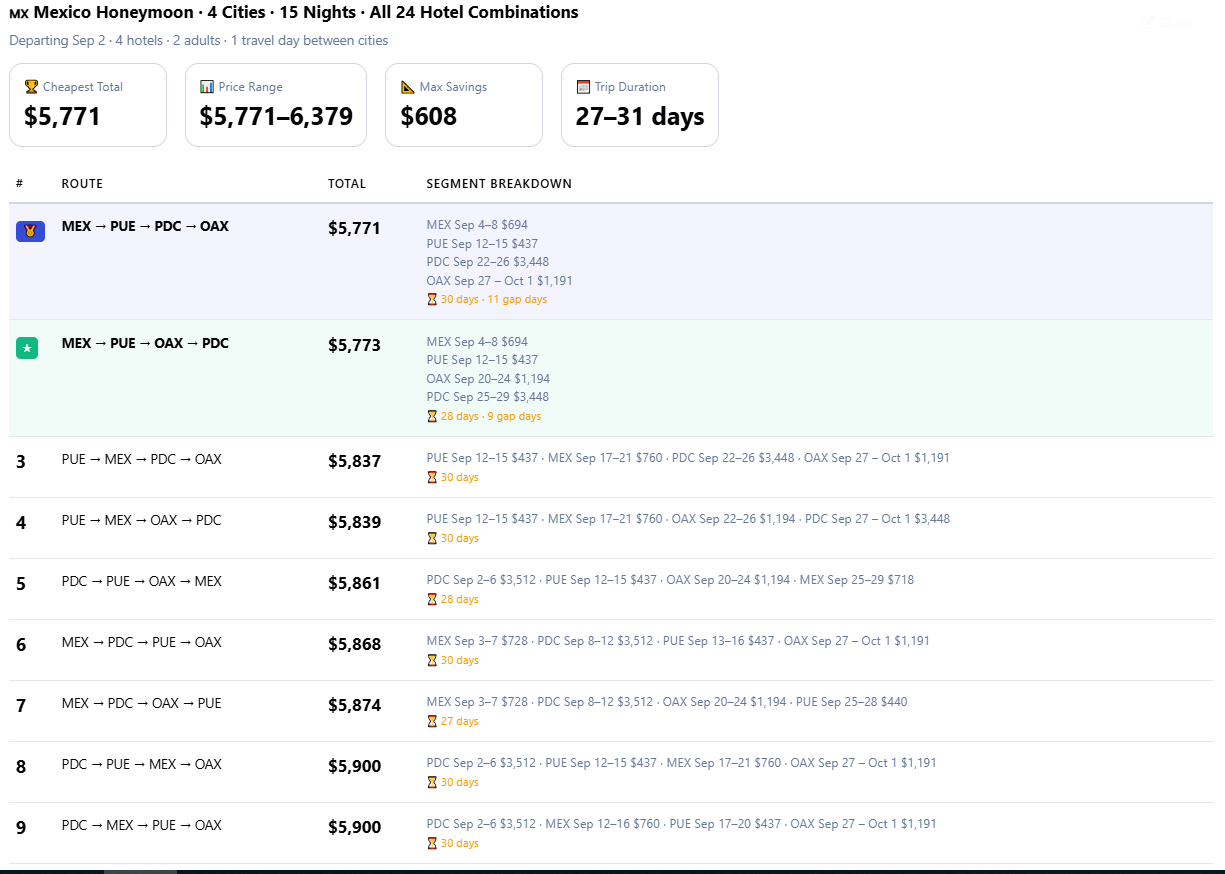
Twenty-four possible city orders came out $58 apart. Reallocating nights between two resorts moved $320. Choosing two rooms over one suite moved $2,974. The variable worth changing isn't the same on every trip — here's how to find yours before you start re-searching everything.
Quick answer: change your dates first. Across real multi-city and multi-hotel trips, moving the calendar produces the biggest swings, reallocating nights between properties comes second, and changing city order usually comes last — often worth less than $100 on a trip where the other two levers moved thousands. But the ranking flips whenever one property dominates your budget and prices unevenly across the calendar. Find that property first, then pull the lever it responds to.
You have a trip, a rough budget, and a nagging sense that it could be cheaper. So you start adjusting. Push the dates a week. Flip the city order. Trim a night here, add one there. Each change means re-searching everything, and after an hour you have twelve browser tabs and no idea whether you're better off than when you started.
The problem isn't that you're adjusting the wrong thing. It's that the three variables have wildly different payoffs, and which one pays off depends on your specific hotels — not on any general rule.
Share
Start a trip Fortrip can actually defend.
Sketch a brief. We come back with an itinerary that reads like a recommendation, not a checklist — and tell you what we’d change about it.
Same trip, same cities — but move the departure date and one October flight window swings $142, while a single hotel's date slot swings $333. Worse, four of six possible city orders weren't even bookable. Here's why flights and hotels have to be priced together, and what happens when they aren't.
Six ways to order the same three honeymoon resorts, same seven nights — and a $650 spread between the cheapest and priciest. Almost all of it traced back to one resort's own calendar, not an even split across all three.
Below are four real trips planned with FortripAI's Optimization Agent, each one isolating a different variable. Traveler details are anonymized. All prices are live quotes pulled at the time of planning.
The three levers, and why they aren't equal
Dates decide the rate
Hotel and flight prices are functions of specific calendar days. Local events, school holidays, day-of-week patterns, and minimum-stay rules all fire on dates, not on how far into your trip a city falls.
City order decides the dates by proxy
You can't change the order of a multi-city trip without changing which dates every hotel gets assigned. Order isn't really a separate variable. It's a slower, clumsier way of moving dates around, constrained by geography.
Nights decide the rate structure you fall into
Length of stay isn't just quantity. Many properties price non-linearly — the per-night rate falls as you add nights, or a minimum-stay rule locks you out entirely below a threshold. Two properties in the same city can have opposite structures.
Start here: find the property that dominates your budget
Before you touch anything, sort your accommodation by total cost and look at the top line.
On a four-city Mexico honeymoon (15 nights across Mexico City, Puebla, Oaxaca, and Cancún), the Cancún all-inclusive came to roughly $2,800 of a $4,666 hotel total. That single stay was 60% of the accommodation budget. Optimizing the other three cities perfectly could not move the needle as much as a small change to that one property.
The rule: your optimization effort belongs where your money is. If one stay is 60% of the budget and prices flat across your window, no amount of reshuffling the other cities will save you meaningful money. If it swings hard by date, that's your entire optimization.
Find your dominant property first. Give FortripAI your hotels and total nights, and the Optimization Agent will price each one across your whole window so you can see which stay is actually driving the total. Start with your trip →
Lever 1: Dates — the biggest swing, and the most uneven
A traveler wanted five nights in Cancún at one of two five-star resorts, with price as the only priority. We scanned both properties across the full summer window.
The two properties behaved completely differently.
Property
Rate behavior across June–August
5-night low
Live Aqua Beach Resort
Essentially flat, ~$368/night all season
$1,840
Grand Fiesta Americana Coral Beach
Stable, then jumps to ~$596/night after Aug 3
$1,682 (Jul 20–25)
Grand Fiesta Americana was the cheaper of the two — and also the one that nearly doubles if you pick the wrong week. Live Aqua never rewarded date flexibility at all, because there was nothing to find.
This is the part travelers get wrong. "Be flexible with your dates" is repeated so often that it sounds like a universal law. It isn't. Date flexibility pays off only at properties that price unevenly. At a flat-rate property, a week of date research earns you nothing, and the time would be better spent on a different variable.
A second scan for the same traveler, comparing three Cancún resorts across July, made the same point from the other direction: two properties had a genuine monthly low worth hunting for, while the third quoted an identical rate every single week of the month.
Lever 2: City order — usually the weakest lever, with two exceptions
A honeymoon couple planned 15 nights across Mexico with all four hotels already chosen: 4 nights in Mexico City, 3 in Puebla, 4 in Oaxaca, 4 in Cancún, starting September 2. They asked for all 24 possible city orders priced.
The winning order was Oaxaca → Cancún → Mexico City → Puebla. The conventional order, starting in Mexico City, ranked 11th.
The gap between them was $58.
Here's why the number is so small, and what it teaches:
Property
Behavior
Order leverage
Cancún all-inclusive (~$2,800)
Date-insensitive
None — 60% of the budget, immovable
Oaxaca boutique (~$700)
Date-insensitive
None
Puebla boutique ($452)
Flat Sep 9–14, no availability Sep 2–8
Blocks orders rather than pricing them
Mexico City ($714–$855)
Swings $141 by check-in date
The only real lever
Twenty-four orderings, and the entire spread came down to one hotel with a $141 date sensitivity. The order that won did so purely because it pushed Mexico City's check-in to September 10.
Exception one: when a big property is date-sensitive. Reorder a trip where the expensive stay swings by date and the savings are real. We've documented a $650 swing across six orderings of three Cancún resorts, where almost all of it traced to one property's calendar.
Exception two: when order determines what's bookable at all. Puebla having no inventory September 2–8 didn't make Puebla-first orders expensive. It made them impossible. Order stops being a price question and becomes a feasibility question, which is a very different kind of problem — one we've seen wipe out four of six possible orderings on a Japan trip.
Lever 3: Number of nights — the lever most travelers never touch
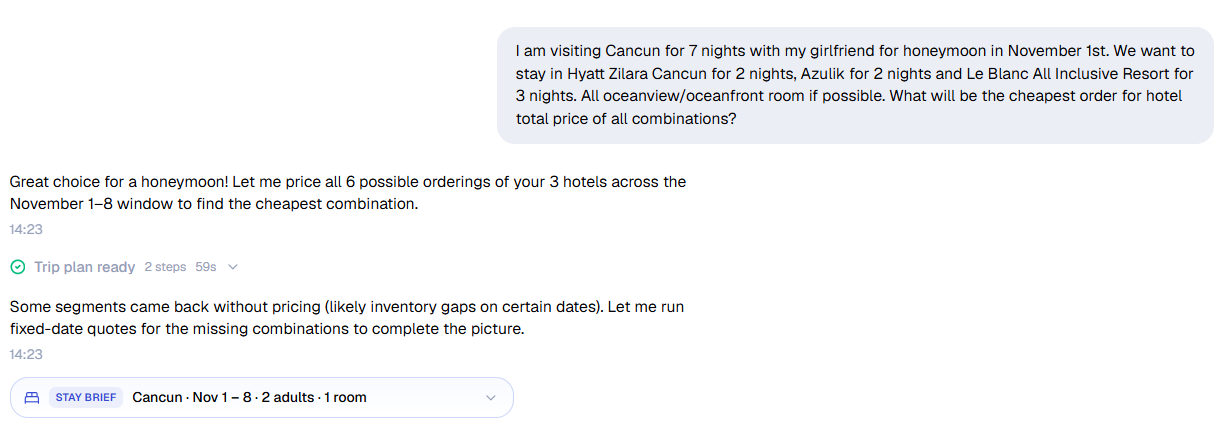
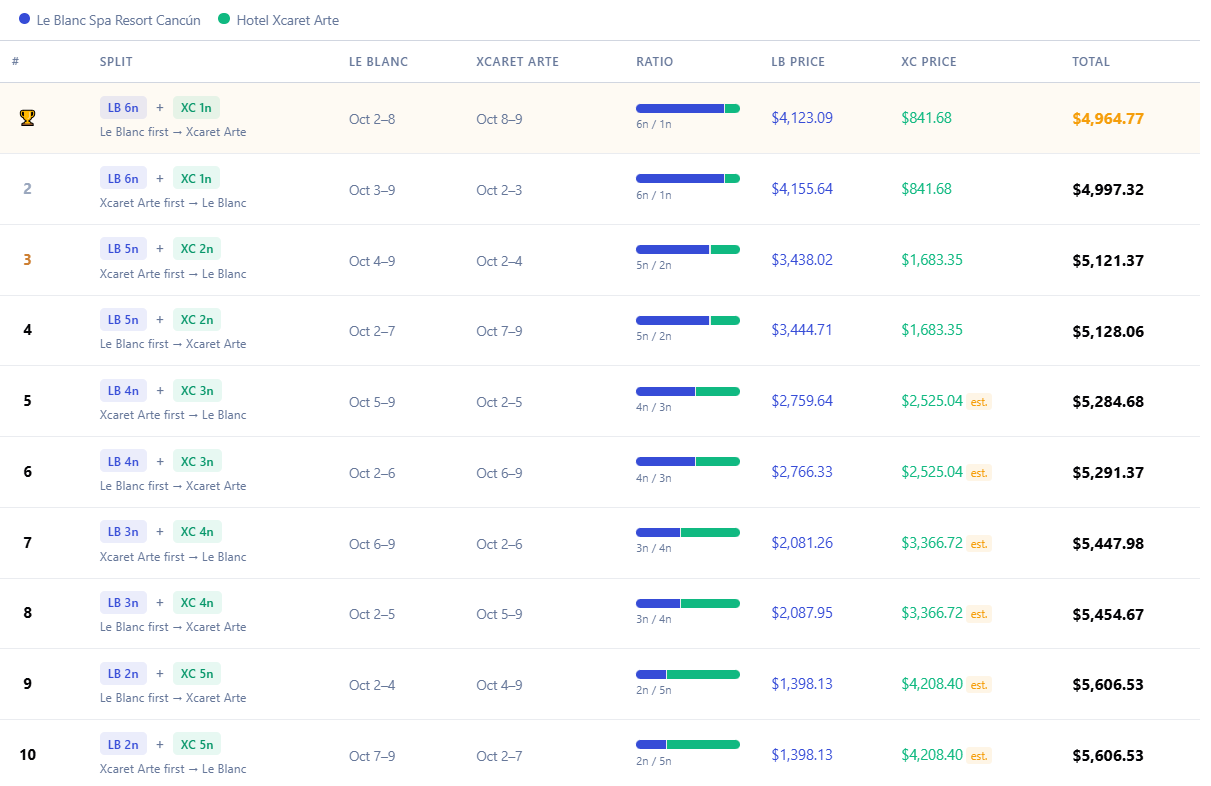
A honeymoon couple had 7 nights in Cancún and two resorts they wanted to split between. They asked for all 12 possible splits priced, both orderings included.
The results separated the two variables cleanly:
Changing the split moved the total by roughly $320 between the cheapest and a popular alternative.
Changing the order within the same split moved it by $32.
Ten times the leverage, from the variable most people treat as fixed.
The reason was structural, not seasonal:
Property
Rate structure
Le Blanc Spa Resort
Per-night rate declines as nights are added (~$691 for one night, averaging ~$687 across six)
Hotel Xcaret Arte
Perfectly flat at $841.68/night, exactly linear at every length
One property rewards concentration. The other doesn't care. So the cheapest arrangement was to load nights onto Le Blanc and take the minimum at Xcaret Arte — 6+1 came to $4,964.77, the lowest of all 12 combinations.
The same pattern showed up on a separate Cancún comparison. Going from 5 nights to 7 cost $737 more at one resort, $1,023 at a second, and $1,157 at a third. The marginal night is a different price at every property, which means "how many nights, and where" is a pricing decision, not just an itinerary decision.
One caveat worth naming. The cheapest split gave one night at a resort whose entire selling point is a multi-day park package. Spending ~$320 more to actually use what you're paying for is a reasonable trade. Optimization gives you the number; it doesn't tell you the number is the point.
Four friends wanted two nights at a Cancún resort and asked a simple question — two standard rooms, or one two-bedroom suite?
Option
Total
2 Superior Deluxe rooms, all-inclusive
$3,008
1 Superior Two-Bedroom Suite, breakfast only
$5,982
The gap was $2,974, and it was actually wider than that: the suite rate didn't include the all-inclusive meal plan, adding several hundred dollars in food and drink across four people over two nights. Upgrading both standard rooms to ocean view still landed at $3,186, nearly $2,800 below the suite, with the meal plan intact.
No date, order, or night-count change on this trip could have found $2,974. The biggest lever wasn't on the list of things the travelers thought to adjust.
A traveler asked for two specific suites at a Costa Rican volcano resort for four nights in July.
Two things came back that no amount of optimization could fix. The requested room category returned no quotes at all for that window — either sold out in high season or not mapped in the booking channel. And one night in the middle of the four had no availability whatsoever, leaving a gap that priced as three nights, not four.
This is why availability has to be checked before you optimize, not after. A ranking of twelve options is worthless if the winner can't be booked, and a plan with a hole in the middle of it isn't a cheaper plan — it's a broken one.
A decision order that actually works
Run these in sequence. Stop when the remaining levers can't move enough to matter.
Step 1: Rank your stays by total cost
Identify the property that owns the largest share of your budget. Everything else is secondary until you know how that one behaves.
Step 2: Test that property's date sensitivity first
Price it across your entire window, not your planned dates. If it's flat, dates are a dead lever for this trip and you can stop researching them. If it swings, this is where your savings are.
Step 3: Check its rate structure across lengths of stay
Does the per-night rate fall as you add nights? Is there a minimum-stay rule? This determines whether reallocating nights is worth testing.
Step 4: Check room configuration before city order
For groups of three or more, comparing room counts and meal plans almost always outranks reordering cities. It's a bigger number and takes less work.
Step 5: Only then, test city order
And test it for feasibility as much as price. The question worth answering isn't "which order is cheapest" but "which orders are actually bookable."
How FortripAI's Optimization Agent runs this
The Optimization Agent exists because doing the above by hand means dozens of searches, and the answer changes every time inventory moves.
Give it the constraints, not the plan
Tell it what's fixed — properties, total nights, travelers, any date you can't move — and leave the rest open. Every variable you specify is one it can't optimize.
Ask for the full option set, not the recommendation
The travelers above asked for all 24 orderings and all 12 splits. That's the right instinct. Seeing the whole distribution tells you which variable is doing the work, which a single recommendation hides.
Read the availability column alongside the price column
Cheapest and bookable are two different rankings, and only one of them can be reserved.
Validate before you book
Price and order are one layer. Whether the plan physically works — transfers, check-in windows, connection times — is another. The Validator checks the second one.
Run all three levers at once. Give FortripAI your hotels and a flexible window, and get every date, split, and order priced against live inventory in one pass. Optimize my trip →
FAQ
Which travel variable saves the most money?
Dates, on average — but only at properties that price unevenly across the calendar. In the cases above, one Cancún resort nearly doubled its nightly rate after a specific date while its neighbor stayed flat all summer. Check your most expensive property's date sensitivity before assuming flexibility will pay.
Does changing city order actually save money?
Sometimes, and less than people expect. A 24-ordering Mexico honeymoon produced a $58 spread because the dominant cost was date-insensitive. A six-ordering Cancún trip produced $650 because it wasn't. Order matters in proportion to how date-sensitive your expensive hotels are.
Should I change my dates or my number of nights first?
Dates, then nights. But if your properties are date-flat, skip straight to nights — one seven-night Cancún split showed $320 of leverage in the night allocation versus $32 in the ordering.
Why do hotels charge different rates for the same room on different nights?
Local events, day-of-week demand, minimum-stay rules, and inventory tiers. The cheapest room categories usually sell out before a property looks expensive, so the same booking page can quietly show you a more expensive room rather than a higher price for the same one.
Is it cheaper to book one suite or two rooms?
It depends on the meal plan more than the square footage. In the case above, two all-inclusive standard rooms beat one breakfast-only two-bedroom suite by $2,974 before food costs were even added. Always compare what's included, not just the headline rate.
Can an AI travel planner compare all these options at once?
FortripAI's Optimization Agent prices every combination against live hotel and flight inventory rather than estimating from training data, which is why availability gaps — like a mid-stay night with no rooms at all — surface before booking instead of after.
Bottom line
There's no universal answer to which variable to change first. There's a reliable method for finding it: identify the stay that owns your budget, test how it responds to the calendar, and let that answer tell you which lever is worth pulling.
Most travelers spend their effort on city order because it's the easiest thing to picture. The money is usually somewhere else.