Splitting 5 Nights Between Two Resorts: The Cheapest Combination Wasn't the Obvious One (A Real $327 Case)
Split the same 5 nights between two resorts four different ways, and the totals came out $327 apart. The "obvious" math — more nights at the cheaper-per-night hotel — pointed the wrong direction, because one resort's cheapest room switches to a whole different tier depending on how many nights you book.
Meta description: Splitting a stay between two fixed resorts sounds like simple math — take each hotel's nightly rate and multiply by the nights you give it. A real Costa Rica case shows why that flat-rate shortcut gets it wrong, with a $327 spread hiding in exactly how many nights go where.
Quick answer: when splitting a fixed number of nights between two hotels, the cheapest split is rarely a simple ratio based on each property's average nightly rate. A hotel's cheapest available room type can change depending on the exact length of stay and the specific check-in date — not just scale proportionally — which means a split that looks obviously cheaper on paper can turn out to be the most expensive option once every combination is priced at its real dates.
Plan a trip with Fortrip
Use Fortrip to draft and validate itineraries with travel-specific reasoning — not generic chat answers.
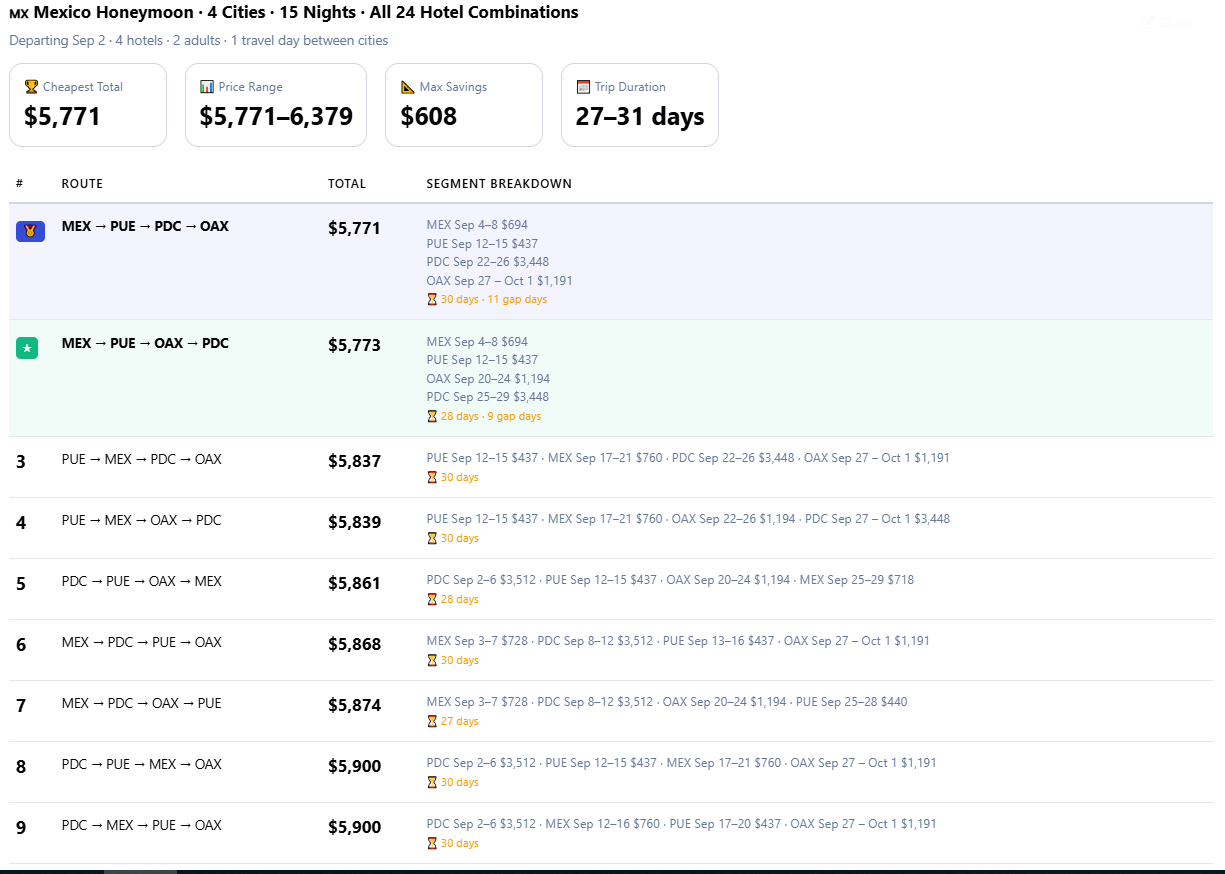
Twenty-four possible city orders came out $58 apart. Reallocating nights between two resorts moved $320. Choosing two rooms over one suite moved $2,974. The variable worth changing isn't the same on every trip — here's how to find yours before you start re-searching everything.
Same trip, same cities — but move the departure date and one October flight window swings $142, while a single hotel's date slot swings $333. Worse, four of six possible city orders weren't even bookable. Here's why flights and hotels have to be priced together, and what happens when they aren't.
The Setup: 5 Nights, 2 Fixed Resorts, 4 Possible Splits
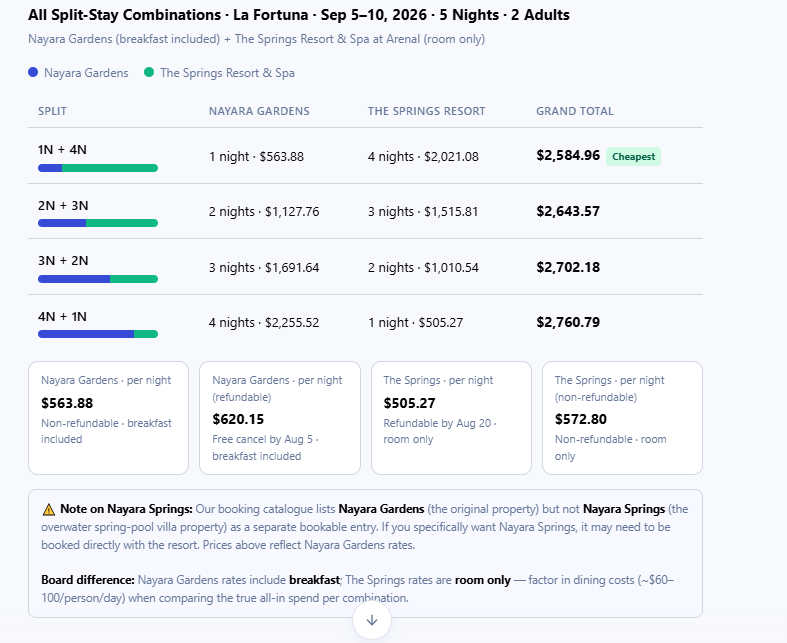
A five-night stay in La Fortuna, Costa Rica, split between two resorts — call them Resort A (room-only rate, averaging around $505/night) and Resort B (breakfast included, averaging around $564/night). The destination and total nights were fixed; the only open question was how to divide the five nights between the two properties.
With five nights split two ways, there are four valid combinations: 1+4, 2+3, 3+2, and 4+1 nights.
Why "Just Multiply the Nightly Rate" Doesn't Work
The instinctive shortcut is to take each hotel's average nightly rate and multiply it by however many nights you're giving it — more nights at the cheaper-per-night hotel should mean a lower total, in theory.
In practice, pricing every split at its exact check-in dates and exact length of stay turned up something a flat-rate estimate can't see: each hotel's own cheapest room changes depending on how long you're booking it for, and on which specific nights.
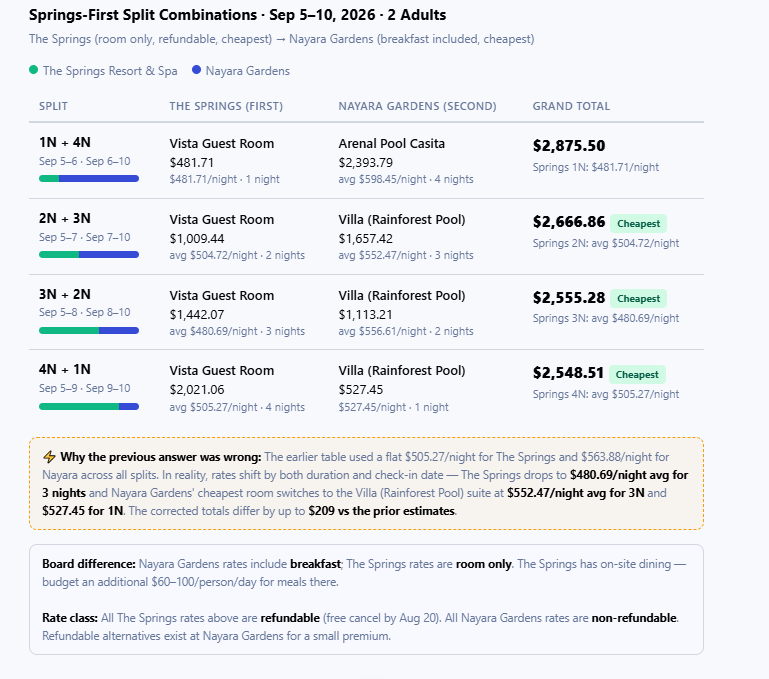
For Resort A, the effect was small — its nightly average shifted only slightly between a 1-night stay ($481.71/night) and a 3-night stay ($480.69/night). Barely worth mentioning on its own.
Resort B was the real mover. For shorter stays, the cheapest room that came back wasn't the property's usual default category — it switched to a different suite type entirely, priced around $527–552/night instead of the pricier room that showed up for longer bookings. That's not a small discount on the same room; it's a different room tier becoming available (or becoming the cheapest option) specifically because of how many nights were being booked.
This is the part a flat-rate estimate can never catch: it assumes one hotel has one nightly rate, when in reality that rate — and sometimes the entire room category attached to it — depends on the exact stay length and dates you're asking about.
The Actual Cheapest Split
Once every combination was quoted at its real dates instead of estimated from average rates, here's what came back:
Split
Grand total
4 nights Resort A + 1 night Resort B
$2,548.51 — cheapest
3 nights Resort A + 2 nights Resort B
$2,555.28 — effectively tied, $7 more
2 nights Resort A + 3 nights Resort B
$2,666.86
1 night Resort A + 4 nights Resort B
$2,875.50 — most expensive
The spread between the cheapest and most expensive split is $327 — for the same two resorts, the same five nights, just divided differently. And the top two options are close enough ($7 apart) that the "cheapest" answer is really a tie between two splits, not a single clear winner.
A Comparison Worth Adjusting Before You Book
One more wrinkle worth flagging: these totals aren't quite comparing like for like. Resort A's rate is room-only; Resort B's includes breakfast. If you're planning to eat at Resort A's restaurants, budgeting roughly $60–80 per person per day narrows the real gap between splits considerably — a combination that looks like the clear cheapest on room rate alone can lose some of its edge once meals are added back in for the nights at the room-only property. Price the split you're actually leaning toward with meals included before locking it in, not just the room total.
How to Check This for Your Own Split Stay
Doing this by hand means quoting both hotels at every valid split's exact check-in dates — not once, but once per combination, since the nightly rate (and sometimes the whole room category) can shift with each one. For a five-night stay split two ways, that's eight separate quotes just to compare four combinations properly.
This is exactly what FortripAI's Optimization Agent runs automatically. Give it your two (or more) fixed properties, your total nights, and your dates, and it prices every valid split at its actual check-in dates — catching a room-category shift the way this one appeared, instead of you working from an average nightly rate that quietly gets the ranking wrong.
FAQ: Splitting a Stay Between Two Hotels
Is splitting nights between two hotels usually cheaper than one longer stay at either property?
It depends entirely on how the nights are divided. In one real case, four possible splits of the same five nights between the same two resorts came back $327 apart — the split itself was a bigger factor than which two hotels were chosen.
Can I estimate the cheapest split using each hotel's average nightly rate?
Not reliably. A hotel's cheapest available room type can change based on the exact length of stay and check-in date, not just scale proportionally with nights booked — an average-rate estimate can point to the wrong split entirely.
Why would a hotel's nightly rate change based on how many nights I book?
Hotels often make different room categories available (or unavailable) depending on length of stay and specific dates. A shorter stay can unlock a cheaper room tier, or lose access to one — it isn't always a simple discount for booking longer.
How do I fairly compare two hotels with different meal inclusions?
Add an estimated per-person daily meal cost to the room-only property before comparing totals. A split that looks cheapest on room rate alone can lose part of its advantage once meals are priced in for the nights at the property without breakfast included.
How many splits do I need to check for a multi-night stay between two hotels?
For an N-night stay split between two properties, there are N−1 valid splits to check (five nights split two ways gives four combinations). Each one needs pricing at its own exact dates, since a nightly average from one split doesn't reliably predict another's total.
Splitting a stay between two resorts and not sure which combination actually wins? Try FortripAI's Optimization Agent — enter your properties, total nights, and dates, and let it price every valid split at its real rates instead of an average.