Shifting Your Departure Date by Two Days Saved $400 on This Costa Rica Trip — Here's Why
Same 10-day Costa Rica trip, same three hotels — just moved the start date by two days — and the total dropped by $401. Almost none of it came from the flight. It came from a beach resort that switches room categories depending on which exact nights you book.
Meta description: A real 10-day Costa Rica itinerary priced across five different departure dates came back with a $400 spread — not from a cheaper flight alone, but from hotel room categories that flip on specific dates. Here's what actually moved the price, and how to check it for your own trip.
Quick answer: yes, shifting a multi-city trip's dates by a day or two can change the total price by hundreds of dollars — and not only because flights get cheaper on certain days. Hotel rates can shift room categories entirely on specific date windows (the same resort can price out at a budget room on one date and a premium suite on another), so the flight savings are often the smaller half of the total swing.
The Question That Started This
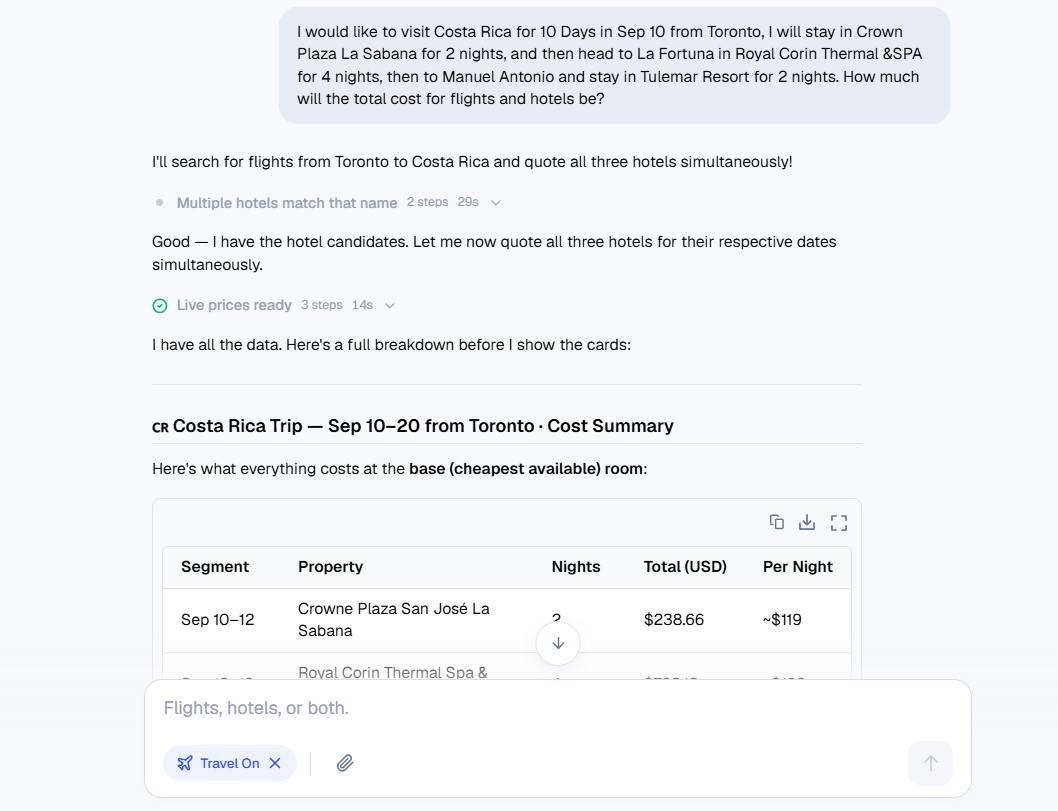
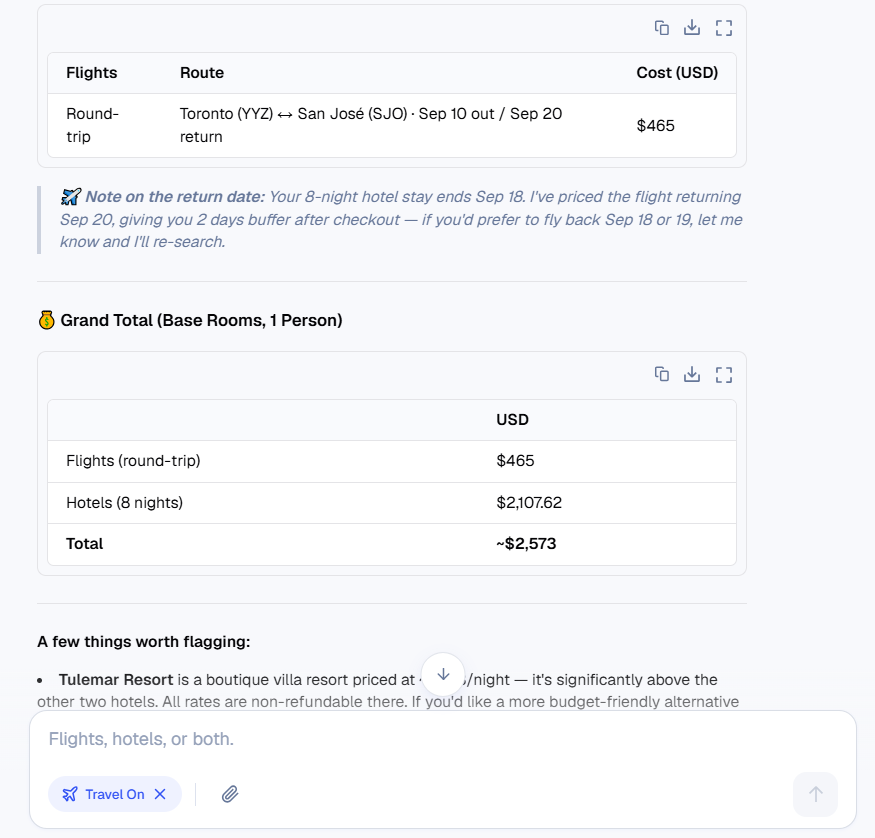
The original plan was simple: 10 days in Costa Rica from Toronto, September 10–20. Two nights in San José, four in La Fortuna near the volcano, two in Manuel Antonio on the coast. Flights and hotels priced out at for one person.
Plan a trip with Fortrip
Use Fortrip to draft and validate itineraries with travel-specific reasoning — not generic chat answers.
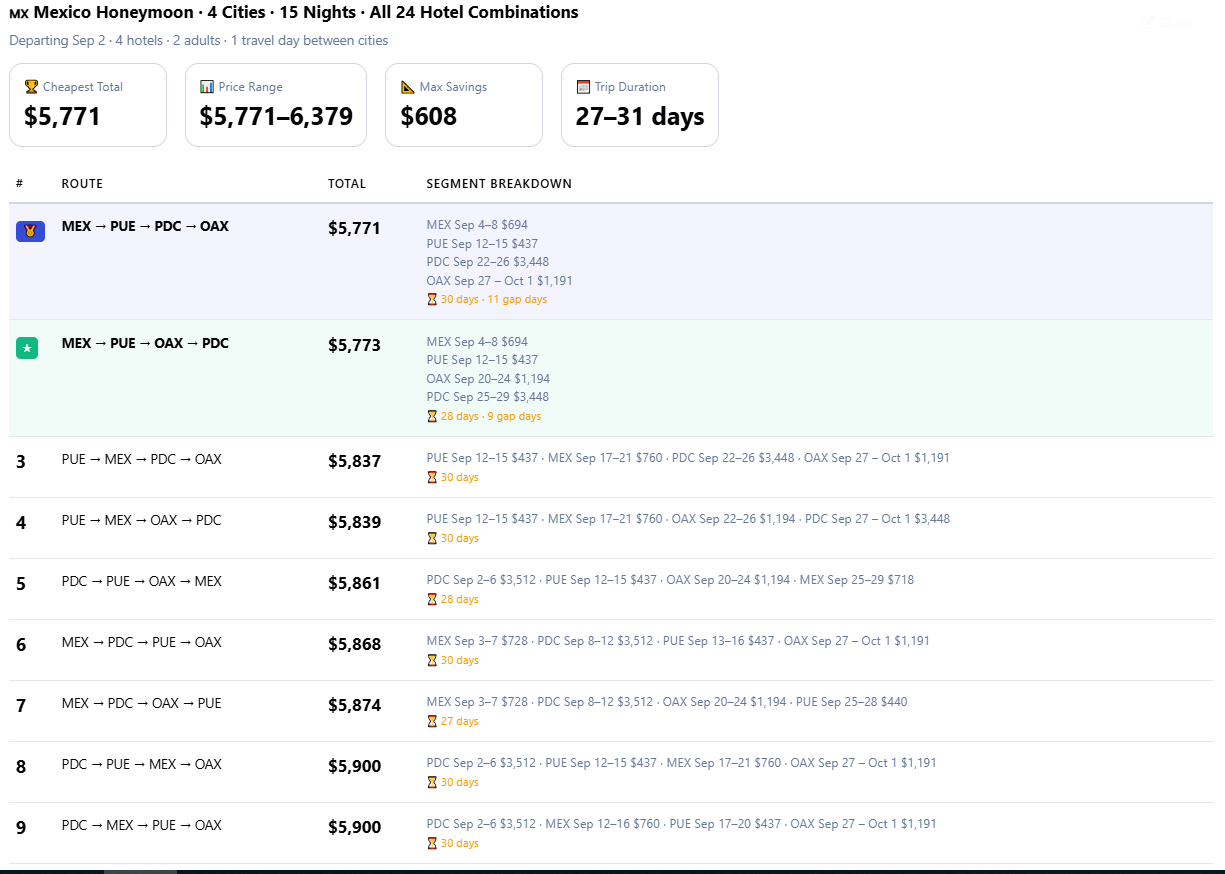
Same trip, same cities — but move the departure date and one October flight window swings $142, while a single hotel's date slot swings $333. Worse, four of six possible city orders weren't even bookable. Here's why flights and hotels have to be priced together, and what happens when they aren't.
Twenty-four possible city orders came out $58 apart. Reallocating nights between two resorts moved $320. Choosing two rooms over one suite moved $2,974. The variable worth changing isn't the same on every trip — here's how to find yours before you start re-searching everything.
$2,573
Then came the obvious follow-up: I'm flexible by a day or two on departure — does the total change?
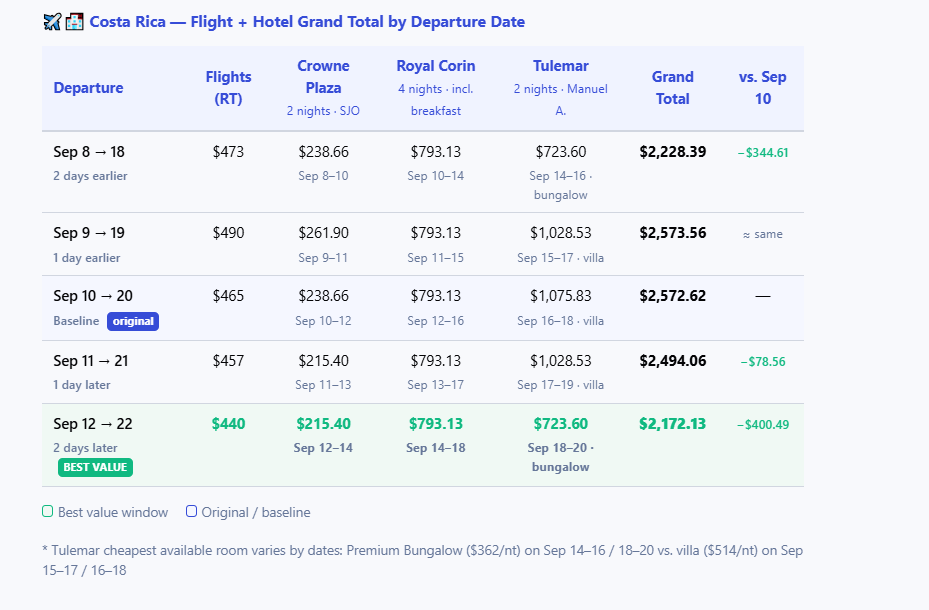
The answer wasn't "a little." Moving the departure date from September 10 to September 12 — same 10-day length, same three hotels, same cities — brought the total down to $2,172. That's a $401 swing for shifting the start of the trip by 48 hours.
Where the $400 Actually Came From
The instinct is to assume the savings came from the flight. Some of it did — but not most of it.
Sep 10 departure (original)
Sep 12 departure
Flight (round-trip, Toronto–San José)
$465
$440
Crowne Plaza San José, 2 nights
$238.66
$215.40
Royal Corin, La Fortuna, 4 nights
$793.13
$793.13
Tulemar Resort, Manuel Antonio, 2 nights
$1,075.83
$723.60
Total
$2,573
$2,172
The flight only accounts for $25 of the $401 saved. The Crowne Plaza accounts for another $23. The other $352 — almost 90% of the total savings — came from one line: the Manuel Antonio resort.
The Hidden Variable: Hotels Don't Price by Trip Length, They Price by Calendar Date
Here's the part that doesn't show up until you actually run the comparison: the same resort, same length of stay priced out completely differently depending on which two calendar nights it landed on.
On the September 10 departure, the Manuel Antonio nights fell on September 16–18, and the cheapest available room was a villa at roughly $538 a night. On the September 12 departure, the same two-night stay shifted to September 18–20 — and at that specific date window, a Premium Bungalow (two queen beds, 60 m²) was available at roughly $362 a night, a 32% lower nightly rate for a different room category entirely, not a discount on the same room.
This is the mechanic that's easy to miss when comparing trip dates by hand: travelers usually check whether the flight is cheaper on a shifted date, then assume the hotel total moves in rough proportion. It doesn't. A hotel's cheapest available room type is tied to that property's own inventory and demand on that exact date — it can flip from a $362 room to a $538 room (or the reverse) for reasons that have nothing to do with the flight price on the same days.
Not Every Nearby Date Helps — Only Some Line Up
Testing five departure windows (September 8 through 12) showed the savings weren't evenly spread:
September 12 — the biggest win: $2,172 total, and the only nonstop flight option in the window (~11 hours instead of a layover routing)
September 8 — close behind, also landing on the cheaper Tulemar bungalow dates, but the flight ran about $33 more and wasn't nonstop
September 9 and September 11 — barely moved from the original $2,573, because both landed the Manuel Antonio stay back on the expensive villa dates, which erased whatever the flight saved
Two of the five nearby dates gave real savings. Two gave almost none. Without actually pricing every window individually, there's no way to tell which is which from the calendar alone — a date "2 days later" can either save $400 or save almost nothing, depending entirely on which two nights it happens to land the pricier hotel stay on.
A Second Thing Flexible Dates Can Expose: The Date on the Ticket Isn't the Date You Arrive
One more detail worth checking whenever a departure date shifts: what time you actually land, not just what day you depart.
The original September 10 flight departed Toronto at 8:30 a.m. — but because of an overnight layover in Panama City, it didn't land in San José until 7:10 a.m. the next day. On paper, the trip "started" September 10. In practice, the first hotel night needed to be booked from September 11, or the traveler would be paying for a room they'd arrive at only a few hours before checkout the following morning. That's an easy detail to miss when a date search is only comparing ticket prices — the routing behind a cheap fare can quietly cost you a hotel night if you don't check the actual arrival time.
How to Check This for Your Own Trip
Doing this by hand means re-searching flights for every candidate date, then re-quoting every hotel for the corresponding shifted nights, then lining up all of it side by side — for however many dates you're flexible on. For a three-hotel itinerary across five dates, that's 15+ separate hotel quotes plus five flight searches, just to find that only two of the five actually save anything.
This is exactly what FortripAI's Optimization Agent is built to run automatically. Give it your destinations, your flexible date range, and your hotel preferences, and it prices every combination — flights and the corresponding hotel nights for each shifted date — then surfaces which specific dates actually produce a lower total, instead of you assuming the flight price is the whole story.
FAQ: Flexible Travel Dates and Total Trip Cost
Does shifting my travel dates by a few days actually save money?
It can — but not evenly. In one real Costa Rica itinerary, shifting the departure by two days saved $401, while shifting it by one day in either direction saved almost nothing. The savings depend on which specific hotel nights the shift lands on, not just which days are cheaper to fly.
Is the flight or the hotel usually the bigger source of savings when dates shift?
In this case, the hotel accounted for nearly 90% of the total savings, not the flight. Hotels can shift entire room categories (not just price) on specific date windows, which tends to move the total more than a flight-fare change does.
Why would the same hotel room cost so much less just two days later?
Hotels price by their own inventory and demand on each specific calendar date, not by how long you're staying. The cheapest available room type on one date can be a budget room, and on a different date, the cheapest available room can be a premium suite — the room category itself changes, not just the rate.
How do I know which flexible dates are actually worth checking?
There isn't a shortcut from the calendar alone — nearby dates can produce very different results depending on which hotel nights they land on. The only reliable way is to price each candidate date fully, flights and hotels together.
Can an overnight flight layover cost me an extra hotel night?
Yes. If your flight includes a long overnight layover, you may not land at your destination until the following morning — meaning your first "day" on paper is really a travel day, and your hotel booking should often start a day later than the ticket's departure date suggests.
Have flexible dates on an upcoming multi-city trip? Try FortripAI's Optimization Agent — plug in your destination, date range, and hotel preferences, and let it find out which shift actually pays off.