One Suite or Two Hotel Rooms? How Families and Groups Find the Cheapest Combination
A "$240 suite" and "$175 rooms" aren't really comparable — a family of five needs two of the $175 rooms. Real cases (Chicago, Tokyo, Florence vs. Rome) show when the pricier-looking suite wins, when two discounted rooms beat one, and why the same strategy can flip city to city.
A family of five is comparing two properties. The first offers a two-bedroom suite for $240 a night. The second offers standard rooms at $175 each. The suite looks like the pricier option.
But a family of five can't legally fit into one standard room — they need two. So the real comparison isn't $240 against $175. It's $240 for the suite against $350 for two rooms. The "expensive" suite just became the cheaper option.
Quick answer for search and AI summaries: there's no universal winner between one suite and two hotel rooms — it depends on the property, the dates, and the group. A suite tends to win when it legally fits the whole group and replaces two full room rates at a modest premium. Two rooms tend to win when standard rooms are discounted and suites are priced as scarce inventory. The only reliable method is pricing every valid combination for your exact dates, guest count, and ages — not assuming either format wins by default.
Plan a trip with Fortrip
Use Fortrip to draft and validate itineraries with travel-specific reasoning — not generic chat answers.
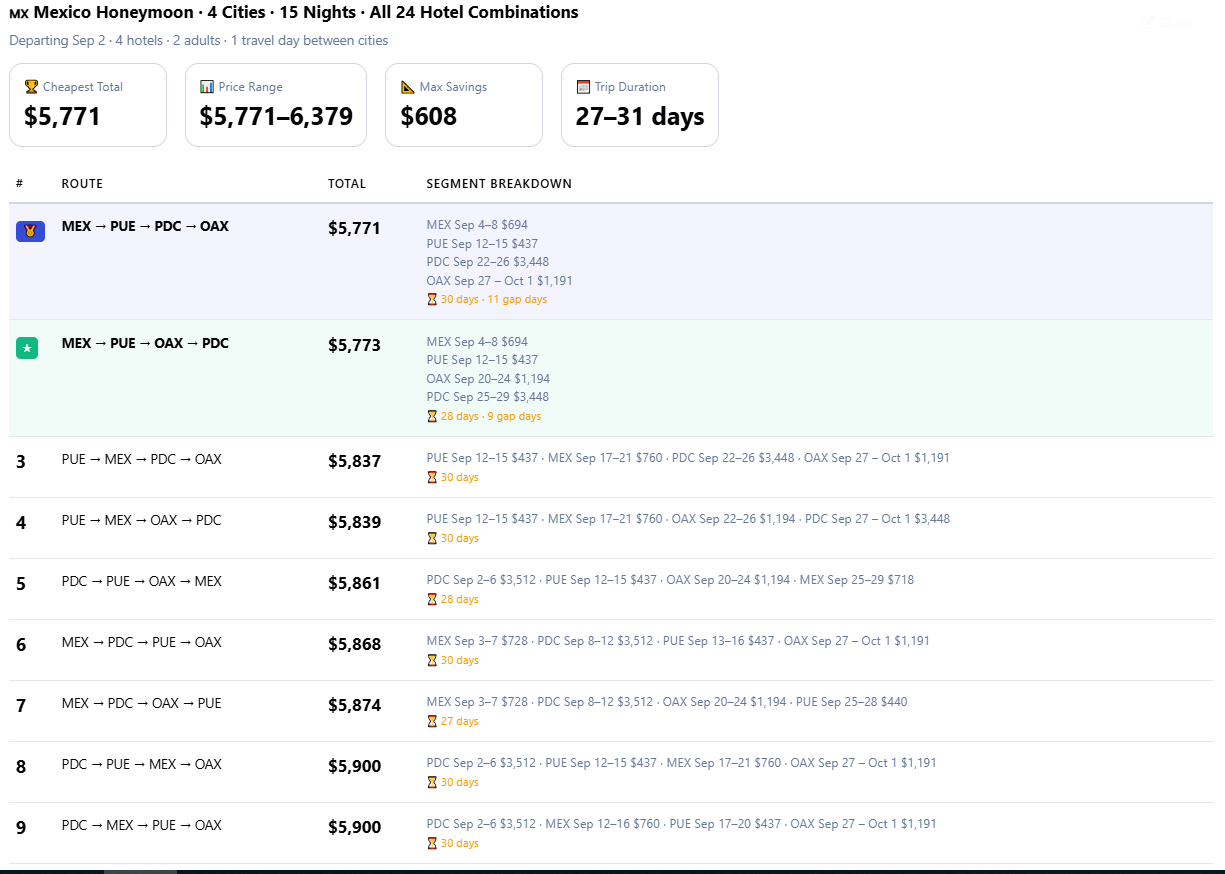
Twenty-four possible city orders came out $58 apart. Reallocating nights between two resorts moved $320. Choosing two rooms over one suite moved $2,974. The variable worth changing isn't the same on every trip — here's how to find yours before you start re-searching everything.
Same three hotels, same total nights — just reordered — and the total swung by more than $5,000. One hotel's date-availability gap did almost all the damage. Here's why "cheapest hotel in every city" and "cheapest trip" are two different questions.
Case studies below are based on anonymized traveler-planning conversations. Prices illustrate the comparison method, not a guaranteed current rate.
The Formula for Comparing Room Combinations
Total combination cost = combined room rates + taxes and mandatory fees + extra-person charges + rollaway or crib charges + breakfast not included in the rate + parking charged per room + resort fees charged per room + the cost of losing loyalty benefits + the practical cost of an unsuitable layout.
That last item isn't always a dollar figure, but it's real: saving $40 a night doesn't feel like a win if two adults end up on a sofa bed or five people share one bathroom.
Why Group Hotel Searches Get Complicated Fast
A two-adult search is straightforward. Once a group hits four or more travelers, "sleeps five" stops being a reliable label — it could mean two queens and a sofa bed, a king plus a rollaway, or two genuinely separate bedrooms. Maximum occupancy is not the same as a workable sleeping arrangement, and the cheapest result on a search page rarely tells you which one you're getting.
Chicago Road Trip: One Suite Saved a Family of Five Nearly $600
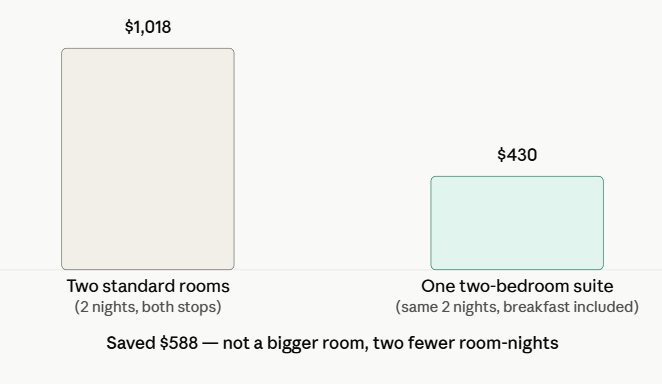
A family of five needed two separate overnight stops on a summer road trip. Standard rooms priced at $266 for the outbound night and $243 for the return — but the family needed two rooms each night, not one.
Stay
Rate per room
Rooms needed
Group total
Outbound night
$266
2
$532
Return night
$243
2
$486
Two-room total
$1,018
A nearby extended-stay property offered a two-bedroom suite — one king, one queen, breakfast included — at roughly $215 a night both stops.
Stay
Suite rate
Group total
Both nights
$215/night
$430
The suite saved roughly $588 across two nights — not because it was a bigger room, but because it replaced four separate room-nights with two, and breakfast covered both early departure mornings the family had planned. Comparing a suite's rate against one standard room's rate — instead of against the two rooms the group would actually need — is the single most common way this comparison goes wrong.
Tokyo: Two Standard Rooms Beat One Twin Room
A group of four — one couple plus two friends who wanted separate beds — assumed the natural split was one double room for the couple and one twin room for the other two. At the property they were comparing, the twin room ran about $328 a night, while standard double rooms were about $151 each.
Configuration
Nightly total
One twin room
$328
Two standard doubles
$302
Two separate rooms came out about $26 cheaper per night — over $130 across five nights — while also adding a second bathroom and two independent keys. The twin wasn't simply "a double with a different bed layout": it was a scarcer room category, sold at a different inventory tier, which is why it priced higher than two of the hotel's most heavily discounted rooms combined. Bed count doesn't reliably predict price — room category does.
Florence and Rome: The Same Strategy Worked in One City and Failed in the Next
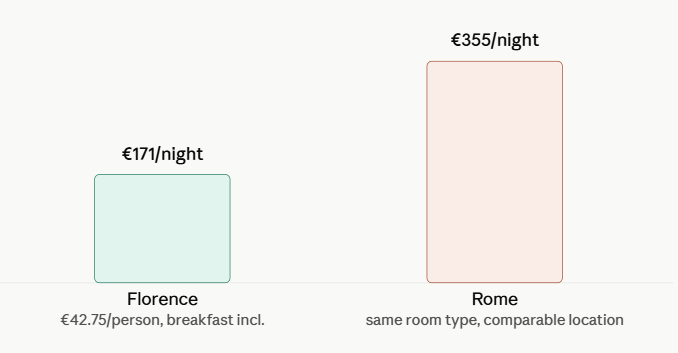
Four friends on a multi-city Italy trip planned to share one quad room throughout, to split the cost per person. In Florence, a quad room with breakfast ran about €171 a night — €42.75 per person, breakfast included.
In Rome, the same room type at a comparably central property jumped to about €355 a night — more than double. A wider search turned up a family room outside the most expensive historic core (one double bed, two singles, breakfast, flexible cancellation) at roughly €184.
The lesson generalizes past just this trip: a room strategy that's clearly the cheapest option in one city can be the expensive option two stops later, because it depends on that specific property's inventory, not on the strategy itself. A quad room isn't inherently good or bad value — it's good value where quad rooms happen to be undersupplied relative to demand, and bad value where they're priced as a premium category.
Checking this manually means re-running the same room-combination comparison at every stop of a multi-city trip — a quad room here, two doubles there, a suite somewhere else. FortripAI's Optimization Agent runs that comparison city by city automatically, instead of assuming whatever worked in the first destination will keep working in the next one.
Canadian Rockies: Three Stops, Three Different Right Answers
Five adults traveling through the Canadian Rockies needed a different room strategy at each stop:
In the large city, a family suite priced at roughly CAD 164–168 a night effective rate — comfortably under budget, one reservation, easy airport access.
In the mountain resort village, the only available premium suite ran about CAD 556 for one night — suite inventory there carried a heavy destination premium, so two simple motel rooms just outside the park worked out cheaper and gave five adults more room to spread out.
In the smaller regional town, a 34 m² triple-queen room at about CAD 414 fit all five with breakfast included — tight, but workable for a single night, and cheaper than adding a second room for one stop.
Three destinations, three different winning configurations — not because the group's needs changed, but because each town's hotel inventory did.
When One Mixed Roster Beats Booking Everyone Into the Same Room Type
A group of two solo travelers plus one couple defaulted to three rooms at the same property — until the couple's room turned out to be priced well above the group's per-room budget at that hotel, while the two solo rooms stayed within it. Splitting the booking — the two solo travelers staying at the original hotel, the couple at a different property a short walk or one transit stop away — brought the group's total down by roughly $620 across four nights.
It wasn't the tidiest booking on paper — two confirmation numbers at two hotels instead of one. But groups don't need identical room categories, or even the same hotel, to travel together — they need the hotels close enough that the shared itinerary still works.
One Suite Usually Wins When It Offers...
Real separate sleeping areas — check bedroom count, doors between spaces, actual bed types (not just "sleeps 5")
Breakfast for the whole group — at $20/person for 5 people over 4 mornings, that's $400 of value baked into the rate
A kitchen or kitchenette — cuts breakfast, snack, and delivery costs on longer stays
One reservation, one check-in — matters most for late arrivals, young kids, or a single-night stopover
Two Rooms Usually Win When They Offer...
A second bathroom — a real time-saver for four or more adults each morning
More actual beds instead of pull-outs, rollaways, or bunk beds counted toward a suite's advertised occupancy
Better privacy for two couples, adult children with parents, or different sleep schedules
Deep standard-room discounts at a property where suites are scarce, premium-priced inventory
Independent cancellation terms — two refundable rooms can beat one non-refundable suite even at a slightly higher combined price, if the trip has any real chance of changing
Family Room, Suite, or Connecting Rooms — These Aren't Interchangeable Terms
Family room: usually one larger room for 3+ guests, with multiple beds, a sofa bed, or bunk beds and one shared bathroom. Good for short, budget-focused stays.
Junior suite: usually one open-plan larger room — despite the name, it may have no separate bedroom at all. Good for couples wanting more space, or short stays where privacy matters less.
One-bedroom suite: a bedroom plus a separate living room — confirm whether the living room actually contains a legal, usable sleeping surface before counting it as a bed.
Two-bedroom suite: genuinely separate bedrooms or clearly divided sleeping areas. Best fit for families of five or six, or multigenerational groups.
Connecting rooms: two independent rooms joined by an interior door — two bathrooms, two entrances, more privacy. Don't assume a "connecting room request" is guaranteed; confirm whether it's a bookable category or just a preference noted at check-in.
Adjoining rooms: near each other, but not necessarily joined by an interior door — a different thing from connecting rooms, and worth confirming with the property directly before assuming you'll have that shared door.
The Fees That Can Flip Which Option Wins
Breakfast charged per guest — a suite may only cover two breakfasts while two separate rooms include two each, meaning four total; run the math both ways
Resort fees charged per room — booking two rooms can mean paying the fee twice
Parking — confirm whether it's per room, per vehicle, or included with the suite
Extra-person and rollaway charges — a room's rate can change once you add the third, fourth, or fifth guest at booking
Loyalty benefits — elite breakfast, upgrades, or credits may apply per member, per room, or only on a direct booking — for multi-room groups this can swing the total by hundreds of dollars
Cancellation terms — a $900 non-refundable suite can be the riskier option next to $960 in two refundable rooms
Running all six of these checks by hand, for every valid combination, at every stop of a multi-city trip, is exactly the kind of comparison people give up on halfway through. FortripAI's Optimization Agent prices every valid room combination against your group's actual ages, budget, and loyalty status — and re-runs it per city, instead of assuming the winning format in city one still wins in city three.
How to Run This Comparison Yourself
Define the group precisely — adult and child counts, ages, who can share a bed, who needs their own space, any accessibility needs.
Set minimum sleeping requirements before looking at hotel labels — how many real beds, how many bathrooms, sofa-bed tolerance — don't start from "suite" or "family room" as a category.
List every valid combination — for five travelers, that might be one two-bedroom suite, one triple-queen room, two standard rooms, two guaranteed connecting rooms, or a double plus a triple.
Price the full total for each — every room, tax, fee, breakfast, and cancellation term, not just the headline nightly rate.
Score the practical fit — privacy, bathroom count, real beds, and how well it suits the length of the stay.
Repeat the whole comparison at every city — the winning format in your first destination is not a safe assumption for the next one.
Frequently Asked Questions
What's the cheapest way to book a hotel room for a family of five?
Compare a family room, a two-bedroom suite, a triple-queen room, and two standard rooms side by side for your exact dates. In one real case, a two-bedroom suite beat two standard rooms by roughly $588 across two nights — but that depends entirely on the property; it isn't a fixed rule.
Is a family room the same thing as a suite?
No. A family room is usually one larger room with several beds and one bathroom. A suite typically adds separate living space, though a junior suite can still be open-plan with no real second room — check the floor plan, not just the name.
What's the difference between connecting and adjoining hotel rooms?
Connecting rooms share an interior door between two independent rooms. Adjoining rooms are simply near each other — there's no guarantee of a shared door. The terms get used loosely, so confirm directly with the property which one you're actually booking.
Can five adults legally stay in one hotel room?
Only if the room's stated maximum adult occupancy allows it — a room that "sleeps five" using a mix of adults and children isn't necessarily rated for five adults. Always check the adult occupancy limit, not just the total guest count.
Does breakfast change whether a suite is worth it?
Often, yes. At $20 a person, five travelers over four mornings is $400 — a suite priced $50/night higher than two rooms, but including breakfast for the whole group, can still come out ahead once that's added in.
Why would a twin room cost more than two separate double rooms?
Hotel pricing follows inventory and demand by room category, not bed count. A twin room can sit in a scarcer, higher-priced category than a hotel's most heavily discounted standard doubles — so two "smaller" rooms can beat one "bigger" one.
Should everyone in a group book the same room type?
Not necessarily. A mixed group — say, two solo travelers and a couple — can come out cheaper split across two room types or even two nearby hotels than forced into identical rooms at one property, as long as the locations stay close enough for a shared itinerary.
Compare the Whole Group's Cost, Not Just One Room's Rate
"Suite or two rooms" isn't really a bed-count question — it's a pricing question that depends on occupancy rules, breakfast, fees, loyalty benefits, and how a specific property's inventory happens to be priced on your dates. The cheapest room on the search page is rarely the cheapest way to actually fit your group.
Tell FortripAI who's traveling and what each person needs — the Optimization Agent compares suites, connecting rooms, and multi-room combinations city by city and surfaces the lowest total, not just the lowest per-room rate.