Booking the Same 3 Hotels in a Different Order Saved $650 — Here's Why
Six ways to order the same three honeymoon resorts, same seven nights — and a $650 spread between the cheapest and priciest. Almost all of it traced back to one resort's own calendar, not an even split across all three.
Same three honeymoon resorts, same seven nights, same rooms — just booked in a different sequence — and the total dropped by $650. The reason wasn't spread evenly across all three hotels. One resort's own calendar was doing almost all the work. Here's the breakdown, and how to check it for your own multi-hotel trip.
Quick answer: yes, the order you book a fixed set of hotels in can change your total price by hundreds of dollars, even with identical rooms and identical total nights. It's not usually because every hotel is equally date-sensitive — usually one property in the mix has sharp date-to-date swings, and whichever order lands your stay on its cheaper dates wins. Test every valid sequence rather than assuming the geographically obvious order is also the cheapest one.
The Setup: Same 3 Hotels, 7 Nights, 6 Possible Orders
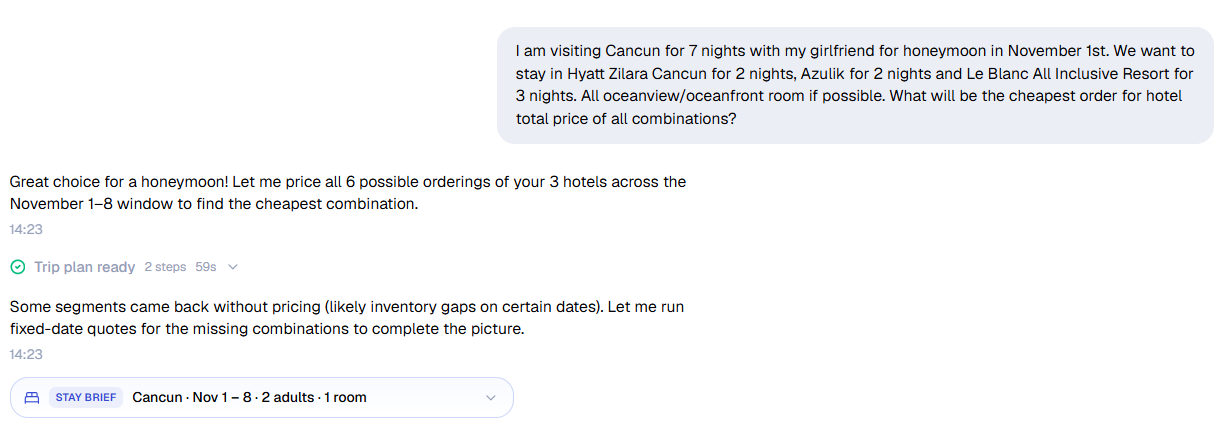
A honeymoon plan for Cancun, November 1–8: two nights at Hyatt Zilara Cancun, two nights at Azulik in Tulum, three nights at Le Blanc Spa Resort — all oceanview or oceanfront, all fixed. The only open question was which hotel to visit first, second, and third.
Plan a trip with Fortrip
Use Fortrip to draft and validate itineraries with travel-specific reasoning — not generic chat answers.
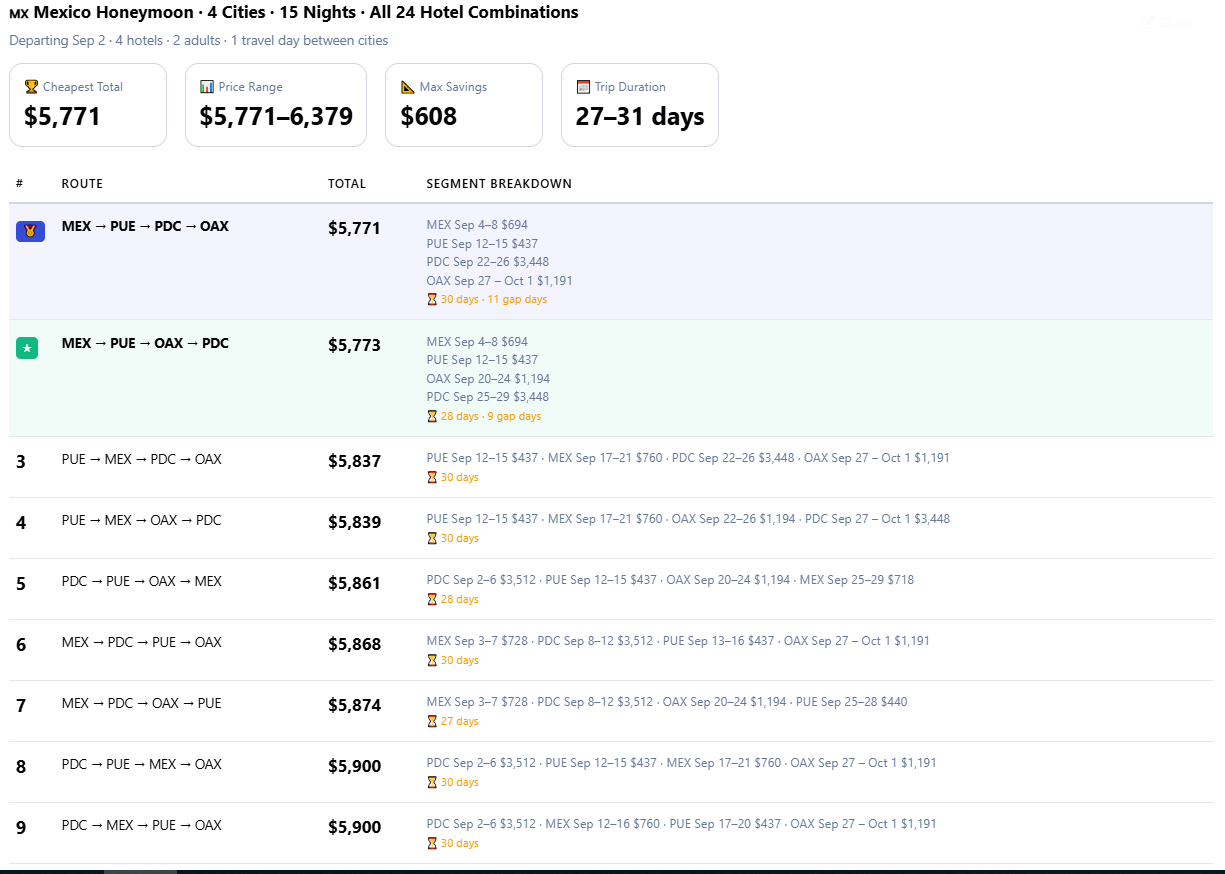
Twenty-four possible city orders came out $58 apart. Reallocating nights between two resorts moved $320. Choosing two rooms over one suite moved $2,974. The variable worth changing isn't the same on every trip — here's how to find yours before you start re-searching everything.
Same three hotels, same total nights — just reordered — and the total swung by more than $5,000. One hotel's date-availability gap did almost all the damage. Here's why "cheapest hotel in every city" and "cheapest trip" are two different questions.
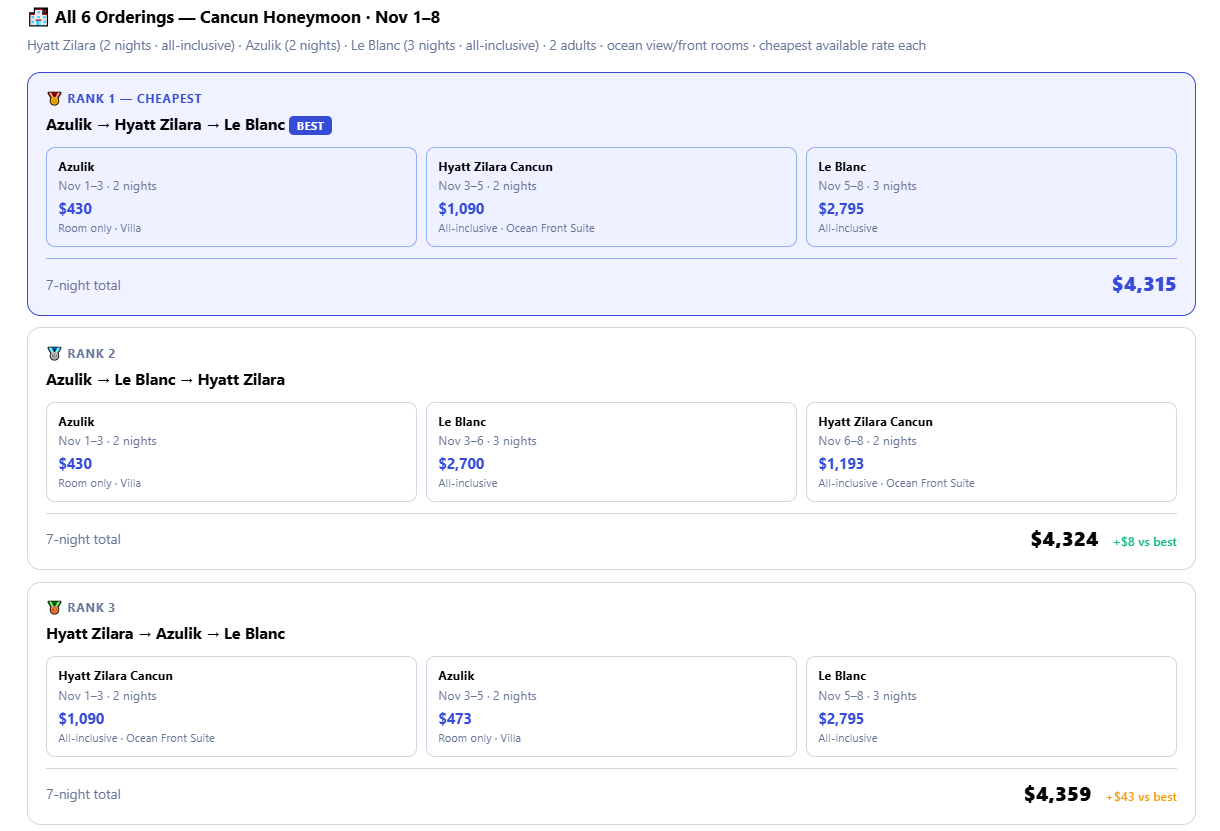
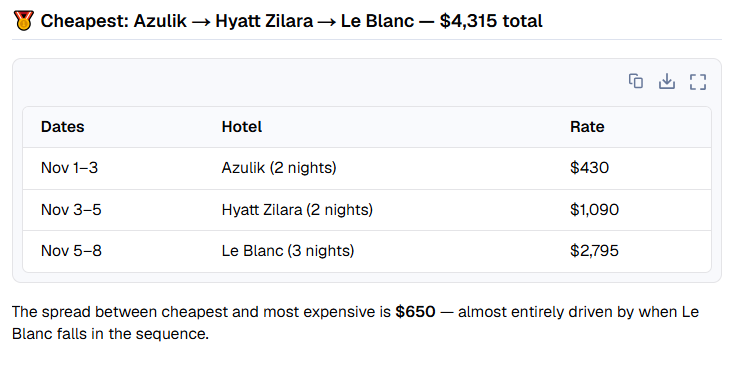
With three fixed-length stays, there are six possible orders. Pricing all six against the same November 1–8 window came back with a $650 spread between the cheapest and most expensive sequence — same three hotels, same room categories, same seven nights, just arranged differently.
Cheapest order: Azulik → Hyatt Zilara → Le Blanc, at $4,315 total.
Dates
Hotel
Nights
Total
Nov 1–3
Azulik, Tulum
2
$430
Nov 3–5
Hyatt Zilara, Cancun
2
$1,090
Nov 5–8
Le Blanc, Cancun
3
$2,795
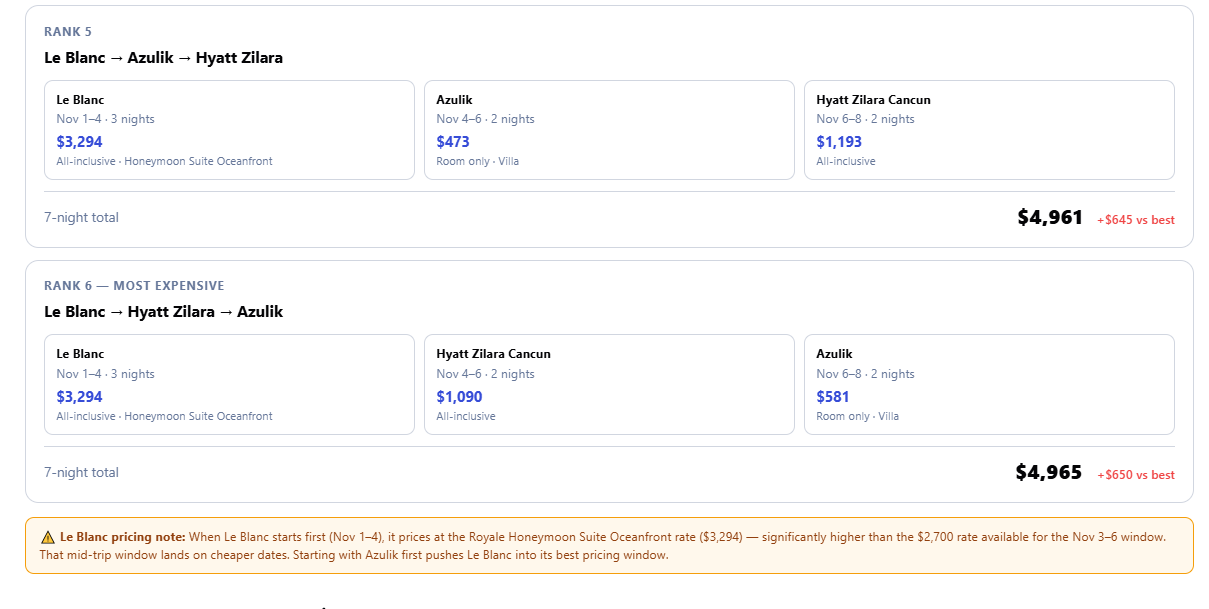
The most expensive of the six orderings ran $4,965 for the identical set of stays — $650 more, for the same hotels and the same total nights.
Where the $650 Actually Came From: One Hotel, Not Three
The instinct is to assume the savings are spread evenly across all three properties — a little cheaper here, a little cheaper there. That's not what happened.
Le Blanc alone accounted for almost the entire swing. Starting the Le Blanc stay on November 1 priced out at $3,294 for three nights. Starting the exact same three-night stay on November 3 — just two days later — dropped it to $2,700. That's a $594 difference for the same rooms at the same resort, based purely on which three calendar nights it landed on.
Every ordering that put Le Blanc first in the sequence came out roughly $645 more expensive than every ordering that pushed it later. Hyatt Zilara and Azulik barely moved between orderings — the entire spread traced back to one hotel's own date-sensitivity, not a general "some orders are better than others" effect.
This is the part worth internalizing: when you're sequencing a fixed set of hotels, you're not really optimizing three roughly-equal variables. Usually one property in the mix has a much steeper date curve than the others, and the sequencing question mostly reduces to "which order lands that one hotel on its cheaper dates?" — the rest of the itinerary is just filling in around it.
The Cheapest Order Also Happened to Solve a Logistics Problem
Azulik sits in Tulum, roughly 90 minutes from the Cancun hotel zone — so any itinerary combining it with Hyatt Zilara and Le Blanc involves at least one transfer day between the two areas.
The cheapest sequence (Azulik → Hyatt → Le Blanc) also turned out to be the itinerary that only makes that Tulum-to-Cancun drive once — on the morning of November 3, with a same-day arrival at Hyatt Zilara. A sequence that bounced back and forth between Tulum and Cancun (Hyatt → Azulik → Le Blanc, for instance) would mean making that 90-minute transfer twice instead of once, on top of whatever the pricing difference came out to. In this case the cheapest order and the least disruptive order were the same order — but that's not guaranteed, and it's worth checking both when a sequence spans two different areas.
A Caveat That Can Erase the Whole Advantage: Room Category
The $430 Azulik rate in this comparison is for their entry-level Villa — room only, no meals. Azulik's actual oceanfront Sea Villa category prices at roughly $1,157 for the same two nights — nearly 2.7x more than the villa used in the sequencing comparison.
This matters because a $650 sequencing advantage can get swallowed by a room-category upgrade decided after the fact. If oceanfront specifically is the point of a honeymoon booking (as it was requested here), the sequencing exercise needs to be run against the actual room category being booked, not the cheapest bookable room at each property — otherwise the "cheapest order" conclusion is answering a slightly different question than the one that matters.
How to Check This for Your Own Multi-Hotel Trip
Doing this by hand means pricing every permutation of your hotel list against the same date window — for three hotels, six orders; for four hotels, twenty-four — and for each one, re-quoting every stay at the specific room category you actually want, not just whatever's cheapest at each property. That's a lot of repeated hotel searches to find one number.
This is exactly what FortripAI's Optimization Agent runs automatically. Give it your fixed hotel list, your date range, group size, and preferred room category, and it prices every valid sequence — flagging which specific hotel is driving most of the spread, the way Le Blanc did here, instead of you discovering that only after running all six searches yourself.
FAQ: Hotel Booking Order and Total Trip Cost
Does the order I book hotels in actually change the total price?
Yes — in one real case, booking the same three hotels for the same seven nights in a different sequence changed the total by $650, with identical room categories and identical total nights.
If hotel order matters, is the savings usually spread across all the hotels?
Not necessarily. In this case, one hotel accounted for almost the entire $650 spread because of how sharply its own rates changed from one date to the next — the other two hotels barely moved between orderings.
How do I find out which hotel in my itinerary is the date-sensitive one?
Price the same hotel's stay starting on a few different dates a couple of days apart. If the total swings sharply, that property is likely the one driving most of your sequencing decision — check it before assuming the savings are evenly distributed.
Does the cheapest hotel order always mean the least amount of travel between stops?
Not always — it happened to align in this case, but a cheaper sequence can sometimes mean more back-and-forth travel between destinations. Check both the price and the transfer logistics for each candidate order before booking.
Should I compare hotel order using each property's cheapest room, or the room I actually want?
The room category you actually plan to book. A sequencing advantage calculated on entry-level rooms can shrink or disappear once you price the specific room category you want at each property.
Booking a fixed set of hotels and unsure which order to lock in? Try FortripAI's Optimization Agent — enter your hotels, dates, and room preferences, and let it price every order to find out which one is actually driving the cost.