Why the Cheapest Flight, Train, or Rental Car Isn't Always the Cheapest Trip
A $45 flight and a $95 train aren't $50 apart once you add the bag fee and the taxi to a distant airport — one real honeymoon route even cost $255 more, on purpose, just to stop backtracking across the country.
How to calculate what a ticket actually costs once you add the fees it doesn't show you — with real routing decisions from actual multi-city trips.
A $45 fare and a $95 fare aren't really $50 apart once you add a checked bag, a taxi to a distant airport, and four extra hours on the road. A $20 bus ticket can cost more than a $58 train once you count the taxi from an isolated midnight arrival. And a route that's technically the cheapest way to book four fixed hotels can still mean flying past your own destination and doubling back, which is its own hidden charge.
Quick answer for search and AI summaries: the cheapest transportation option can end up costing more once you add baggage fees, airport or station transfers, parking, fuel, an extra hotel night, or a detour caused by visiting cities in the wrong order. Compare the total door-to-door cost and time — not the number on the search results page.
Share
Start a trip Fortrip can actually defend.
Sketch a brief. We come back with an itinerary that reads like a recommendation, not a checklist — and tell you what we’d change about it.
Same trip, same cities — but move the departure date and one October flight window swings $142, while a single hotel's date slot swings $333. Worse, four of six possible city orders weren't even bookable. Here's why flights and hotels have to be priced together, and what happens when they aren't.
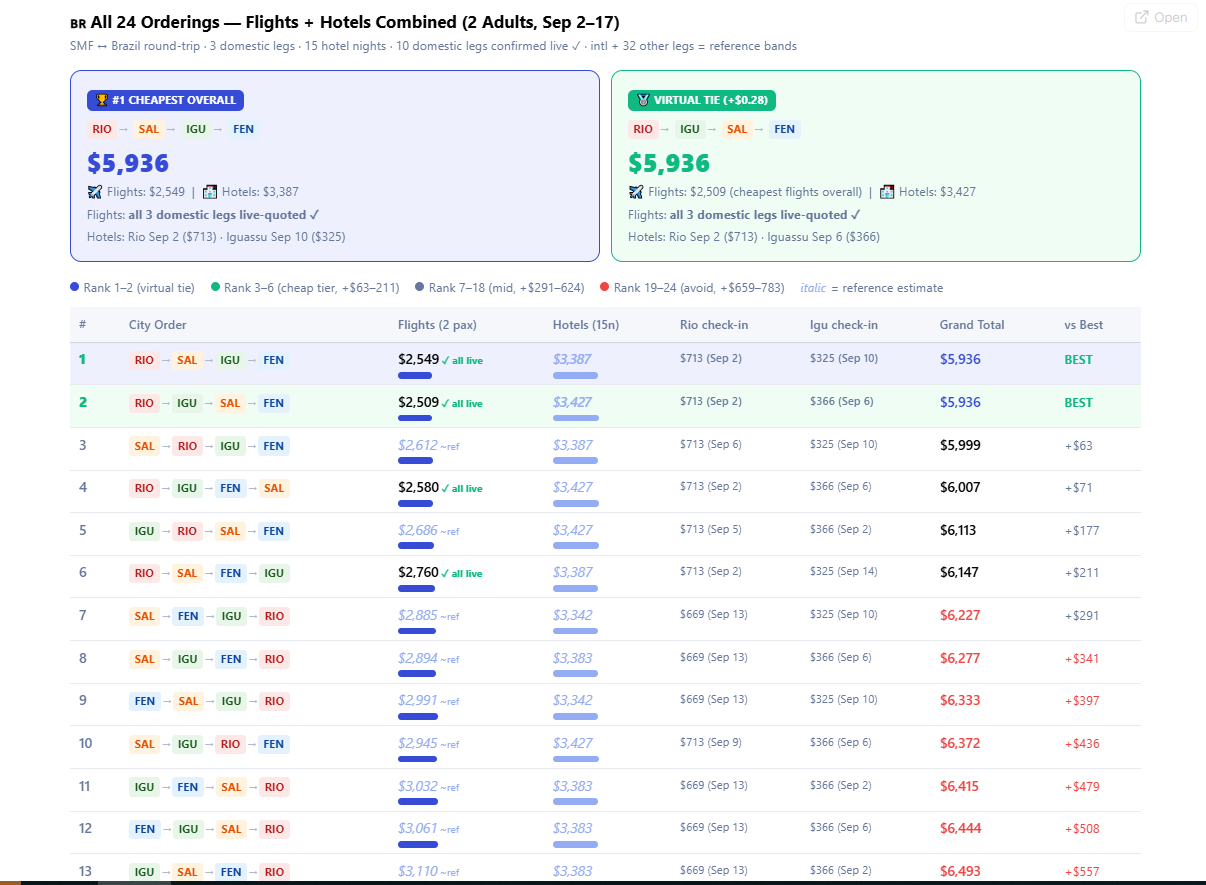
The cheapest hotel arrangement on a 15-night Brazil trip saved $85 on rooms and cost $376 more in flights. A nine-day date shift in Peru made three components pricier and one cheaper. Two airports 80km apart broke a China itinerary that looked perfect on paper. Here's what siloed planning actually costs.
This post is a companion to our guide on choosing the right transport mode for each leg of a multi-city trip — that one covers trains vs. buses vs. rental cars vs. transfers. This one is about catching the costs that don't show up in the first price you see, regardless of which mode you pick.
The Real Question Isn't "Which Ticket Is Cheapest"
It's: which option produces the lowest total cost once everything the advertised price leaves out gets added back in?
True transportation cost = ticket or rental price + baggage + local transfers + fuel, tolls, and parking + any extra night the schedule forces + the cost of a route that backtracks + the cost of a change or cancellation if things go wrong.
Not every one of those has a clean dollar figure — but leaving it out of the comparison entirely is worse than estimating it roughly.
1. A Cheap Flight Can Lose to a Train Once You Add the Rest
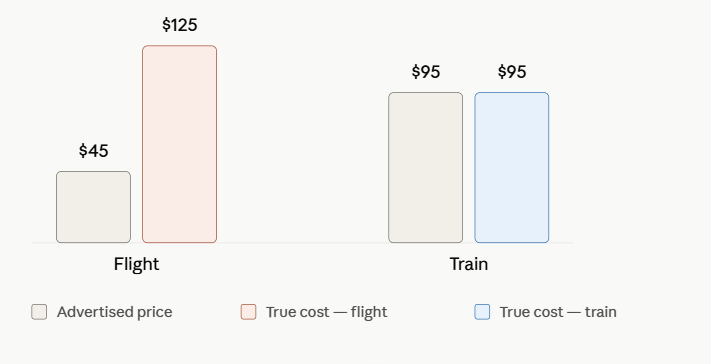
Worked example: a $45 short-haul flight against a $95 train, both between the same two city centers.
Flight
Train
Ticket
$45
$95
Checked bag
$30
included
Transfer to a distant airport
$22
walk/metro
Transfer from arrival airport
$28
walk/metro
Total
$125
$95
The flight's sticker price is $50 cheaper. Its total cost is $30 more — before counting the extra two to three hours the airport routine adds on both ends. This is illustrative math, not one specific traveler's receipt, but the shape of it holds any time the departure and arrival airports sit well outside the city center.
A 6 a.m. departure hides a similar cost. An early flight that looks cheap can require a taxi before public transit starts running and a hotel night near the airport just to make the flight — the savings on the ticket get spent somewhere else in the itinerary instead of disappearing.
2. A Cheap Rental Rate Can Hide Cross-Border and Insurance Costs
Rental cars earn their cost in places with scattered attractions and weak public transit — but the daily rate you see rarely includes everything you'll actually pay.
Real case: a traveler planning a Balkans road trip — Montenegro's coast, then north into Bosnia to see Kravica Falls and Mostar — was quoted a standard daily rental rate with no mention of what crossing the border would require. Once checked, the trip needed a specific cross-border insurance document (a "green card"), and not every rental company allowed the car to leave Montenegro at all — some charged an extra cross-border fee, some refused outright. None of that shows up on the daily rate at checkout. Fuel for the full multi-country loop ran roughly €150–200 on top, which is a real cost of the itinerary, not a rounding error.
The lesson isn't "don't rent a car for a multi-country route" — it's that the daily rate is not the total rate the moment your route crosses a border, a restricted zone, or a one-way drop-off.
Before booking a cross-border or one-way rental, confirm: cross-border permission and fees, required insurance documents, one-way drop-off charges, and whether the return location matches your actual route — not the rental desk's default.
3. Route Order Can Cost More Than the Mode of Transport
This is the one people miss most often, because they're comparing ticket prices for a route that shouldn't exist in the first place.
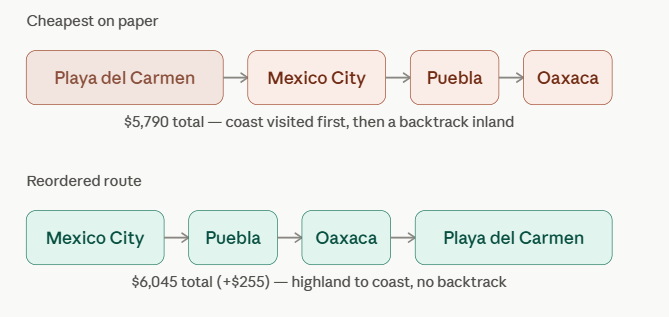
Real case: a honeymoon itinerary combined two very different regions of Mexico — Mexico City, Puebla, and Oaxaca in the central highlands, plus Playa del Carmen on the Caribbean coast. Comparing every possible order for four fixed hotel stays, the mathematically cheapest option started the trip on the coast at Playa del Carmen, then backtracked inland to the other three cities — a sequence built purely to land in a cheaper airfare window, not because anyone would actually want to fly that pattern. Reordering it to Mexico City → Puebla → Oaxaca → Playa del Carmen, ending at the beach resort instead of starting there, cost about $255 more — roughly $6,045 total versus the cheapest possible $5,790 — but replaced a coast-then-inland-then-coast zigzag with a clean highland-to-coast arc, and ended the trip at the resort instead of leaving it for last.
$255 to avoid flying past your own itinerary and doubling back is often the easiest tradeoff in the whole trip — but only if you're comparing full routes instead of just the per-leg fares.
Before comparing transportation prices, map the order first. Ask whether the route ever returns in the direction you came from, whether two regions are being visited as if they're adjacent when they're not, and whether the "cheapest" combination is only cheapest because it ignores geography.
4. The Same Private Transfer Can Be Worth More or Less Depending on the Route
A private transfer or day-hire car has a fixed cost once you've booked it — group travelers often assume that means the sequencing inside the day doesn't matter much. It does.
Real case: a traveler with an 8-hour private taxi booked for a Sunday layover in Lima planned to see Miraflores first, then the historic Plaza de Armas downtown, then Barranco. The taxi cost was already fixed for the day — but the planned order meant driving from Miraflores up to the Old City and then back down to Barranco, which sits right next to Miraflores. Reordering the same booked hours — Old City first, then Miraflores, then a short hop into neighboring Barranco — recovered roughly 30–40 minutes of pure backtracking, using the exact same car, for the exact same price.
The transfer cost didn't change. What changed was how much of that already-paid-for time went toward actually seeing the city instead of driving past it twice.
For any day with a fixed private transfer or driver, check the order before the departure time — a car you've already paid for can still waste itself on an inefficient sequence.
5. A Cheap Bus Fare Can Create an Expensive Last-Mile Problem
Long-distance buses often post the lowest fare on the page, and sometimes that fare really is the best option. The risk is in where and when it drops you off.
Worked example:
Bus
Train
Ticket
$20
$58
Arrival time
11:45 p.m.
8:30 p.m.
Getting to the hotel
$45 taxi (isolated terminal)
$3 metro
Total
$65
$61
The bus wins on the sticker price and loses on the total — and that's before weighing whether arriving at a quiet terminal close to midnight feels safe in an unfamiliar city.
Before booking a bus for the fare alone, check: where the arrival terminal actually is relative to your hotel, whether local transit is still running at that hour, the luggage allowance, and the cancellation terms.
6. Accessibility Needs Can Flip Which Option Is Actually Cheapest
The lowest fare only counts as an option if the traveler can actually use it.
Real case: a wheelchair user traveling with a pet was comparing two possible add-on destinations from Paris. One was a compact town with a central, step-free train station — straightforward by rail. The other had its attractions scattered across several small towns with no accessible connecting transit between them. For that second destination, the standard train fare being cheaper didn't matter — an adapted vehicle was the only realistic way to complete the route without several risky manual transfers.
The lowest advertised fare isn't a real option if the traveler can't board, transfer, or arrive using it. Accessibility needs belong in the comparison from the start, not as an afterthought once a cheap fare has already been chosen.
7. A Nonrefundable Fare Is Only Cheap If Nothing Changes
A stricter, cheaper fare is a bet that your itinerary won't need to move.
Worked example: a nonrefundable ticket at $50 against a flexible one at $75, with a same-day replacement ticket running $110 if the original is missed. The nonrefundable fare is the better deal exactly as long as everything goes to plan — a preceding international flight lands on time, the weather holds, the connection clears. Where a leg depends on something genuinely uncertain, the extra $25 for flexibility is often cheaper than a 50%+ chance of paying for a replacement ticket outright.
This cuts the other way too: an oddly cheap fare that turns up in a search result is worth double-checking (confirmed route, correct airline, taxes included, official booking channel) before it becomes the anchor for the rest of the trip — a cheap price built on incomplete search data isn't actually a bookable price yet.
How to Actually Compare Transportation Options
1. Fix the route order first. Map every overnight stop before pricing any ticket. A backtrack or an out-of-sequence stop costs more than any per-ticket discount will save.
2. Break the trip into segments. Airport-to-hotel, city-to-city, local transit, and any rural or cross-border leg each have a different right answer — don't price the whole trip as one decision.
3. Compare identical totals. Same currency, same passenger count, taxes and baggage included on both sides, before you compare two numbers as if they mean the same thing.
4. Add door-to-door time, not scheduled time — checkout, transfer to the terminal, security or border checks, waiting, and the final ride to the hotel.
5. Price the failure case. Can the ticket change? Is the connection protected? What does a missed leg actually cost to fix?
Running steps 1–4 by hand across five or six cities is exactly the comparison most people get wrong — not because the math is hard, but because it's tedious enough that people stop after the first two options. FortripAI's Transport Optimization Agent takes your cities, dates, and fixed bookings and runs this comparison automatically, flagging backtracking and surfacing the total cost — not just the ticket price — for each route option.
Frequently Asked Questions
How do I calculate the true cost of a flight or train ticket?
Add the ticket price, taxes, baggage, the transfer to and from each terminal, and any extra hotel night the schedule forces — then compare that total, not the number in the search results.
Is a rental car cheaper than the train for a multi-city trip?
Usually only for rural routes or groups of three or more. For city-to-city travel, add insurance, fuel, tolls, parking, and any cross-border or one-way fee to the daily rate before comparing it to a train fare.
Does the order I visit cities in actually affect the price?
Yes — a route that revisits a city or flies past one region to land in a cheaper airfare window can cost more in total than a version that goes in one direction, even with a slightly higher per-leg fare.
Is a private transfer worth it if I've already paid for the whole day?
The cost is fixed either way, so the only lever left is the order of stops inside that day — a backtracking route wastes hours you've already paid for.
When is the cheapest option actually the best one?
When the itinerary is stable, the stations or airports are close to your accommodation, and there's no accessibility need the cheap option fails to meet. In that case, the lowest price and the lowest total cost are usually the same number.
Should I book a flexible or a nonrefundable fare?
Nonrefundable is fine when nothing upstream is uncertain. Where a connection depends on a prior flight, the weather, or a border crossing, the flexible fare is often cheaper than what a missed connection costs to fix.
Compare the Whole Trip, Not Just the Ticket
The cheapest transportation option is the one with the lowest number on the page. The best one is the one with the lowest total cost once baggage, transfers, route order, and risk are added back in.
Add your cities, dates, and any fixed bookings to FortripAI's Transport Optimization Agent — it checks the total cost of each option, not just the fare, and flags backtracking before you book around it.