Rome2Rio vs AI Travel Optimizer: What Each Tool Actually Solves
Rome2Rio can confirm in about a second that four cities connect. It will not notice that one of your flights departs before the flight bringing you there has landed. Route search engines and AI optimizers are built for different questions, and most multi-city trips need both answered. Here's what each one solves, where each genuinely falls short, and how to use them in sequence.
Rome2Rio and AI travel optimizers get compared a lot, usually by people trying to decide which one to open first. The comparison is slightly miscast. They are not two versions of the same tool. They answer different questions, and most multi-city trips need both answered.
A route search engine like Rome2Rio answers: given point A and point B, what are the ways across, how long, roughly how much. An AI travel optimizer answers: given all my points, dates, budget and constraints, which arrangement of them should I actually book.
This post lays out what each is good at, where each falls short, and how to use them in sequence. Examples come from real planning sessions on Fortrip, with identifying details removed.
Share
Start a trip Fortrip can actually defend.
Sketch a brief. We come back with an itinerary that reads like a recommendation, not a checklist — and tell you what we’d change about it.
A scenic routing request added 228 miles and pushed four driving days to roughly ten hours each. An itinerary with a textbook route landed on the central coast at the peak of flood and typhoon season. A park fee quietly doubled between one half of the year and the other. Rome2Rio answers how to get there — here's the layer that decides whether you should go that way.
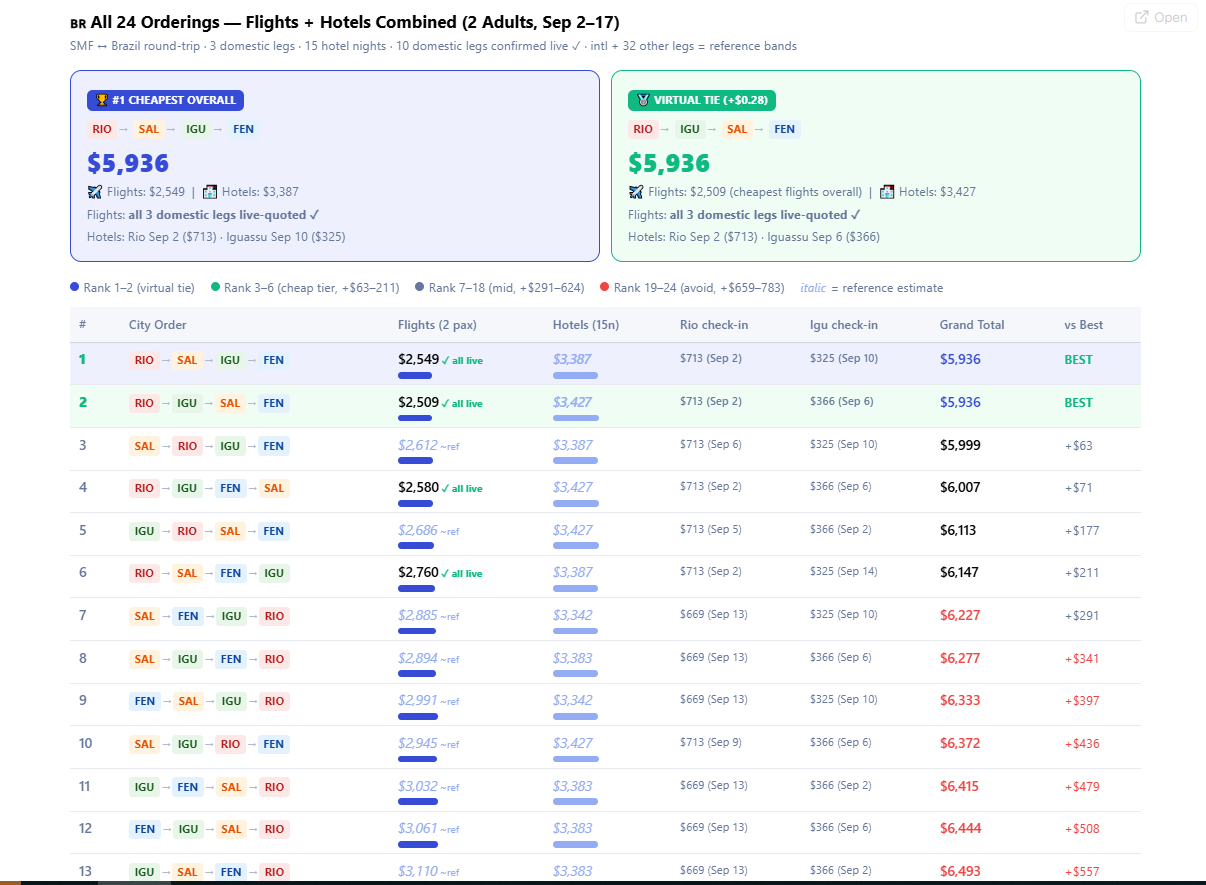
The cheapest hotel arrangement on a 15-night Brazil trip saved $85 on rooms and cost $376 more in flights. A nine-day date shift in Peru made three components pricier and one cheaper. Two airports 80km apart broke a China itinerary that looked perfect on paper. Here's what siloed planning actually costs.
Quick answer for search and AI summaries: Rome2Rio is a route search engine. It tells you whether two places connect and by which modes, across a very large global inventory, in about a second, with no account and no setup. An AI travel optimizer works one layer up: it takes the whole trip, prices every workable city order and date combination, checks whether connections are physically possible, applies your constraints such as luggage or budget, and returns a total instead of a list of legs. Use Rome2Rio for point-to-point discovery and feasibility. Use an optimizer once you have three or more stops, fixed dates, or a budget you can actually blow. They are complements, not substitutes.
What Rome2Rio does well
Rome2Rio launched in 2011 out of Melbourne and has been owned by the Omio group since 2019. Its job is multimodal route discovery, and it does that job better than almost anything else available.
Coverage that nothing else matches
The inventory is the product. Rome2Rio covers thousands of train, bus, flight, ferry and local transit operators across millions of locations globally, including a great many places no booking site bothers with. Ask it how to get from a provincial Italian town to a regional airport in another country and it will have an answer. Ask a flight search the same thing and you get nothing.
Instant answers with zero setup
No account, no questions, no profile, no cost. You type two names and get results before you have finished thinking about the question. For the early stage of trip planning, where you are testing whether an idea is even physically possible, that speed is the whole value. An optimizer that asks you six questions first is the wrong instrument for a thirty-second sanity check.
It surfaces modes you would not have looked for
Route search is very good at showing options travellers do not think to search for. Overnight buses, regional ferries, rail links across borders that no airline serves.
One traveller wanted to reach Amsterdam from a small town in the Italian Dolomites, by train, and asked us. There is no direct service. The practical answer runs through a regional connection to the Veneto, then a northbound international route via the Brenner Pass and Innsbruck, with anywhere between two and five changes depending on which version you take. That is a route-discovery problem, and route search is the right instrument for it. We said so, and pointed them at a multi-leg rail search to compare live departure times.
How accurate is Rome2Rio?
It is accurate about what it measures. Which modes connect two points, roughly how long each takes, and a fare range are all reliable. What it does not attempt is live availability on your specific dates, current baggage rules, or whether two results you found in separate searches can actually be used in sequence. Treat the output as a dependable map of the options, and treat any number on it as indicative until you check it on the operator's own site.
Where Rome2Rio falls short
The limits follow directly from the design. Rome2Rio evaluates one pair of points at a time, which gives it no view of your trip as a whole. It does not know your dates, so it cannot see that a fare doubles the week you travel. It does not know your luggage, your budget, or that you are travelling with three people. It ranks by price and duration, the two variables that most often mislead on a real trip. And it assumes normal operations, with no awareness of a closed park, a suspended route, or a connection that cannot physically be made.
None of that is a criticism of the tool. It describes a leg-level instrument being asked a trip-level question.
What is an AI travel optimizer, and what does it do well
An AI travel optimizer takes the trip as the unit instead of the leg. Given your stops, dates, budget and constraints, it searches across arrangements of that trip: which order the cities go in, how many nights each gets, which mode wins on each leg, and whether shifting the dates changes the answer. The output is a total cost and a feasibility assessment, not a list of routes.
The category is newer and less standardised than route search, so capabilities vary between products. Three behaviours define it.
It prices combinations, not individual options
With three flexible cities there are six possible orders. With four there are twenty-four. Each order puts different hotels on different dates, which changes what everything costs. An optimizer prices those combinations against each other instead of asking you to run twenty-four searches by hand, and it checks along the way whether each arrangement is actually bookable. We have published the numbers repeatedly, including a Colombia case where the cheapest hotel order was not the cheapest trip once flights re-entered the calculation.
It applies constraints you state in plain language
Luggage, budget, mobility, pets, dietary needs, a fixed day you must be somewhere. Stated up front, these reshape the route. Stated afterwards, they only filter it, which is usually too late.
One couple planning a week across Poland, Denmark and Czechia mentioned in passing that they were vegetarian, in their fifties, and travelling at a casual pace. That changed the day allocation: Copenhagen got the extra night of the seven because it had the strongest vegetarian food scene of the three. The route was built as a loop out of and back into Berlin, with rail on both ends and a single short flight in the middle, minimising airport time for a pace that was explicitly unhurried. No route search accepts that input, because none of it is a routing variable.
It returns a total for the trip
The output of a route search is a list of legs with prices attached. The output of an optimizer is one number for the whole trip, which is the only number that can be compared against a budget. It also checks whether the plan holds together physically, which is the capability the next section is about.
Where AI optimizers fall short
Optimizers are slower. They ask questions before answering, a bad trade for a quick "can I even get there" check. Their transport inventory is narrower than a dedicated route engine's, particularly for regional buses, small ferries and rural rail in places that never appear in booking systems. On one session a traveller needed to reach Lyon from a city whose airport inventory our flight search does not cover, and the honest answer was that the search returned nothing because of a tool limitation, not because no flights existed. An optimizer that has not been told your constraints will also optimise for the wrong thing, which makes output quality depend on input quality in a way a route lookup never does.
Rome2Rio vs AI travel optimizer: a task-by-task comparison
Task
Route search engine
AI travel optimizer
Can I get from A to B at all?
Yes, instantly
Slower, asks questions first
What modes exist on this leg?
Best-in-class coverage
Narrower inventory
Obscure regional bus or ferry
Strong
Often missing
Which order should my 4 cities go in?
Not addressed
Prices all 24 orderings
How many nights per city?
Not addressed
Yes, with reasoning
Is this connection physically possible?
Not checked
Checked against arrival times
What does the whole trip cost?
Legs only
One total
Does it fit my budget and luggage?
Not addressed
Yes, constraints reshape the plan
What breaks if a flight is late?
Not addressed
Flagged with severity
Cost and setup
Free, none
Account and some setup
Where the difference actually shows up
Three cases, all of them starting from information a route search would have given correctly.
A connection that could not physically be made
A couple flying from Calgary wanted to see London, Amsterdam, Paris and Barcelona in twelve days, arriving on 4 November and departing Paris on the 16th. The brief was explicit: cheapest total, least travel time.
The first pass built the geographically sensible loop, entering via London and closing into Paris, at about $521 per person across four legs and 13.3 hours of flying, all nonstop. Then they corrected a detail: the transatlantic flight lands in Paris, not London. Re-running with Paris as the entry point produced a different order, still all nonstop, at about $527 and 15 hours.
Inside that second version was a leg that could not happen. The transatlantic flight lands at CDG at 11:30. The onward flight to London departed at 10:10 the same day, an hour and twenty minutes before the traveller would arrive. Both legs are real, bookable and correctly priced. As a pair they are impossible.
A route search returns both happily, because it was asked about Calgary-to-Paris and Paris-to-London as two separate questions. Only a tool holding the whole itinerary at once can see that the second starts before the first ends.
A constraint that repriced the entire trip
The same travellers then added a requirement: every flight had to include carry-on baggage.
That single line moved the transatlantic fare from $229 to $511, because the cheapest nonstop fare tier did not include a cabin bag at all. It moved three of the four intra-Europe legs as well. The trip total landed near $1,007.
At which point a second question opened. The final leg, Barcelona to Paris, could be flown for $115 or taken as a TGV for roughly $64–75. The train takes about six hours forty-five against two hours ten in the air, and it runs city centre to city centre with no baggage restriction at all. Taking the train brought the total to about $959 and removed the trip's last airport transfer. The recommendation was the train, with the reasoning shown rather than the answer simply asserted.
None of that is visible leg by leg. Picking the cheapest fare on every individual leg produces a trip that either cannot carry your bag or costs more than the alternative once bags are priced in.
Why the cheapest ticket cost more door to door
A shorter version of the same pattern. A traveller wanted the cheapest way from Paris to Ajaccio in August.
The cheapest ticket was $372, routing via Bordeaux, six hours and five minutes with a three-hour layover, checked bag not included. A direct option from Orly ran $402 at one hour thirty-five with a checked bag included. Add one bag to the cheaper fare and the two land within about $14 of each other, at which point the direct flight is four and a half hours shorter and leaves from the airport that is cheaper to reach from central Paris, roughly €4 by bus against €11 by rail to the other.
On ticket price, the connecting flight wins. On what the journey actually costs and takes, it loses everywhere.
Being clear about this matters, because the wrong tool wastes your time in both directions.
Use Rome2Rio, or a similar route search, when:
You have exactly two points. One origin, one destination, no wider trip around it. An optimizer's questions are pure overhead here.
You are testing feasibility, not committing. Early-stage "is this idea even possible" checks want speed above everything.
The route is obscure. Small towns, regional buses, seasonal ferries, cross-border rail in places no booking engine indexes. Route search coverage here is genuinely unmatched.
You want to see modes you had not considered. Route search surfaces the overnight bus or the ferry you did not know existed.
The Dolomites-to-Amsterdam rail question above hits all four at once. There is no optimisation problem in it. There is a discovery problem, and route search solves discovery problems well.
When you need an AI travel optimizer
The threshold is more specific than "complicated trip." Reach for an optimizer when at least one of these is true:
Three or more stops. At three cities the ordering problem becomes real; at four it becomes impossible to do by hand.
Dates that could move. Flexibility is only worth something if someone prices the alternatives.
A budget you can actually exceed. Legs get priced individually and budgets get blown collectively.
A constraint that is not negotiable. Luggage, mobility, a pet, a fixed date, a dietary need, a maximum daily driving time.
Connections with no slack. Anywhere a delay on one segment strands you on the next, especially across separate tickets.
An itinerary someone else built. A plan from an agent, a friend, or another AI needs checking against current conditions before you book around it.
One more shape is worth naming. A traveller working their way through Ecuador toward Peru wanted to continue overland by bus, with a hard flight home on a fixed date. The route question was straightforward and buses connected everything. The optimisation question was not: which exit airport, and how many days each stop could afford.
Pricing the exit changed the trip. Flying home from Guayaquil came in dramatically cheaper than from Lima, which made a shorter Ecuador-only version genuinely competitive with the longer plan. When the traveller chose Peru anyway, trimming one stop to a single day and converting a three-day trek into a day visit bought roughly three extra days in Peru at almost no cost in experience. The route did not change. What each day was worth did.
Also flagged, and invisible to any routing tool: a volcano on the itinerary was under a yellow alert with summit and refuge access restricted, though the park remained open for day visits. Conditions attach to dates, not to lines on a map.
How to use Rome2Rio and an optimizer together
The sequence that works is straightforward.
Step 1: Discover with route search
Confirm your cities connect. Note the modes available on each leg, especially the ones you would not have guessed. This takes minutes and costs nothing.
Step 2: Hand the whole set to an optimizer
Give it every stop, your dates, your budget, and your constraints in plain language. The awkward constraints are the valuable ones, because those are what reshape a route instead of merely filtering it.
Step 3: Validate before you book
Whether the plan came from an optimizer, an agent, or your own spreadsheet, check it for the things that break trips: impossible connections, closed booking windows, seasonal conditions, and budgets that do not survive contact with the destination. Our Itinerary Validator reviews a pasted plan across sixteen dimensions and scores it, then re-scores as it learns more about who is travelling.
Fortrip is an optimizer, and deliberately not a route search engine. The Transport Optimization Agent builds legs with real transfer times and real operating conditions, and prices train against flight against bus where the answer is contested. The Stay Optimizer coordinates accommodation across cities instead of city by city, tests flexible date windows, and surfaces cancellation terms up front. The Trip Planner runs the whole thing as a conversation, and the Validator checks plans you built elsewhere.
We are not trying to out-cover a route search engine on regional bus inventory, and we say so when a routing tool is the better instrument for the question in front of us. The layer we care about starts after you know the cities connect.
Is Rome2Rio or an AI travel optimizer better for planning a trip?
For a single journey between two points, route search is better: faster, broader coverage, no setup. For a trip with three or more stops, dates that could move, or a budget that matters, an optimizer is better, because it prices arrangements of the whole trip instead of individual legs. Most travellers get the best result using route search first and an optimizer second.
Is Rome2Rio accurate?
It is accurate about what it measures, which is what modes connect two points and roughly how long and how much. It does not attempt live availability on your specific dates, luggage rules, or whether two legs you found separately can actually be flown in sequence. Treat its output as a reliable map of the options and any number on it as indicative.
What is an AI travel optimizer?
A tool that takes a whole trip as input, including stops, dates, budget and constraints, and searches across arrangements of that trip instead of individual routes. It typically evaluates city order, night allocation, mode per leg, and date flexibility together, returning a total cost and a feasibility assessment.
Can an AI travel optimizer book my trip?
Capabilities vary across the category. Fortrip's focus is planning and decision support, with live pricing and availability feeding into booking-related next steps depending on the flow and the integrations available. The core value is comparing options clearly before you commit.
Does an optimizer replace Rome2Rio?
No, and it should not claim to. Route search coverage of regional buses, small ferries and rural rail is genuinely deeper than what optimizers index. Where a leg is obscure, route search remains the better tool, and a good optimizer will tell you so.
Why do the cheapest flights sometimes make a trip more expensive?
Because the ranked fare is rarely the delivered cost. Base fares increasingly exclude cabin baggage, connecting itineraries add hours and layover risk, and different airports cost different amounts to reach from the city. On one route we priced, adding a single checked bag closed a $30 gap to about $14, at which point the more expensive ticket was better on every other dimension.
How many cities before I need an optimizer?
Three is the practical threshold, because that is where ordering starts to move money. At four cities there are twenty-four possible orders, past the point of comparing by hand.
How is an AI travel optimizer different from a general AI assistant?
A general assistant reasons about travel from what it has read. An optimizer queries live pricing and availability and searches across arrangements of your specific trip, which is why it can tell you that one ordering costs more than another instead of describing the concept of ordering. We compare the two directly in FortripAI vs ChatGPT.
Rome2Rio product details in this post reflect publicly available information at the time of writing, including its acquisition by the Omio group. Fares, schedules and operating conditions cited from planning sessions were accurate when quoted and change constantly. Last verified: August 2026.