Shanghai vs. Beijing First: How Order Changed Our Budget
We swapped the order of a Shanghai + Beijing family trip and the hotel cost jumped 40.8%. A real 2026 budget test on why city order matters more than you think.
A real 2026 Beijing + Shanghai family trip budget test
Multi-city trips always sound simple at first. You pick a few cities, book the flights, find some hotels, maybe add a train in between, and call it a day. Easy, right?
Well… not exactly.
For our 2026 family trip to China, we were planning to visit Shanghai and Beijing for about 15 days. Same two cities. Same 13 hotel nights. Same hotel standard. Same family of three.
But when we changed the order from to , the hotel total jumped from about to about .
Share
Start a trip Fortrip can actually defend.
Sketch a brief. We come back with an itinerary that reads like a recommendation, not a checklist — and tell you what we’d change about it.
Same three hotels, same total nights — just reordered — and the total swung by more than $5,000. One hotel's date-availability gap did almost all the damage. Here's why "cheapest hotel in every city" and "cheapest trip" are two different questions.
Same trip, same cities — but move the departure date and one October flight window swings $142, while a single hotel's date slot swings $333. Worse, four of six possible city orders weren't even bookable. Here's why flights and hotels have to be priced together, and what happens when they aren't.
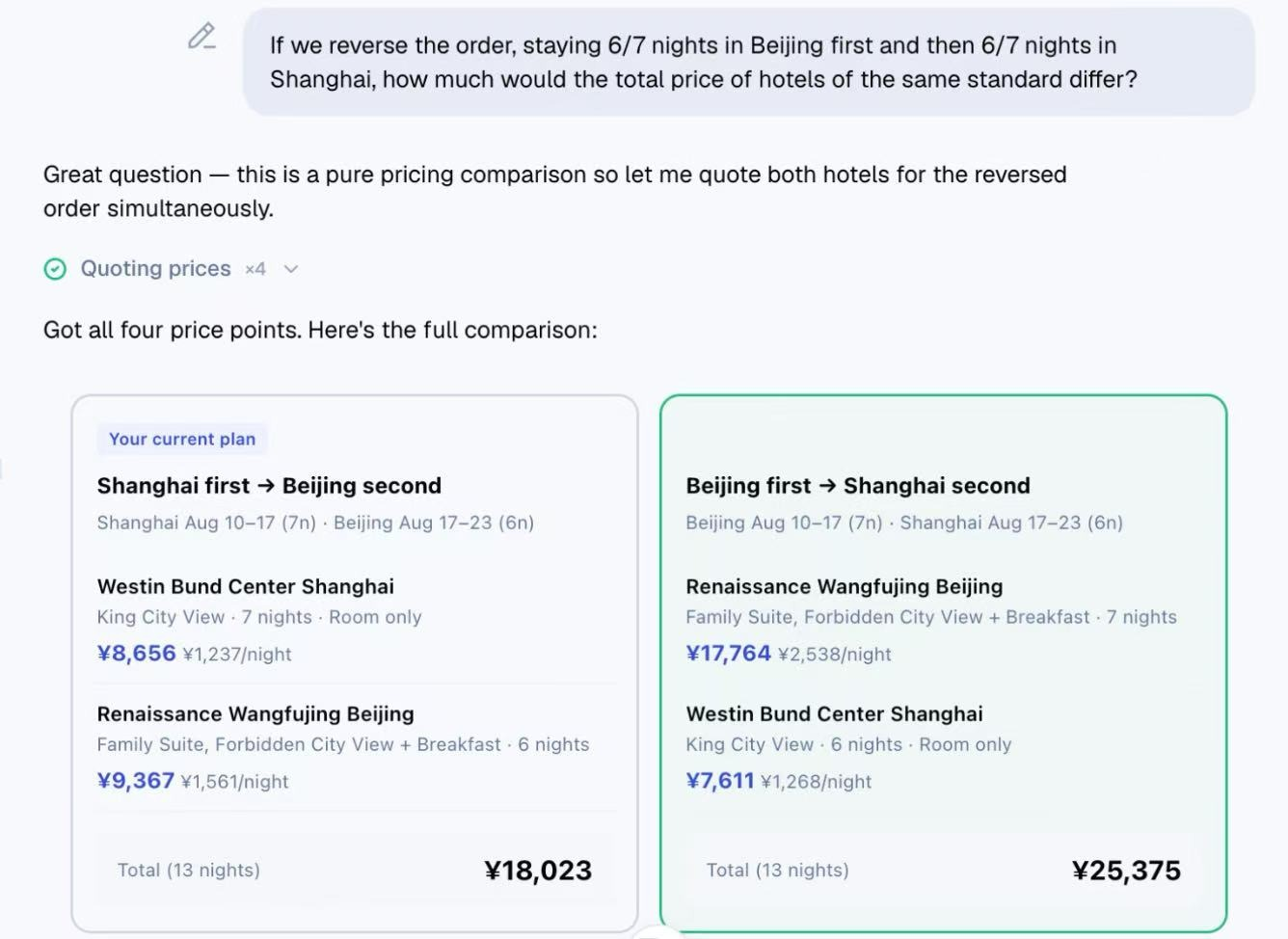
Shanghai first, Beijing second
Beijing first, Shanghai second
$2,520
$3,550
That is $1,030 more, or about 40.8% higher.
And that is before adding the flight difference.
The hotel difference alone was already big. On top of that, the lowest 1-stop flight comparison we found also favored the Shanghai-first route by about $411, bringing the early flight + hotel difference close to $1,400.
That was the moment we realized: for a multi-city trip, the order is not just a “vibe” decision. It can be a real budget decision.
The trip sounded simple at first
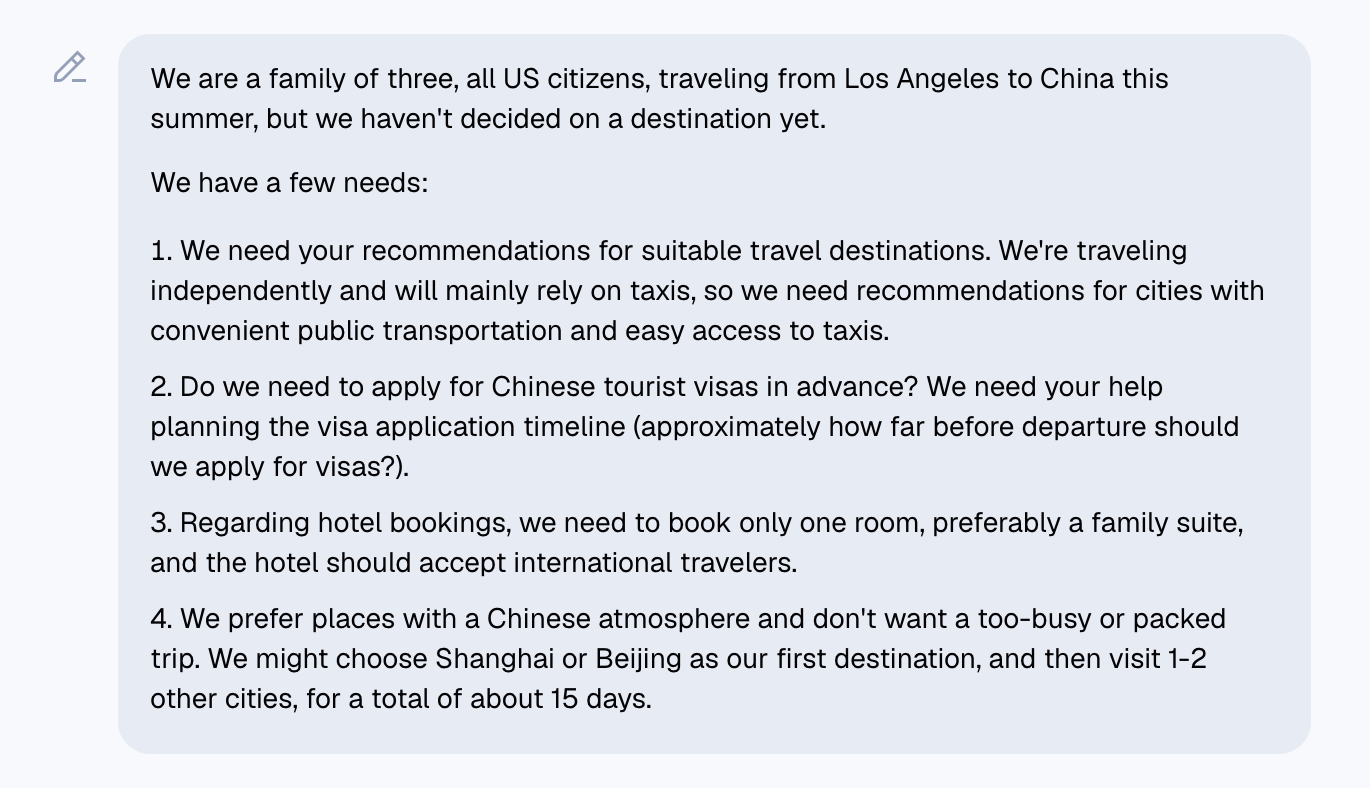
We are a family of three planning our first trip to China in summer 2026, flying from Los Angeles. At first, the plan felt pretty straightforward: classic cities, comfortable pace, easy transportation, and one hotel room that could actually fit all three of us.
But once we added real constraints — a 7-year-old child, foreign passport check-in, family-friendly rooms, easy taxi access, and a $2,800 hotel budget — the route was no longer just about where we wanted to go. It became a question of which city order would make the trip smoother and keep the cost under control.
Before the route, we had to deal with the boring-but-important stuff
Before deciding whether to start in Shanghai or Beijing, we had to get the practical timeline straight.
For an international family trip, planning is not just about “where should we go?” It is also about:
When do we apply for visas? Should flights be booked this week? Will the family room sell out? When do high-speed rail tickets open? Do we need to grab Forbidden City tickets the second they go on sale?
Not glamorous. Very necessary.
Fortrip AI helped organize these into a clear timeline instead of leaving us with a giant mental checklist.
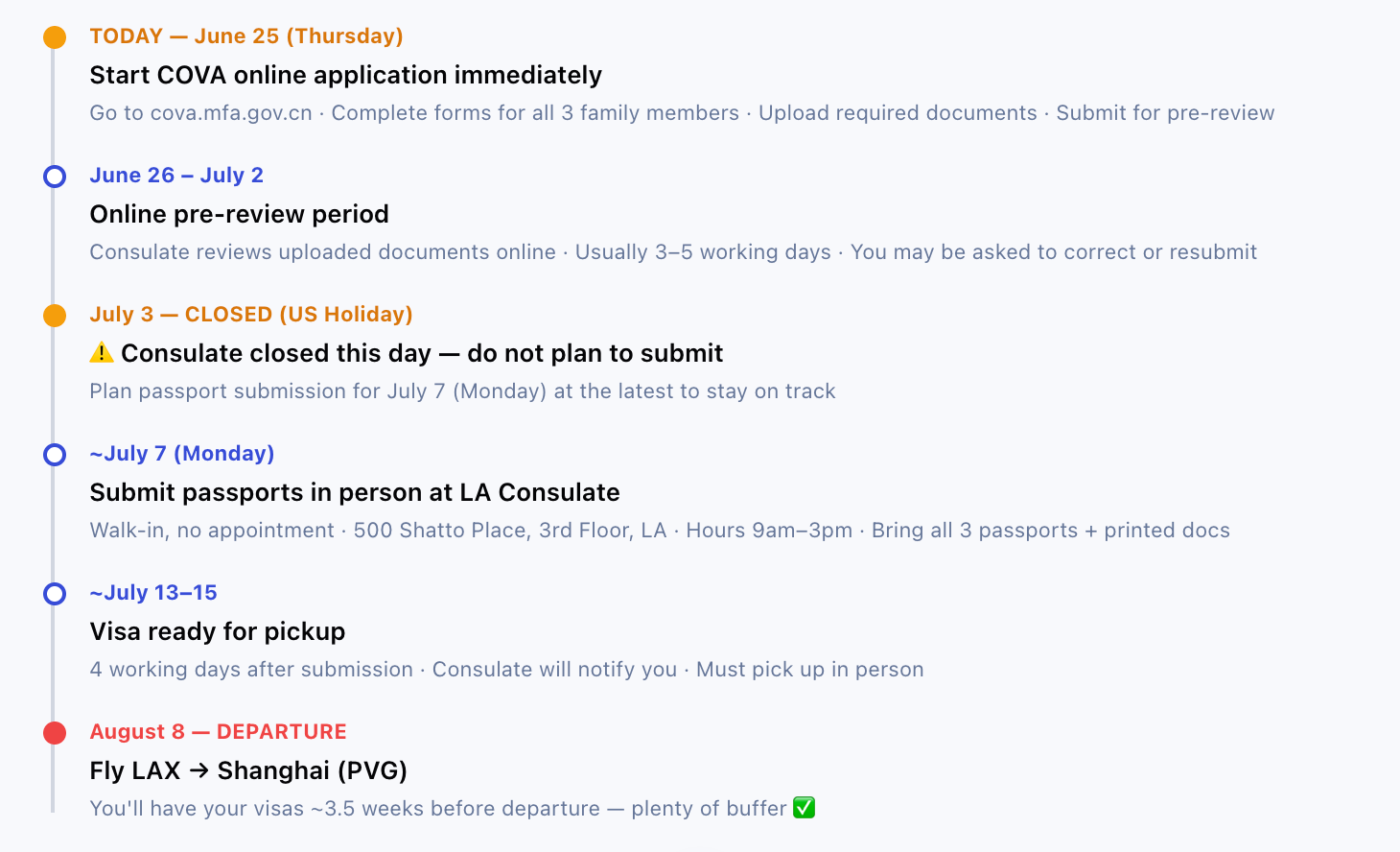
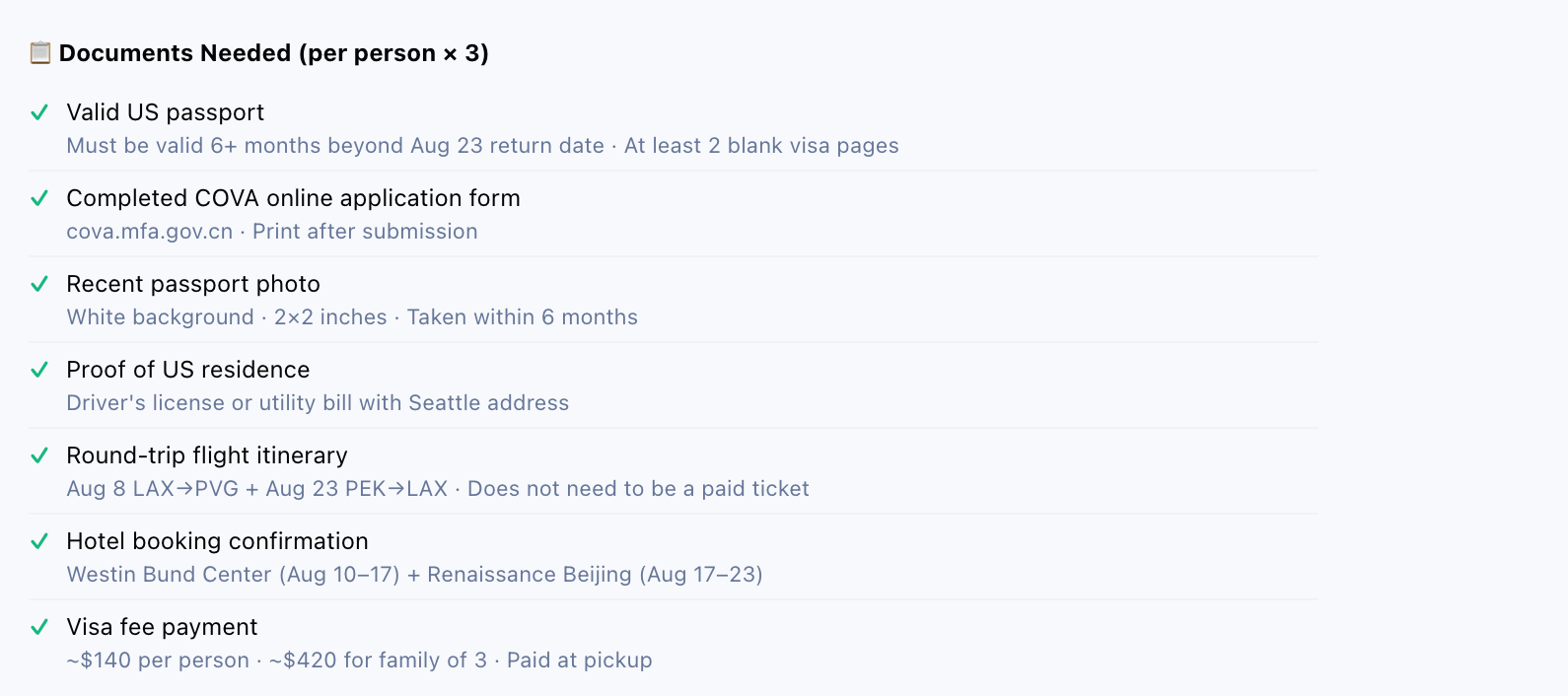
For the visa part, we needed Chinese tourist visas for 3 U.S. passports. The timeline suggested starting the COVA online application on June 25, uploading passport scans, white-background photos, flight details, and hotel confirmations. Then we would allow 3–5 working days for online pre-review.
If everything went smoothly, we could submit all three passports around July 7, and expect to pick them up around July 13–15. The visa fee was estimated at $140 per person, or about $420 total for our family of three. If we used express service or a visa agent, that would add extra cost.
That mattered because our departure date was August 8. If we had passports back by mid-July, we would still have about three weeks before departure. Not too tight. Not panic mode.
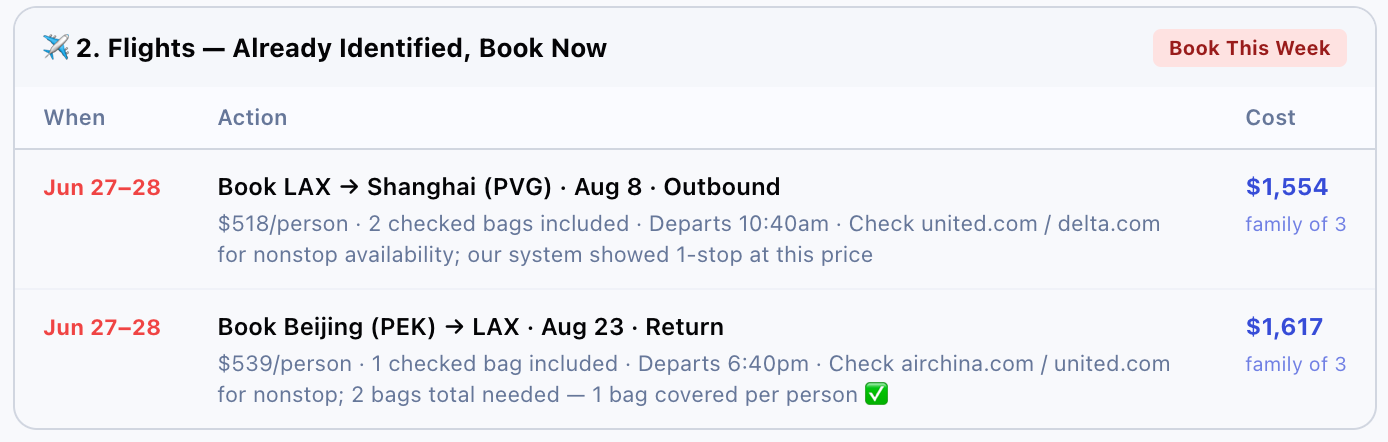
It also pulled flights and hotels into the same timeline. For flights, it separated LAX → Shanghai and Beijing → LAX, suggesting we book around June 27–28. The outbound leg for three people was about $1,554, and the return leg was about $1,617.
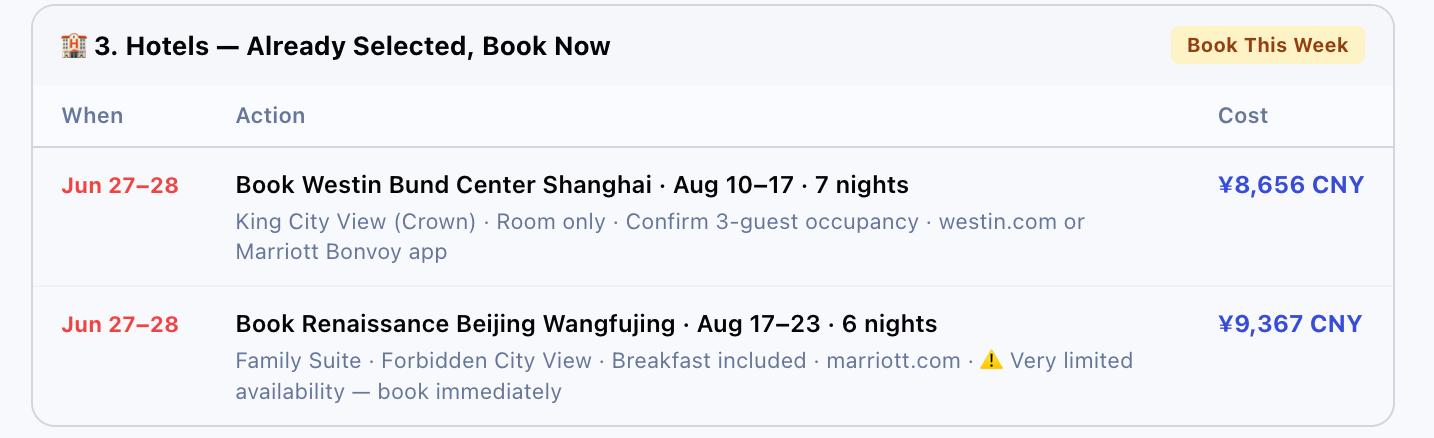
The hotel timeline was also useful. It showed the selected Shanghai hotel at about $1,210 for 7 nights and the Beijing hotel at about $1,310 for 6 nights. The Beijing family suite had limited availability, so that was not something we wanted to sit on forever.
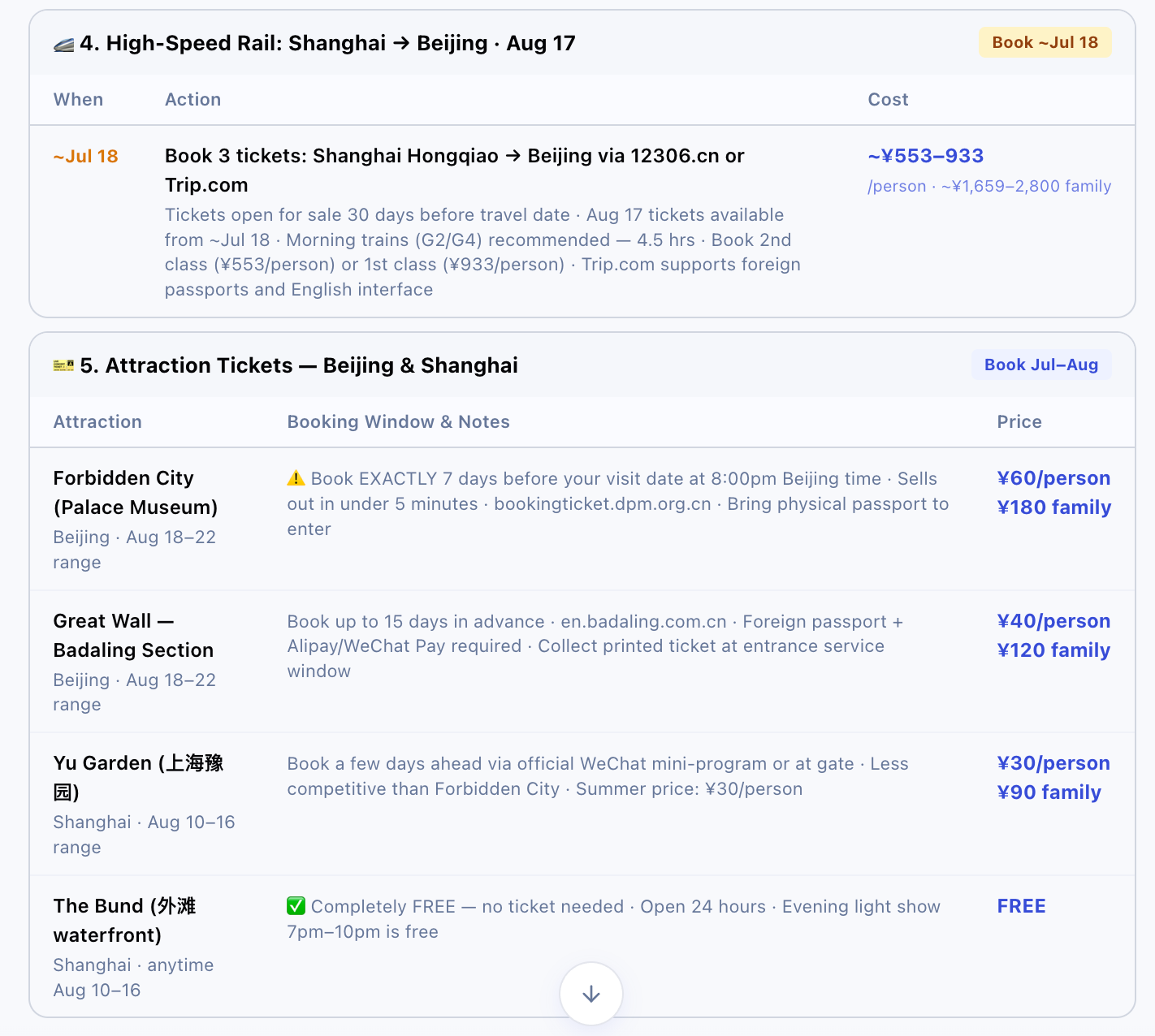
Then there were trains and tickets. The Shanghai-to-Beijing high-speed rail tickets open about 30 days before travel, so for an August 17 train, we needed to start watching around July 18. The Forbidden City ticket window was even more specific: usually 7 days before the visit, right at 8:00 PM Beijing time. In other words, not exactly “I’ll get to it whenever.”
For us, this timeline was honestly one of the most useful parts. It was not just saying, “Here are fun things to do in China.” It was helping us avoid the classic family trip disaster combo: visa delay, sold-out family room, bad train time, and missed attraction tickets.
No one wants to explain to a 7-year-old why the Forbidden City plan failed because someone forgot to click at the right time.
From a wish list to a route that actually worked
At first, we were considering Shanghai, Beijing, and maybe one more city like Xi’an, Suzhou, or Hangzhou. Chengdu sounded tempting too — pandas are hard to say no to — but for a first China trip with a child, it felt like too much moving around.
So we narrowed the plan down to two main cities: Shanghai and Beijing.
We preferred nonstop flights from LAX if possible. But for the exact dates we were testing, the first fare comparison came back as 1-stop options. That still gave us a useful early signal: even among the lowest 1-stop fares, route direction changed the price.
The route came down to two directions:
Option 1: Fly into Beijing, fly home from Shanghai Option 2: Fly into Shanghai, fly home from Beijing
That is where the trip stopped being just a route choice. The order would affect flight options, hotel dates, room availability, and the final budget.
The first 1-stop fare comparison also favored Shanghai first
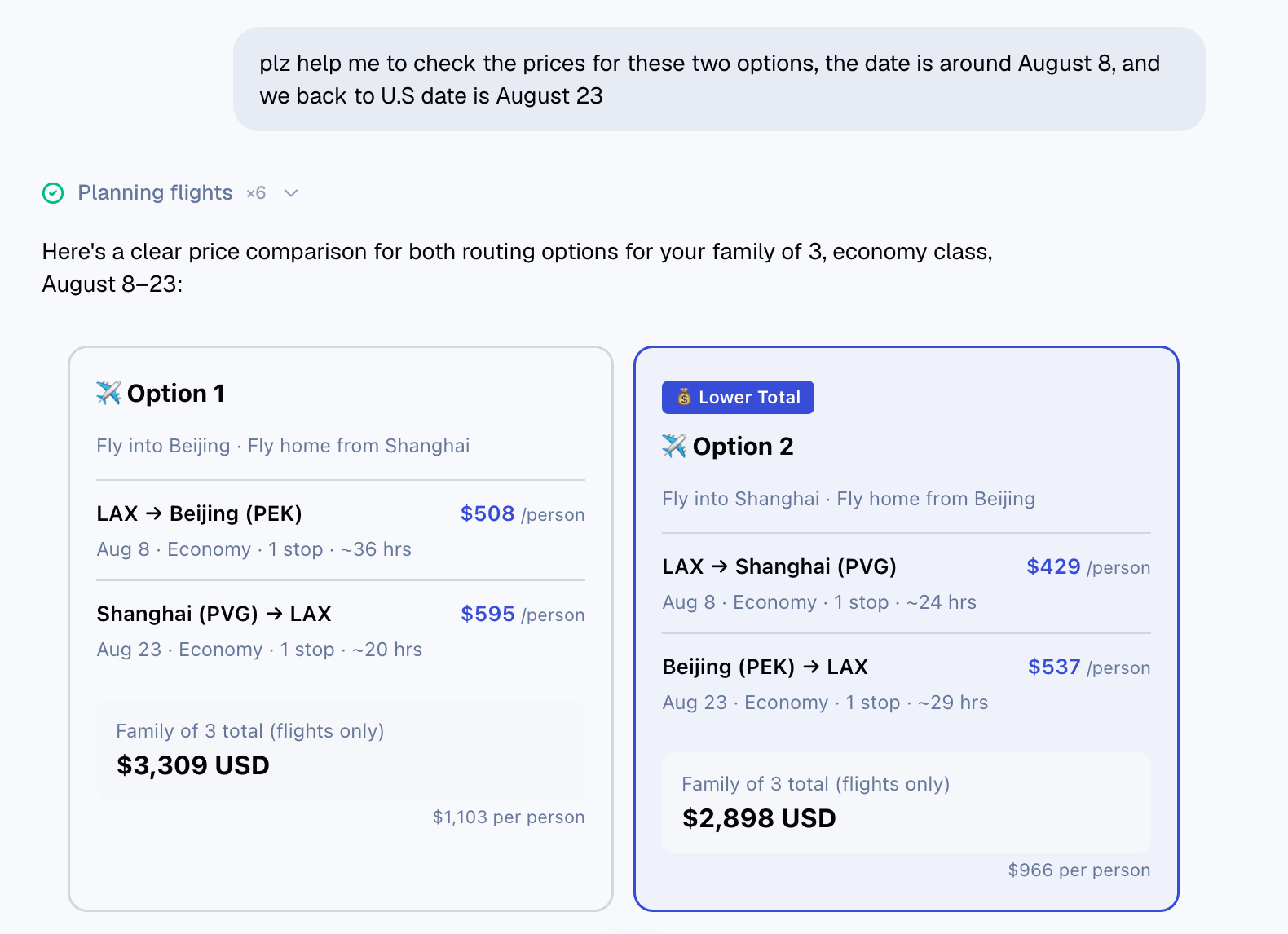
For August 8 departure and August 23 return, we compared the lowest available economy fares for both route directions.
Important note: these were 1-stop fares, not nonstop fares. Since we preferred nonstop flights, we would still need to verify nonstop inventory and prices directly with the airlines before booking.
For Beijing in, Shanghai out, the economy flights for our family of three came to about $3,309 total, or about $1,103 per person.
For Shanghai in, Beijing out, the total was about $2,898, or about $966 per person.
That means among the lowest 1-stop fares we found, the Shanghai-first direction was about $411 cheaper.
This did not answer the nonstop question directly. But it did show that route direction mattered before we even touched the hotel budget.
Why we leaned toward Shanghai first
After looking at the flight prices, trip flow, and what it would feel like to arrive with a child, we leaned toward a slower two-city plan:
August 8: Fly from LAX to Shanghai August 10–17: Stay in Shanghai for 7 nights August 17: Take the high-speed rail from Shanghai to Beijing, about 4.5 hours August 17–22: Stay in Beijing for 6 nights August 23: Fly from Beijing back to LAX
This order made sense for us. Shanghai felt like an easier landing point: more international, easier to adjust, and less intense right after a long flight. Beijing could come later, when we had more energy for the Forbidden City, the Great Wall, hutongs, and the heavier historical sightseeing.
Experience-wise, the route felt good.
But the real question was: did the numbers agree?
Hotel test: 13 nights under a $2,800 budget
Our hotel needs were more specific than I expected.
We needed one room for three people. We did not want to switch hotels within the same city. We wanted either a king bed + sofa bed, a family suite, or at least a room setup that could comfortably work for two adults and one child. And since we were traveling with U.S. passports, the hotel needed to accept foreign guests.
Our hotel budget was under $2,800 for 13 nights.
The first hotel combination Fortrip AI found was:
In Shanghai, The Westin Bund Center Shanghai for 7 nights, King City View, room-only, about $1,210 total, or about $173 per night.
In Beijing, Renaissance Wangfujing Beijing for 6 nights, Family Suite, Forbidden City View + Breakfast, about $1,310 total, or about $218 per night.
Together, the 13-night hotel total came to:
$1,210 + $1,310 = $2,520
That kept us under the $2,800 hotel budget, with about $280 left.
For a family of three, that felt pretty solid. It was not the cheapest possible combination, but it actually worked for our room needs, location, and travel style.
But what if we reversed the order?
This is where I got suspicious.
The flights had already shown that direction mattered. So I wanted to know: what about hotels?
What if we did Beijing first, then Shanghai? Would that be cheaper?
Same hotel standard. Similar room types. Same total number of nights.
The result was a little painful.
In the reverse plan, Beijing came first for 7 nights. The same Renaissance Wangfujing Beijing Family Suite jumped to about $2,480 total, or about $354 per night.
Shanghai came second for 6 nights at the Westin Bund Center, about $1,070 total, or about $178 per night.
The reverse hotel total became:
$2,480 + $1,070 = $3,550
Compared with the original $2,520, that was $1,030 more.
That is a 40.8% increase.
And it pushed the hotel plan about $750 over budget.
Why the order mattered
The big difference came from Beijing.
In the original plan, we stayed in Beijing for 6 nights, and the Family Suite was about $1,310. In the reverse plan, Beijing became 7 nights, and the same type of room jumped to about $2,480. Shanghai stayed much more stable: about $1,210 for 7 nights in the original plan, and about $1,070 for 6 nights in the reverse plan.
So the issue was not just adding one more night. It was putting the Beijing family suite into a more expensive date window.
That is exactly the kind of thing I would probably miss if I were checking hotels one by one. Same cities, same hotel standard, same 13 nights — but the order changed the price by about $1,030.
In the end, Shanghai first made more sense for us. The hotel total stayed around $2,520, under our $2,800 budget, while the reverse order came out around $3,550. The lowest 1-stop flight comparison also favored the Shanghai-first route by about $411.
Fortrip AI did not make the decision for us. It just showed the trade-offs clearly before we paid for anything — and that was the useful part.