Splitting Your Cancun Stay Between Two Resorts? The Check-In Order Can Change Your Total, Even With the Same Split
Splitting a Cancun honeymoon between Le Blanc and Live Aqua, I figured the night split was the only thing that mattered for price. Turns out even with the exact same split, just flipping which resort you check into first changed the total by $40+ every time — for the identical trip.
If you're planning a Cancun honeymoon or anniversary trip and thinking about splitting your stay between two resorts, say a few nights somewhere upscale and the rest somewhere more relaxed, you've probably already figured out that the split itself matters. More nights at the pricier resort means a bigger bill. That part's obvious.
What's less obvious: even when the split stays exactly the same, the order you check into each resort can change your total too.
The Trip: 7 Nights, Two Resorts, One Question
The itinerary here was a 7-night Cancun honeymoon starting November 10, split between Le Blanc Spa Resort (adults-only, all-inclusive, one of the more premium properties in the Hotel Zone) and Live Aqua Beach Resort, a few minutes down the same stretch of Blvd. Kukulcán.
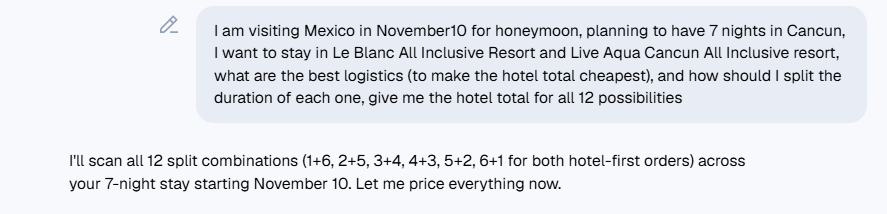
With 7 nights and two hotels, there are 12 different ways to arrange the stay: how many nights go to each resort, and which one you check into first. The obvious question was which split made the most sense for the honeymoon. The less obvious question, the one worth digging into, was whether the order mattered at all once the split was locked in.
Share
Start a trip Fortrip can actually defend.
Sketch a brief. We come back with an itinerary that reads like a recommendation, not a checklist — and tell you what we’d change about it.
The whale shark is a filter-feeding fish, not a whale, and the largest confirmed individual measured 61.7 feet. Here's what it actually is, where it lives, and the seasonal windows at Ningaloo, Holbox, La Paz, and the Maldives where you can swim near one.
Among cheap diving destinations, Utila and Dahab still anchor the budget certification market, while shore-access towns like Tulamben, Moalboal, and Koh Tao beat liveaboard-dependent sites like Raja Ampat on pure cost. Here's what actually drives the price gap, with sourced pricing, a quick-answer summary, and an FAQ so the comparisons hold up.
Same Split, Different Order, Different Total
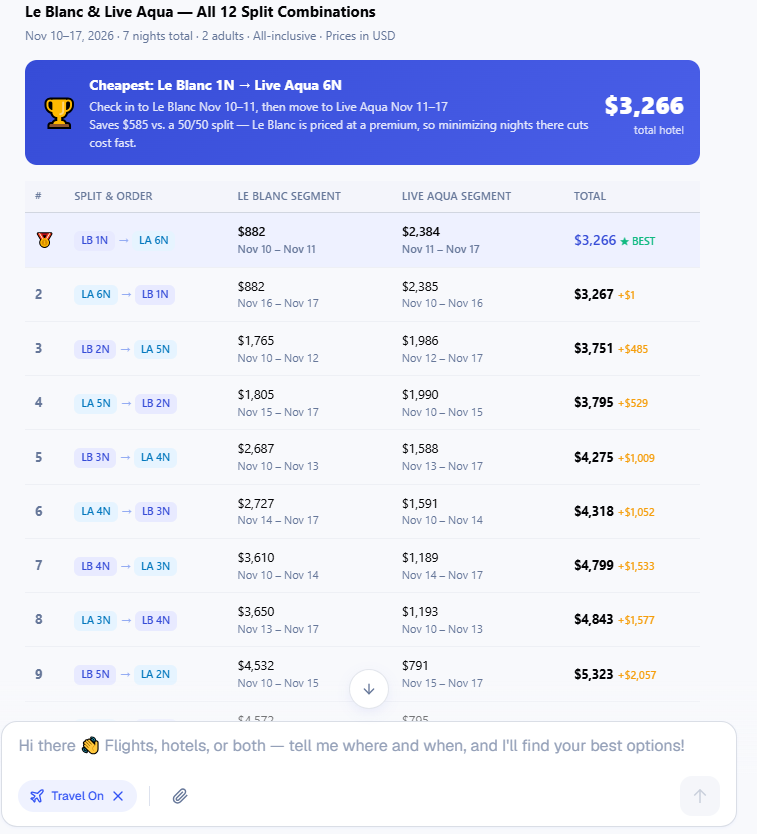
Here's where it got interesting. Looking at a few matched pairs, same number of nights at each resort, just the order reversed:
Le Blanc 2N → Live Aqua 5N: $3,751
Live Aqua 5N → Le Blanc 2N: $3,795 (+$44 for the identical split, just flipped)
Le Blanc 3N → Live Aqua 4N: $4,275
Live Aqua 4N → Le Blanc 3N: $4,318 (+$43)
Le Blanc 4N → Live Aqua 3N: $4,799
Live Aqua 3N → Le Blanc 4N: $4,843 (+$44)
Le Blanc 5N → Live Aqua 2N: $5,323
Live Aqua 2N → Le Blanc 5N: $5,367 (+$44)
Same two hotels. Same total nights. Same exact split every time. The only thing different is which resort comes first, and Le Blanc-first won every one of these matchups by a consistent $43 to $44.
The one exception was the most lopsided split, 1 night at Le Blanc and 6 at Live Aqua (or the reverse), which came out essentially tied at $3,266 versus $3,267. With only one night at Le Blanc, there's barely any date range left for the price to move around in.
Why Order Changes the Price at All
The explanation comes down to how Le Blanc's nightly rate moves across the week. It isn't flat, some dates within the same seven-day window are priced higher than others. Checking into Le Blanc first locks your nights there into the earlier, slightly cheaper end of that window. Checking in later in the trip pushes those same Le Blanc nights onto the pricier dates instead. Live Aqua's rate barely moves either way, so the whole swing comes down to which resort ends up sitting on the better dates.
This isn't a Cancun-specific quirk, either. Any time you're splitting a stay between two properties in the same destination, or even planning a multi-city trip with more than two stops, hotel pricing is rarely flat across every date in your window. Which property lands on which dates can move your total without changing anything else about the trip.
What This Means If You're Planning a Split Stay
If you're already committed to two resorts and just deciding on the ratio, it's worth checking both orders for whatever split you land on before you book. In this case, a $2-night Le Blanc stay barely felt like enough time to enjoy the property (the spa, the butler service, the overwater aesthetic), so the honeymoon plan settled on 2 nights at Le Blanc and 5 at Live Aqua rather than the absolute cheapest 1+6 split. But within that 2+5 split, booking Le Blanc first instead of Live Aqua first saved that extra $44 for zero downside: same hotels, same nights, same everything except which one comes first.
That's the part worth remembering. The cheaper order isn't a worse trip in any way. It's the identical stay, just arranged to land on better dates.
How FortripAI Handles This Automatically
Manually comparing 12 different splits and orders, each one requiring you to look up rates for specific date ranges at two different hotels, isn't something most people want to do by hand. This is exactly the kind of comparison FortripAI's Hotel Optimization Agent is built for.
Give it your destination, your two (or more) hotels, and your total trip length, and it prices every viable combination of nights and order at once, using live rates rather than estimates. For a split-stay trip like this one, that means seeing all 12 combinations ranked side by side, with the exact date ranges each one implies, instead of manually testing a handful of options and hoping you didn't miss the cheaper arrangement.
The same logic extends past two-resort splits. If you're planning a multi-city trip with three, four, or more stops, the number of possible orderings grows fast (four cities alone gives you 24 different sequences), and the agent handles that same comparison at scale, flagging which cities or hotels are the actual price drivers so you're not guessing at what to reorder.
Planning a Multi-Resort or Multi-City Trip?
Whether you're splitting a Cancun stay between two resorts, deciding how to sequence a multi-city itinerary, or just trying to figure out if your current hotel picks and dates are actually the cheapest way to book the trip you already planned, running the comparison takes the guesswork out of it.
Does the order you check into two resorts change the total price?
Yes, when the resorts' nightly rates aren't flat across your travel dates. Checking into the pricier resort earlier in a trip can lock its nights into a cheaper date window, while checking in later can push those same nights onto more expensive dates, even with the identical number of nights at each property.
How many ways are there to split a 7-night stay between two hotels?
Seven nights split between two hotels gives you 12 total combinations: six possible night splits (1+6, 2+5, 3+4, 4+3, 5+2, 6+1), each of which can be booked in either order.
Is it cheaper to book the more expensive resort first or last?
It depends on how that resort's rates move across your date window, but in cases where the pricier resort's rates rise later in the stay, booking it first tends to come out cheaper. Checking both orders for your specific dates is the only reliable way to know for sure.
What's the best way to compare all the possible hotel splits and orders for a trip?
Pricing every combination by hand across multiple date ranges is tedious and easy to get wrong. FortripAI's Hotel Optimization Agent prices every viable split and order at once using live hotel rates, so you can see the full ranked comparison instead of testing a few options manually.
All hotel prices referenced are based on live rates pulled for November 2026 travel. Prices fluctuate with availability and season, so run your own dates for current numbers.