What Is the Best Order to Visit Multiple Cities? A Step-by-Step Optimization Method
I had my hotels picked out for a 12-night China trip and figured the city order was just a logistics question, not a price one. Turns out the same four hotels, the same nights, just arranged differently, came out $436 apart, and the flight side of the equation mattered just as much as the hotels did.
If you're planning a multi-city trip and already have your hotels picked out, there's a question most people never think to ask: does the order you visit these cities in actually change what you pay? I didn't think it would, until I ran the numbers on a China itinerary and found a $436 gap between the best and worst possible route, using the exact same hotels and the exact same number of nights in each city.
Here's how I found that gap, and the step-by-step method I used to optimize it.
The Trip: Four Cities, Fixed Hotels, One Open Question
The plan was a 12-night trip through China in September, three nights each in Beijing (JW Marriott Beijing), Chongqing (Conrad Chongqing), Zhangjiajie (Pullman Zhangjiajie), and Chengdu (The Ritz-Carlton Chengdu), flying in and out of Tokyo. With four cities that could go in any order, that's 4! = 24 possible sequences. The hotels weren't changing. The number of nights in each city wasn't changing. The only variable was the order.
Share
Start a trip Fortrip can actually defend.
Sketch a brief. We come back with an itinerary that reads like a recommendation, not a checklist — and tell you what we’d change about it.
Generative AI has made itinerary generation nearly instant — but speed was never the hard part of travel planning. The harder part is the decision-making underneath it: trade-offs between cities, hotels, and pace that no traveler can fully specify upfront. This piece argues that the next real opportunity in travel AI isn’t prettier itineraries, but helping travelers understand the choices behind them.
Three days, two nights, $230 total including flights, hotel, food, and entry fees — and it felt more restorative than a night at a beach resort. A full Sukhothai guide covering ancient ruins with zero crowds, sunrise at a hilltop Buddha, and exactly how to get there.
My first instinct was to just pick an order that made sense on a map and book it. Instead, I decided to price out all 24 combinations, hotels and flights together, before committing to anything.
Step 1: Price the Hotels Across Every Possible Order
The first thing to check is whether any of your hotels have rates that shift meaningfully by date, since that's what actually creates a price difference between orderings in the first place. If every hotel charged the same rate no matter when you checked in, the order wouldn't matter at all.
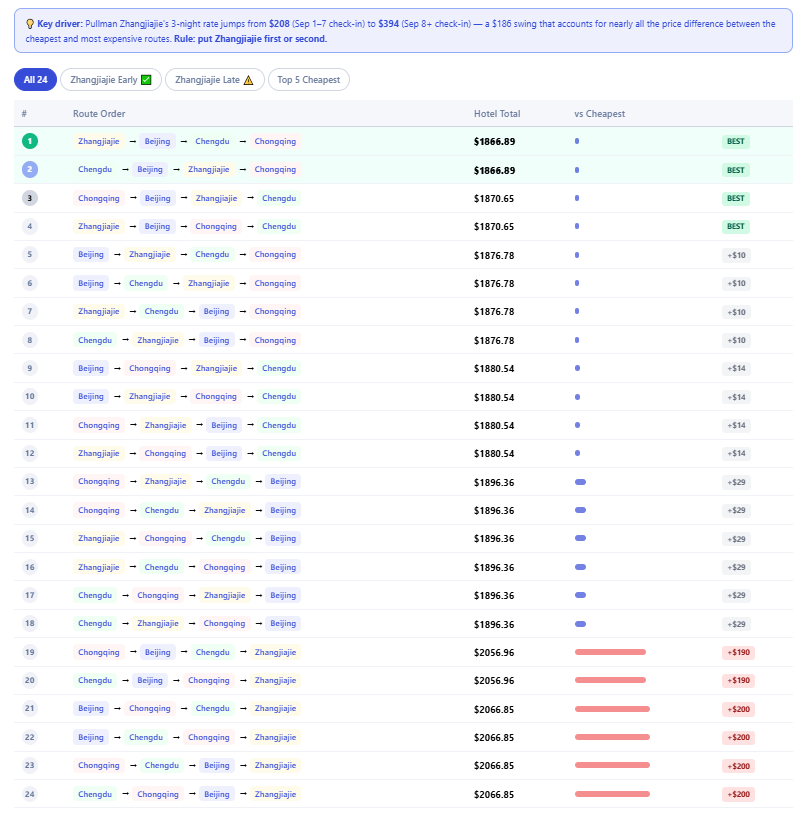
In this case, one hotel completely dominated the math: Pullman Zhangjiajie had a hard rate cliff on September 8. A 3-night stay checking in anywhere from September 1 through 7 cost $208. Checking in September 8 or later jumped the same room to $394, a $186 difference for an identical stay.
Every other hotel in the trip stayed roughly flat regardless of date. So the entire hotel-side optimization came down to one rule: whatever order you pick, make sure Zhangjiajie lands in an early slot, not the last one.
Two orderings tied for cheapest on hotels alone, both landing at $1,866.89 for all four properties combined:
Zhangjiajie → Beijing → Chengdu → Chongqing
Chengdu → Beijing → Zhangjiajie → Chongqing
The worst ordering, where Zhangjiajie fell into the final slot and got hit with that $186 rate jump, came out around $2,067, roughly $200 more for the same four hotels and the same twelve nights.
Step 2: Price the Flights Across Every Possible Order
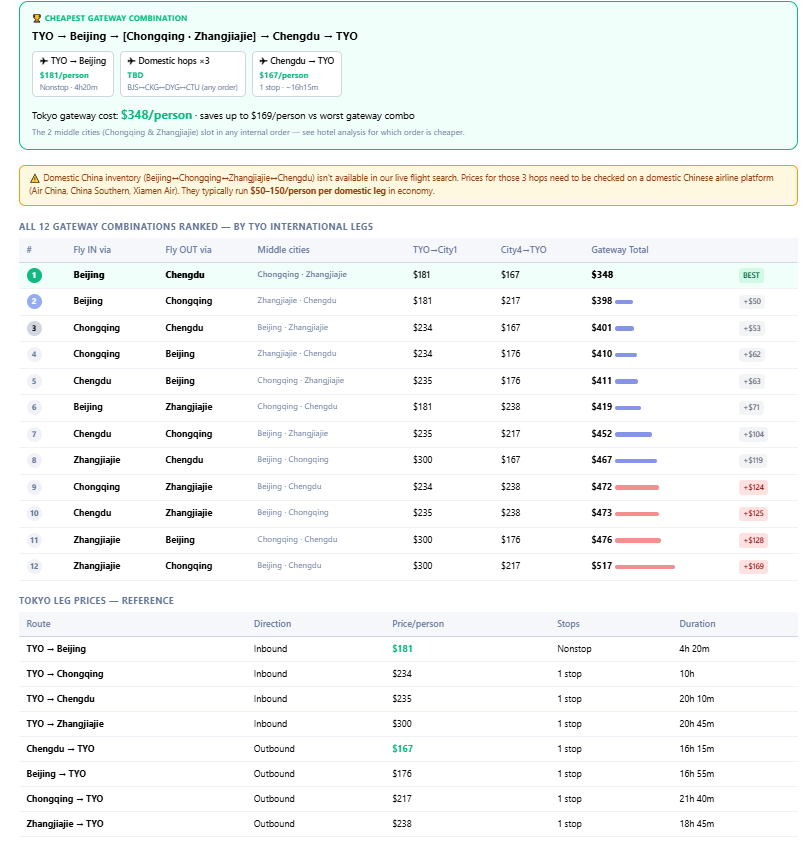
Hotels are only half the picture on an international multi-city trip. Since every domestic hop within China used roughly the same set of city-pair flights regardless of order, those legs stayed close to constant no matter how the cities were sequenced. What actually moved was the international gateway, meaning which city you flew into first and which one you flew out of last.
Flying into Beijing came out to $181 per person on the cheapest available option, and it was the only nonstop option among the cities in this itinerary. Flying out through Chengdu was similarly the cheapest outbound leg at $167 per person. Starting or ending the trip in Zhangjiajie instead, by comparison, meant paying up to $169 more per person on the gateway flights alone, since Zhangjiajie's international connections were far thinner.
So the flight-side rule turned out to be just as simple as the hotel-side one: open in Beijing, close in Chengdu, and keep Zhangjiajie somewhere in the middle.
Step 3: Combine Hotels and Flights, Not Just One or the Other
This is the step people skip, and it's the one that matters most. Optimizing hotels alone gives you one answer. Optimizing flights alone gives you a different answer. The actual cheapest trip only shows up when you combine both, because sometimes the hotel-optimal order and the flight-optimal order don't fully agree, and you need to see which tradeoffs are worth making.
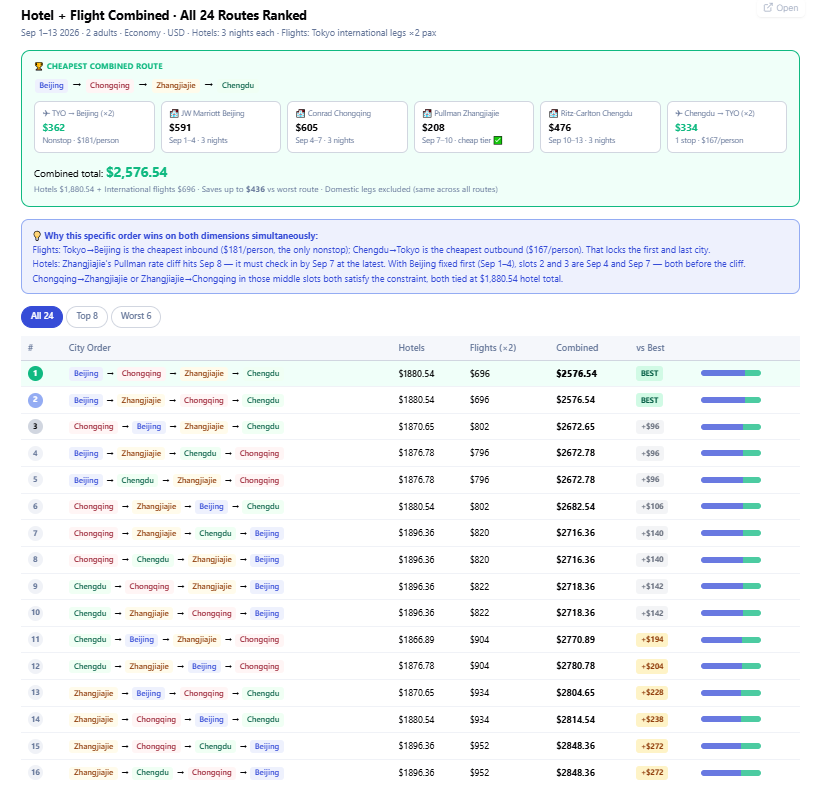
In this case, the two constraints turned out to line up almost perfectly. Beijing opening the trip satisfied the cheapest inbound flight. Chengdu closing it satisfied the cheapest outbound flight. And with Beijing in the first slot, Zhangjiajie naturally landed in the third slot, just ahead of the September 8 rate cliff that would have added $186 to the hotel bill.
Combined winner: Beijing → Chongqing → Zhangjiajie → Chengdu (tied with Beijing → Zhangjiajie → Chongqing → Chengdu), both landing at $2,576.54 for international flights plus all four hotels.
The worst combined ordering came out to $3,012.85, a $436 difference for the identical trip: same hotels, same nights, same cities, just a different sequence.
The Pattern Worth Remembering
None of this shows up if you're booking city by city on a normal travel site. You pick a city, you check dates, you book, you move to the next one. Nothing in that process tells you that one of your hotels has a hard price cliff on a specific date, or that your cheapest international gateway is a different city than the one you assumed you'd start with. You only see it once you compare every viable ordering side by side.
The bigger takeaway is that hotel optimization and flight optimization aren't always the same question, and treating them as one combined problem, rather than optimizing each separately, is what actually finds the cheapest version of a trip you were already planning to take.
How I Ran This Through FortripAI's Optimization Agent
Manually pricing 24 different city orderings across two separate cost categories, hotels and international flights, isn't something most people have the patience to do by hand. I used FortripAI's Hotel and Flight Optimization Agent to handle the actual number-crunching. The process looked roughly like this:
Input the fixed variables — the cities, the specific hotels already chosen, the number of nights in each, and the origin and return city for flights.
Let the agent price every viable ordering at once — all 24 permutations, using live hotel rates across the relevant date windows rather than static averages.
Flag the actual cost drivers — in this case, the agent surfaced the Zhangjiajie rate cliff and the Beijing/Chengdu gateway advantage automatically, rather than requiring a manual date-by-date comparison across four hotels and multiple flight routes.
Combine hotel and flight rankings into one total — since optimizing for one alone can miss cheaper combinations that only appear when both categories are weighed together.
That last step is the one that actually mattered here. Optimizing hotels alone would have pointed toward Zhangjiajie opening the trip. Optimizing flights alone would have pointed toward Beijing opening it. Only by combining both did the actual $436-cheaper route become visible.
Planning Your Own Multi-City Trip?
If you've already got hotels picked out for a multi-city itinerary, or you're still deciding on cities, the order you sequence them in is worth checking before you commit to a route. The same principle scales past four cities too: five cities gives you 120 possible orderings, and the more stops your trip has, the more likely it is that at least one property or one flight leg has a meaningful date-based swing hiding in there somewhere.
Does the order you visit cities in on a multi-city trip actually change the total cost?
Yes, when at least one hotel or flight leg has a rate that shifts by date. In this China itinerary, the spread between the cheapest and most expensive of 24 possible orderings came out to $436, using the identical hotels, the identical number of nights per city, and the identical flight routes, just sequenced differently.
Should I optimize a multi-city trip around hotel prices or flight prices?
Both, combined. Optimizing hotels alone and optimizing flights alone can point toward different orderings. The actual cheapest trip is usually found by pricing hotels and flights together as one combined total rather than picking whichever order wins on hotels or wins on flights individually.
How many possible orderings are there for a multi-city trip?
It depends on the number of cities with flexible order. Four cities give you 4! = 24 possible sequences. Five cities give you 5! = 120. Any city that's fixed as a first or last stop (like a return flight origin) reduces the number of combinations that need to be compared.
What usually causes the price difference between city orderings?
Typically one or two properties or flight legs with date-sensitive pricing. In this itinerary, a single hotel had a hard rate increase after a specific date, and the international gateway city made a meaningful difference in flight cost. Most of the total spread across all orderings traced back to just those two factors.
What's the easiest way to compare every possible order for a multi-city trip?
Pricing dozens of combinations manually across multiple hotels and flight routes is time-consuming and easy to get wrong. FortripAI's Optimization Agent prices every viable ordering at once, combining hotel and flight costs into a single ranked comparison so you can see the cheapest route without doing the math by hand.
All hotel and flight prices referenced are based on live rates pulled for September 2026 travel. Prices fluctuate with availability and season, so run your own dates for current numbers.