AI Trip Planner vs Travel Advisor vs OTA: Which One Do You Actually Need?
OTAs search inventory. Travel advisors coordinate. AI validates and optimizes the trip you already planned. In one anonymized multi-city case, the same three hotels and the same stay lengths ranged from roughly $6,150 to over $11,000 based only on the order the cities were visited. Here's which tool solves which problem — and how to use all three together.
By [Author name] · Published [date] · Last updated [date]
Planning a trip used to mean choosing between two options. You either planned everything yourself using search engines and online travel agencies, or you paid a travel advisor to put the trip together for you.
AI created a third option. But the three are not interchangeable.
An online travel agency (OTA) — Booking.com, Expedia, Trip.com — is excellent at showing you inventory and helping you book it.
A is excellent at understanding context, applying human judgment, and coordinating a complicated trip with real suppliers.
Share
Start a trip Fortrip can actually defend.
Sketch a brief. We come back with an itinerary that reads like a recommendation, not a checklist — and tell you what we’d change about it.
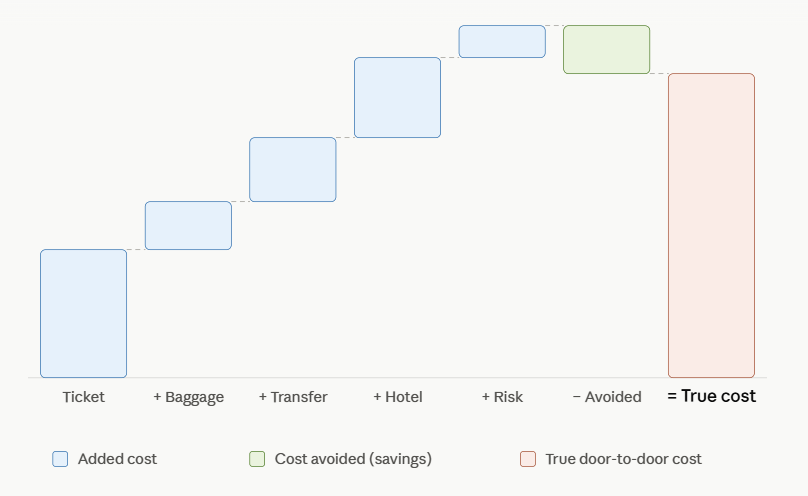
A cheap flight and a pricier train can end up costing the same once you add baggage, transfers, and an extra hotel night. Here's how to compare the full door-to-door cost — with five real routing cases where the obvious choice wasn't actually the cheapest one.
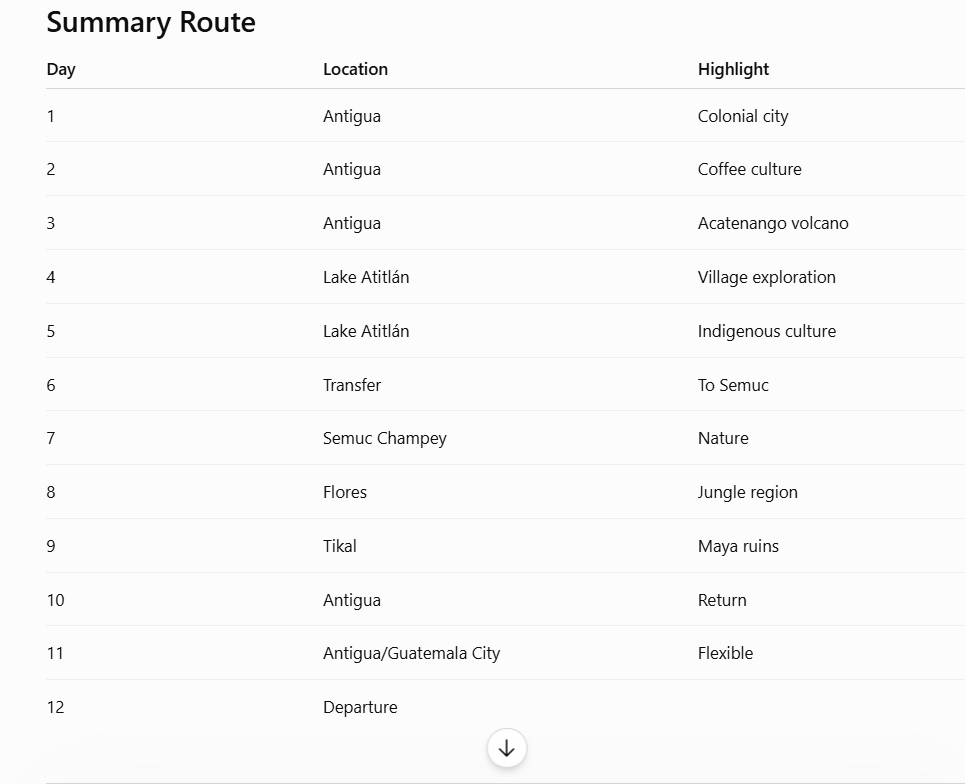
ChatGPT can plan a Guatemala trip in seconds — but a validator caught an altitude risk, two 10+ hour transfer days, and a season the itinerary never accounted for. Here's what to check before you book.
An AI trip planner sits somewhere else entirely: between the moment you start considering a trip and the moment you are confident enough to book it.
That distinction matters, because for a lot of travelers the hardest question is no longer "Where can I book this hotel?" It is "Should I book this hotel at all?"
Or:
Should I visit these four cities in this order?
Am I trying to fit too much into 10 days?
Is this itinerary actually feasible?
Is the cheapest hotel still cheapest after transportation?
Should five of us book one suite or two rooms?
Would shifting one destination by two nights lower the total hotel cost?
What happens if my flight time changes after I have planned everything?
I already built my own itinerary — can someone check whether it actually works?
Those are not inventory questions. They are travel decision questions. And that is where the difference between the three tools becomes important.
Quick Answer: AI Trip Planner vs Travel Advisor vs OTA
If you already know exactly what you want to book, an OTA is the fastest place to search inventory and complete the transaction.
If you want high-touch human service, complex supplier coordination, or someone to manage the trip for you, a travel advisor is the better option.
If your biggest problem is deciding what the trip should look like — comparing alternatives, validating an itinerary you already made, or recalculating the plan as things change — an AI trip planner is the right tool.
What you need
OTA
Travel Advisor
AI Trip Planner
Search flights and hotels
Excellent
Good
Good, depending on integrations
Book known inventory
Excellent
Excellent
Varies
Decide where to go
Limited
Strong
Strong
Understand vague preferences
Limited
Strong
Strong
Compare multiple trip structures
Limited
Strong
Very strong
Check whether an itinerary is realistic
Limited
Strong
Very strong
Test many city orders or hotel combinations
Very limited
Limited by time
Very strong
Explain trade-offs
Limited
Strong
Strong
Make repeated "what if?" changes
Limited
Labor-intensive
Very strong
Respond instantly
Search-based
Usually slower
Near-instant
Work 24/7
Yes, but transactional
Usually no
Yes
Review an itinerary you already made
Limited
Strong
Strong
Replan continuously after changes
Limited
Possible, but manual
Strong
Handle non-standard requests
Limited
Strong
Strong
Give human judgment and reassurance
Limited
Excellent
Improving, but different
There is no universal winner. The right tool depends on which stage of the travel decision you are currently in.
Does City Order Change Your Hotel Price? A $4,900 Example
Start with the finding that surprises most travelers, because it reframes everything else.
A traveler had already decided on three destinations and three hotels:
Cancún — 4 nights
Jamaica — 4 nights
Dominican Republic — 3 nights
The hotels were chosen. The total travel window was fixed. At first glance there was nothing left to optimize.
But three destinations can be sequenced six different ways, and each sequence assigns a different set of calendar dates to each hotel. Hotel pricing is date-sensitive. So is availability. So are room types.
In one anonymized trip analyzed through FortripAI, the same three hotels, the same stay lengths and the same overall travel window produced total accommodation costs ranging from roughly $6,150 to more than $11,000 — purely because the city order changed which dates landed on which property.
No destination changed. No hotel changed. Only the structure changed.
We call this the sequence premium: the amount a multi-city trip costs you for being ordered one way instead of another. It is invisible on any booking site, because a booking site prices each stay independently, against dates you have already decided.
It happens on single-city trips too
The effect is not limited to multi-country routes. A traveler wanted five nights in Amsterdam during a major music festival and planned to split the stay across two hotels to avoid paying peak rates for the whole week. Two splits were tested against live quotes:
Split
Segment A
Segment B
Total
2 nights + 3 nights
Peak window
Tail window
$888
3 nights + 2 nights
Peak window
Tail window
$1,081
Same city, same five nights, same arrival and departure dates. Moving the longer block from the tail of the festival to the peak of it cost $193. Adding a "must be in the city centre" requirement moved the same five nights to roughly $2,497 — which is a legitimate choice, but one worth making knowingly rather than by accident.
(Prices reflect live quotes at time of search. Travel prices and availability change continuously.)
When to Use an OTA
Online travel agencies are extremely good at one thing: turning a defined travel decision into searchable inventory.
You provide destination, dates, travelers, room requirements and filters, and the OTA returns hundreds of options.
If you already know "I need a hotel in central Madrid from October 12–15 for two adults, under $220 per night, with free cancellation" — an OTA solves that efficiently, and nothing else solves it better.
What OTAs are best at
They have structural advantages that are difficult to replicate: enormous accommodation inventory, extensive flight connectivity, large review datasets, payment infrastructure, loyalty programs, cancellation workflows, supplier relationships and standardized booking processes.
Why OTAs search inside a decision you already made
There is an assumption underneath the entire OTA experience: the traveler has already made the important decisions.
An OTA answers "What hotels are available in Kyoto on these dates?" It is much less equipped to answer "Should Kyoto even fall on these dates?"
That sounds like a small distinction. On a multi-city trip, the previous section shows what it can be worth.
Most OTA interfaces open with some version of "Where are you going?" — which works perfectly when you know, and not at all when you do not. A real travel question often looks more like:
"I have two weeks in Southeast Asia, around $1,500, traveling alone, and I care most about culture, food and nature. I am considering Thailand, Vietnam, Singapore and Indonesia, but I do not want the trip to feel rushed."
There is no search box for that. Before any flight or hotel can be searched, someone has to decide how many countries make sense, which destinations combine naturally, how many nights each place deserves, which transfers destroy too much time, and what should be removed.
That is not a search problem. It is a decision problem.
OTAs search inside a decision. AI helps you form the decision.
When to Use a Travel Advisor
A good travel advisor does something an OTA generally cannot: understand the traveler.
Someone can say "My parents are coming, so I want culture and nature, but I do not want every day to be exhausting" — or "This is our honeymoon. We are happy to save on transportation, but there are two or three hotels where we actually want to spend more."
A good advisor interprets the intention behind those statements, and then coordinates the things software cannot: private transfers, guides, special requests, unusual activities, complicated room arrangements, destination management companies, high-end properties, group logistics, and problems that occur mid-trip.
For complex or luxury travel, that human service is genuinely valuable. But human advice has one unavoidable constraint: time.
The hidden cost of every "what if?"
Imagine you are planning a five-city trip and you ask:
What if we reverse the last two cities?
What if we stay three nights here instead of four?
What if we keep the route but change the hotel?
What if we fly Tuesday instead of Wednesday?
What if our fourth traveler only joins for two nights?
What if two rooms are cheaper than the family suite?
A great advisor can answer all of these. But each variation costs labor, which naturally limits how many alternatives ever get tested.
AI changes the economics of iteration. The marginal cost of one more "what if?" becomes close to zero — and that matters more than it sounds, because travel preferences are usually discovered rather than known.
You might think you want five cities until you see how much travel time that creates. You might think you want the cheapest hotel until you realize it adds 40 minutes of transit every day. You might think you want a family suite until you find two standard rooms are cheaper.
There is also no social cost to changing your mind with software. Even with a completely professional advisor, people hesitate before saying "Actually, can we change it back?" — and that hesitation quietly reduces how good the final plan gets.
When to Use an AI Trip Planner
The most valuable moment for AI is not the blank page. It is this one:
"I have a plan, but I'm not sure it's the best plan."
By that point the traveler has already done the work. They may have a spreadsheet, a Google Doc, a ChatGPT itinerary, an advisor's proposal, booked flights, several hotel candidates, a rough route.
They do not want another itinerary. They want a second opinion.
Trip validation: checking an itinerary you already made
Validation asks a different question from generation. Not "what should I do?" but "does what I planned actually work?"
Consider a traveler with one day in a major European city. The flight lands around 10 AM, the return leaves around 9 PM, and the wish list has eight items: a canal cruise, a museum, a food market, a cooking class, an escape room, a viewpoint and several food stops.
A basic itinerary generator drops all eight onto a timeline. A validator asks: how much usable time actually exists?
A 10 AM landing does not put you in the city centre at 10 AM. A 9 PM departure does not mean sightseeing ends at 9 PM. Real usable time is what remains after airport exit, airport-to-city transport, activity check-in, walking between stops, schedule buffers, return transport, security and boarding.
The useful answer is therefore something like: "Eight activities were requested. Five fit comfortably. Six are possible with some risk. All eight would make the day fragile."
That is feasibility reasoning, and it is worth having before money is spent.
What validation catches in practice. In one anonymized case, a traveler brought a 22-day Southeast Asia itinerary they had built themselves. The route was good. Three things were not:
A same-day connection near the end of the trip left a possibly insufficient gap between an inbound domestic flight and a long-haul departure — the only error in the plan that could have caused real financial damage.
Day 17 had a Sunday night market scheduled on a Thursday.
Day 9 stacked three city-centre temples ahead of a long drive that would have been easier the following morning.
None of those is the kind of mistake that shows up while you are writing the plan. All three show up while you are living it.
Why validation matters: it is really about regret
Most travelers enjoy planning. What they dislike is discovering the plan was wrong.
Travel regret has a fairly consistent shape:
arriving at a closed attraction
missing a connection
changing hotels unnecessarily
realizing a day trip needed twice the expected travel time
spending too little time somewhere important
spending too many nights somewhere that did not need them
booking an expensive hotel in the wrong location
discovering afterwards that a different city order would have been much cheaper
Closures are the most common and the most avoidable. Across three separate anonymized trips, pre-departure checks surfaced: a coastal beach access closed after storm damage to its stairway (with a five-minute alternative substituted); a canyon site that closes entirely during high wildfire-risk days in late summer; and a typhoon approaching a destination inside the traveler's exact dates, which moved outdoor sites to indoor alternatives.
All three warnings arrived before anything was booked.
Seasonal closures are the version travelers underestimate most. In another anonymized case, a solo traveler brought a 14-day western US camping route. Two of the campgrounds in the plan close for the season before the traveler would have arrived, and a third accepts hard-sided vehicles only — no tents. The traveler, in turn, corrected two of the system's driving-time estimates. The final route was better than either party would have produced alone, which is the honest version of how this works: AI as a second reader, not an oracle.
Trip optimization: is this the best version of the trip?
Validation asks can this trip work? Optimization asks is this the best version of it?
With three flexible destinations there are 6 possible orders. With four, 24. With five, 120. And that is before layering in different stay lengths, hotel alternatives, room types, split stays, breakfast, cancellation policies, nearby airports, transfer methods and flexible dates.
A human advisor makes excellent judgments from experience. But almost nobody manually prices 120 route permutations multiplied by hotel-date combinations. Software can — and that is a genuinely different kind of work from writing an itinerary. It is searching a decision space too large to explore by hand.
The same logic applies to room configuration. A group might choose among one family room, one suite, two standard rooms, a double plus a single, connecting rooms, or different configurations on different nights. The cheapest answer often changes by city — so an optimized multi-city trip might use a suite in City A, two rooms in City B and a triple in City C. Traditional hotel search optimizes each stay independently. A trip-level optimizer asks what combination produces the best overall trip.
Ranking trade-offs, not properties
OTAs rank inventory using price, reviews, popularity, location, filters, availability and commercial factors. They are very good at it.
But travelers often need a ranking of decisions, not properties.
Hotel A costs $67 less over six nights. Hotel B is better located for nearly every activity on the itinerary. The question stops being which is cheaper and becomes is saving $67 worth adding several hours of transit across six days?
That requires context about the specific itinerary. A decision system can say: "For this itinerary, take the more central hotel — the $67 premium is small relative to the time saved across six days."
Small decisions count here too, and they are exactly the ones no one would contact a professional about. One traveler, mid-trip, asked whether a 24-hour transit pass was worth buying for the next day. The answer was no: their plan used public transport for exactly one round trip, two single tickets cost €6.40 against €11.20 for the day pass, and they would have needed four or more journeys to break even. The saving was €4.80 — too small to justify a phone call to anyone, and still worth knowing.
Answering questions no booking site has a field for
Some questions cannot be entered into a search interface at all. One traveler asked, in effect: "I want to travel the Balkans by rail next year. I have one free week now. Which country is hardest to reach by public transport, so I should use a flight to tick it off while I can?"
There is no filter for that. The answer — that the countries with the weakest rail connections are worth flying to now, so the following year's route can run entirely overland — changed the structure of an entire trip, not a single booking.
Weather-driven sequencing works the same way. A traveler planning three months across four Southeast Asian countries supplied a list of more than 60 candidate towns and asked for an order. The constraint was not price but monsoon timing: the regions have opposing wet seasons, so the workable answer moved north early and south late, and explicitly removed two coastal areas that fall in typhoon season during the exact travel window.
Reasoning across categories that OTAs keep in separate tabs
Travel does not happen in verticals. A road trip involves route planning, fuel, hotels, ferries, driving conditions, insurance, breakdown cover, parking, attraction closures, weather, food budget and local regulations — but flights live in one tab, hotels in another, activities somewhere else, and the traveler has to integrate it mentally.
One traveler planning a long drive from northern England to the Spanish coast started with a straightforward comparison: Channel Tunnel versus a long ferry crossing, weighed on cost and driving hours. Then they added one detail — a six-year-old was coming.
That single constraint flipped the recommendation. The ferry became the better answer, not on price but because the crossing is itself an activity, everyone sleeps properly in a cabin, and the drive on the far side drops to a few hours instead of two more days strapped into a car seat. The same conversation also covered the insurance paperwork, headlamp adaptors and vehicle stickers the drive required — items that live on four different websites.
Decisions interact. A cheaper hotel may require a rental car. A cheaper flight may require another hotel night. A scenic route costs fuel. A later departure saves annual leave. A destination stops being worth it if the one attraction you came for is closed. Travelers are not optimizing individual products. They are optimizing the trip as a system.
Replanning when something changes
Travel plans change constantly. A flight arrives three hours later. A traveler drops out or joins. A hotel sells out. An attraction closes. The budget moves. A static itinerary is outdated the moment any of that happens.
The better model is: change one constraint, then recalculate only what it affects.
In one anonymized case, a traveler had sightseeing planned for arrival day, then clarified that the real flight landed around 6–7 PM. The right response was not to regenerate the whole vacation. It was to move the attractions that would already be closed and leave the rest of the plan intact.
What travelers actually ask for: a workspace
One of the most revealing behaviors we see is travelers asking: "Can I save this so I can come back and decide later?"
They do not just need Day 1 through Day 10. They need somewhere to hold:
Decided — route, flights, hotel, dates
Still deciding — two rooms or a suite, city A or city B, car or train, beach day Friday or Sunday
Need to book — hotel, activity, transfer
Need to verify — entry requirements, insurance, opening hours, road conditions
That is not an itinerary generator. It is a travel decision workspace.
If You Already Have a ChatGPT Itinerary, What's Missing?
A general-purpose AI assistant will produce a plausible, well-written day-by-day plan in about a minute. That part is genuinely easy now, and it is not where trips go wrong.
What a generated itinerary usually cannot tell you:
Whether the dates are real. Markets on the wrong weekday, museums on their closing day, festivals that ended last year.
Whether the transfers are real. Driving times pulled from memory rather than measured; connections that look fine on paper and are not.
Whether anything is closed. Seasonal campground closures, wildfire-risk closures, storm damage, permit requirements with limited daily quotas.
Whether the prices are real. A generated itinerary that quotes fares and room rates is usually quoting from training data, not from live availability.
Whether the structure is efficient. A generated plan takes the city order you gave it. It will not tell you that reversing two stops would move thousands of dollars.
Whether it still works tomorrow. When your flight time changes, a static document does not update.
The practical move is not to choose between them. Generate wherever you like — then have the result checked against live data before you pay for any of it.
Can You Use All Three Together?
Yes, and for a complicated trip that is usually the right answer.
Decide with AI — which destinations, how many nights, what city order, how to allocate the budget.
Validate with AI — travel time, closures, feasibility, missing nights, risky connections.
Optimize with AI — alternative sequences, hotel dates, room configurations, transport options.
Book with an OTA or direct with suppliers — flights, hotels, standard activities.
Bring in a human advisor or DMC — private services, specialist experiences, complex on-the-ground requests.
The real opportunity for AI may not be replacing OTAs or travel advisors at all. It may be becoming the decision layer that connects them.
So "which one is best?" is usually the wrong question. The better one is: which problem am I trying to solve right now?
Where FortripAI Fits
FortripAI is built on a simple belief: travelers do not need another tool that generates an itinerary faster.
Generating a plausible itinerary is increasingly easy. The hard problems come before and after that document exists.
Should you visit four cities or three? Is the order costing you money? Does the itinerary actually work? What happens if your flight changes? Is the cheapest hotel really cheapest after transportation? Should your group book a suite or two rooms? Did the AI-generated plan include something that is closed?
Those are decision problems — which is why FortripAI is built as travel decision infrastructure, around validation and optimization rather than itinerary generation alone.
Check Your Itinerary Before You Book It
Paste the plan you already have. We will check it against live data and flag what a document cannot tell you:
transfers and connections that are tighter than they look
attractions, campgrounds and sites closed on the days you scheduled them
days with more planned than the usable hours allow
whether a different city order or set of hotel dates would lower your total cost
[Check my itinerary — free]
You plan the trip. Fortrip helps you make sure it is worth booking.
Frequently Asked Questions
Can AI check an itinerary I already made?
Yes, and it is one of the most useful applications of travel AI. A validator reviews an existing itinerary for unrealistic timing, tight transfers, seasonal or permanent closures, activities scheduled on days the venue is shut, missing accommodation nights and scheduling conflicts. You keep the plan you built; the AI checks the parts that are easy to get wrong.
Does the order of cities change the total cost of a trip?
Often significantly. Because hotel and flight prices are date-sensitive, changing the sequence of destinations changes which calendar dates are assigned to each property. In one anonymized multi-city trip, the same three hotels and the same stay lengths produced accommodation costs ranging from roughly $6,150 to over $11,000 depending only on the order the cities were visited.
How many cities can I realistically visit in 10 days?
For most travelers, three is comfortable and four is the practical ceiling — but the real limit is transfer time, not city count. Two cities connected by a one-hour flight are easier than two cities separated by a six-hour drive. The useful calculation is how many hours each move consumes, including check-out, transit and check-in, against how many usable hours the trip contains.
Is an AI trip planner better than using ChatGPT to plan a trip?
They do different jobs. A general assistant writes a plausible itinerary quickly, but it generally cannot verify live prices, confirm opening days, check seasonal closures or test whether a different city order would cost less. A dedicated travel AI validates a plan against current data and compares structural alternatives. Many travelers generate with one and check with the other.
Can AI tell me if my itinerary is too rushed?
Yes. The method is to calculate usable time rather than count activities — subtracting airport transfers, check-in windows, walking time between stops, buffers and return transport from the raw hours available. The output is typically a count of how many planned activities fit comfortably, how many fit with risk, and which ones make the day fragile.
Is it cheaper to book one suite or two rooms for a group?
It varies by city and by date, which is why it is worth checking per stop rather than deciding once. On a multi-city trip the cheapest configuration frequently differs between destinations — a suite in one city, two standard rooms in another, a triple in a third. Standard hotel search prices each stay independently, so this comparison rarely surfaces on its own.
What happens to my itinerary if my flight time changes?
The right response is targeted recalculation, not regeneration. If an arrival moves from morning to evening, only the affected day needs restructuring — attractions that would already be closed move to another day, and everything downstream stays intact. Rebuilding the whole trip discards decisions you already made.
Do I still need a travel agent if I use an AI trip planner?
For complex, high-touch or luxury travel, often yes. Travel advisors are strongest at supplier coordination, VIP access, unusual on-the-ground requests and being reachable when something goes wrong mid-trip. AI is strongest at comparing many alternatives quickly, validating logistics and handling repeated revisions. The two are complementary rather than competing.
Editor's note: Examples in this article are drawn from anonymized travel-planning sessions. Identifying details have been removed or generalized. Prices are included only to show how travel decisions affect cost, and reflect quotes at the time of search — live prices, inventory, schedules and availability change continuously.