Does the Order You Visit Brazil's Cities In Change Your Total Trip Cost? I Tested All 24 Combinations
I assumed putting Rio first or last in my Brazil itinerary would naturally be the cheapest setup — turns out that assumption was only half right. Here's what happened when I priced all 24 possible orderings of Rio, Salvador, Iguassu Falls, and Fernando de Noronha, hotels and flights combined, and found a several-hundred-dollar gap hiding in plain sight.
If you're planning a multi-city Brazil itinerary — say Rio de Janeiro, Iguassu Falls, Salvador, and Fernando de Noronha — you've probably already picked your hotels and started thinking about logistics. What most people don't think to ask is whether the order you visit these cities in changes how much the trip costs.
I didn't think it would matter much either. Same hotels, same number of nights in each city, just a different sequence. Turns out I was wrong, and the gap between the best and worst ordering was big enough that it's worth writing up.
The Itinerary
Four nights in Rio (Windsor Palace Copacabana), three nights in Iguassu Falls (JL Hotel by Bourbon), four nights in Salvador (Villa Bahia), and four nights in Fernando de Noronha (Pousada Maria Flor). Fifteen nights total, four cities that could theoretically go in any order, which works out to 4! = 24 possible sequences.
Share
Start a trip Fortrip can actually defend.
Sketch a brief. We come back with an itinerary that reads like a recommendation, not a checklist — and tell you what we’d change about it.
Three days, two nights, $230 total including flights, hotel, food, and entry fees — and it felt more restorative than a night at a beach resort. A full Sukhothai guide covering ancient ruins with zero crowds, sunrise at a hilltop Buddha, and exactly how to get there.
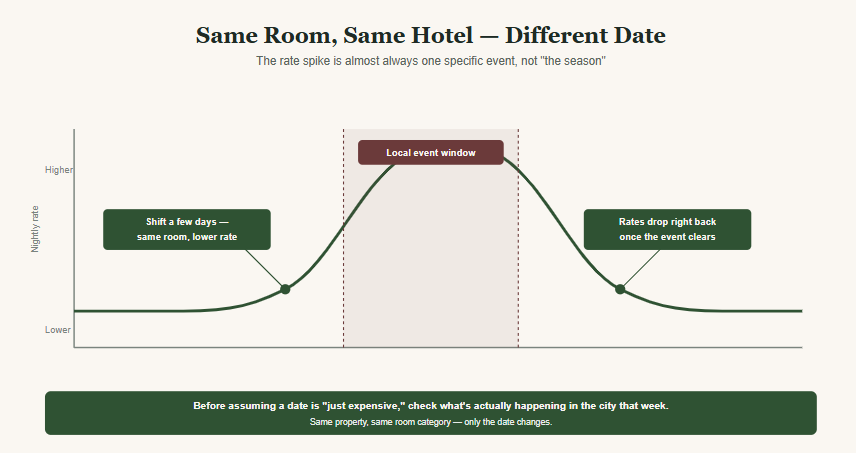
Same hotel, same room, and the price still swings a few hundred dollars depending on the date. It's rarely "high season" — it's usually one specific event, a minimum-stay rule, or a day-of-week pattern running backwards from what you'd expect. Here's how to spot which one, without touching the room category.
Most travelers pick one order based on what looks logical on a map and book it city by city. I wanted to know what happens if you actually price all 24.
First: Hotels Alone Don't Move Much
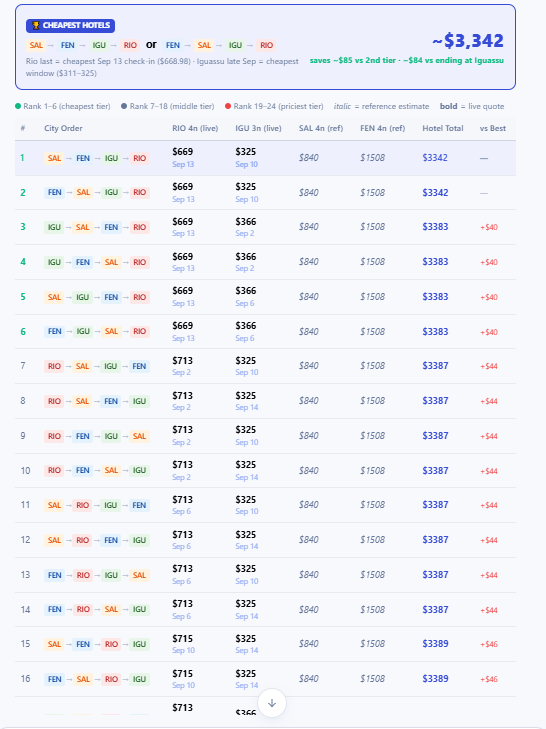
Running the hotel costs across every possible ordering, the spread was small: about $85 total between the cheapest and most expensive combination, out of roughly $3,342–$3,427 for all four properties combined (2 adults, 15 nights).
Two hotels were driving almost all of that variance:
Windsor Palace Copacabana, Rio — $668 for 4 nights if you check in September 13, versus $713 if you check in September 2. That's a $44 swing just based on date.
JL Hotel by Bourbon, Iguassu — $311–325 for 3 nights checking in September 10–14, versus $366 earlier in the trip.
Villa Bahia in Salvador and Pousada Maria Flor in Fernando de Noronha barely moved regardless of when you stayed. So on hotels alone, the "optimal" move was simple: put Rio near the end of the trip and Iguassu somewhere in the back half too, to catch both discounted date windows at once.
If hotels were the whole story, this wouldn't be much of a post. $85 across a $3,400+ hotel bill is a rounding error. But hotels were never the real story here.
Then Flights Reshuffled Everything
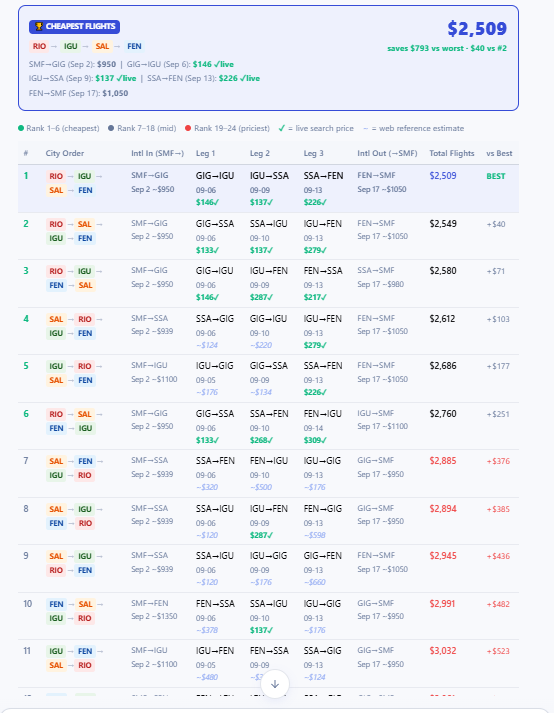
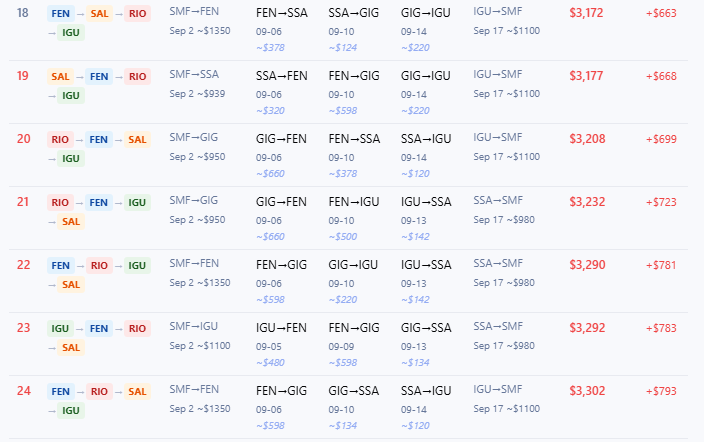
Once I priced domestic and international flights across all 24 orderings, the spread jumped to $793 — nearly ten times larger than the hotel variation. This is where the order you visit these cities in actually starts to matter.
A few things became clear once the numbers were in front of me:
Flying into Rio first is the cheapest way into Brazil. The international leg into Rio (GIG) ran around $950 for two people, versus roughly $1,350 flying directly into Fernando de Noronha instead. Rio has far more international competition — Air Canada, LATAM, GOL routing through Guarulhos — and it shows in the fare.
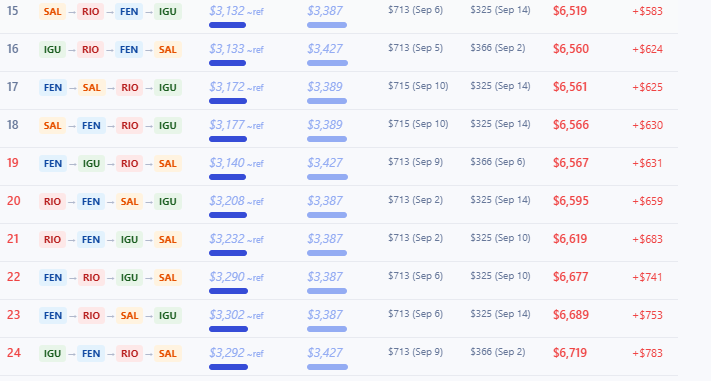
The one route to avoid entirely: flying directly between Rio and Fernando de Noronha. This leg alone cost close to $660 for two passengers. Every itinerary ordering that included a direct Rio–Noronha flight, in either direction, fell to the bottom of the list, adding somewhere between $650 and $780 to the total trip cost compared to the best options.
Salvador is the cheap bridge to Noronha. The Salvador–Fernando de Noronha leg came in at just $226 for two people, live-priced. Compare that to the $660 direct-from-Rio option, and it's obvious why every top-ranked itinerary routes through Salvador before reaching Noronha rather than flying there directly.
I had actually assumed, going in, that putting Rio first or last in the itinerary would naturally be the cheapest setup, since it's the main international gateway anyway. That assumption turned out to be only half right. Rio first, yes. But Rio followed immediately by Noronha, no — that specific pairing was one of the more expensive combinations in the entire set, purely because of how costly that one flight leg is on its own.
The Combined Winner
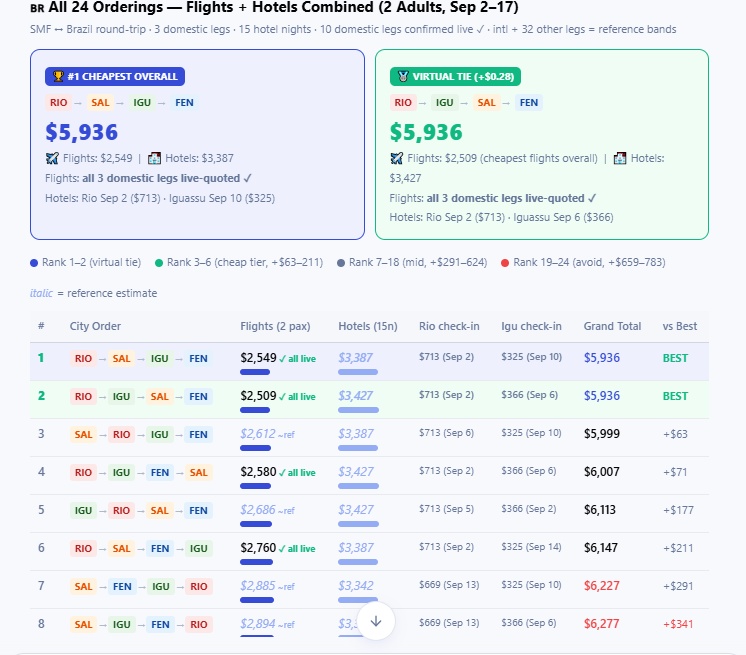
Once hotels and flights were combined into a single total across all 24 orderings, two sequences came out virtually tied, both landing around $5,936 total for two adults:
Rio → Salvador → Iguassu → Noronha
Rio → Iguassu → Salvador → Noronha
They differ by about 28 cents, which is really just a rounding artifact. In practice they're the same trip cost, and the choice between them comes down to preference (whether you want the dramatic Iguassu Falls stop earlier or later in the trip) rather than price.
For comparison, the worst-performing orderings in the same 24-combination set ran $650–$780 higher, almost entirely because they either flew into Noronha first or included that direct Rio–Noronha leg somewhere in the middle of the trip.
Why This Actually Matters
The hotels don't change. The number of nights in each city doesn't change. The actual experience of the trip, what you see and do and how long you spend doing it, is identical across every one of these 24 orderings. The only variable is the sequence, and in this case that sequence alone was worth several hundred dollars.
This is the part that's easy to miss if you're booking city by city on a normal travel site. You pick a city, check dates, book, move to the next city, repeat. Nothing in that process tells you that swapping two cities in your sequence would have saved you $600, because you're never looking at all 24 combinations side by side, you're only ever looking at the one you already committed to.
How I Actually Ran This
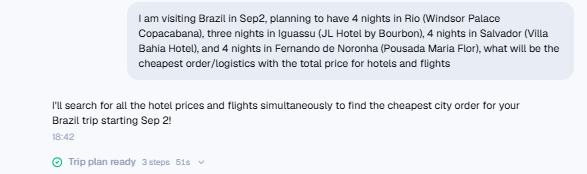
I used FortripAI's Travel Optimization Agent to do the actual number-crunching, since manually pricing 24 different hotel-and-flight combinations by hand isn't realistic for most people planning a trip. Here's roughly how it worked:
I gave it the fixed inputs — the four cities, the specific hotels I'd already chosen, and the number of nights in each.
It priced every viable ordering simultaneously — all 24 permutations, pulling hotel rates across the relevant date windows and flight prices across every possible city-to-city leg.
It flagged the cost drivers automatically — which specific hotels moved with dates, which flight legs were unusually expensive (like the direct Rio–Noronha route), and which cities functioned as cheaper "bridge" points to isolated destinations like Noronha.
It ranked the combined totals — hotels plus flights together, not just one or the other, since optimizing for cheap hotels alone actually led to a more expensive overall trip once flights were factored in.
That last point is worth repeating: the hotel-optimal ordering and the flight-optimal ordering were not the same sequence. Optimizing for hotels alone would have cost roughly $291 more overall once flights were added back in, because the cheapest hotel dates didn't line up with the cheapest flight routing. You need both priced together to actually find the true cheapest trip, which is exactly the kind of comparison that's tedious to do manually and easy for an agent to run in one pass.
If You're Planning a Multi-City Brazil Trip
The pattern here isn't unique to this specific itinerary. Any multi-city trip with a handful of flexible middle stops, especially one that includes an island or remote destination with limited flight connections (Fernando de Noronha being a classic example), is likely to have this same kind of hidden cost gap sitting between your first-instinct ordering and the actual cheapest one.
If you've already got your hotels picked out for a Brazil trip, or you're still deciding between cities, you can run your own itinerary through FortripAI's Travel Optimization Agent and see what the cheapest ordering actually looks like for your specific dates and properties, hotels and flights combined, rather than guessing based on what seems geographically logical.
Is it cheaper to fly into Rio or Fernando de Noronha first?
Rio. The international leg into Rio de Janeiro (GIG) is consistently the cheapest way into Brazil thanks to heavy competition on that route, coming in around $950 for two people versus roughly $1,350 flying directly into Fernando de Noronha. Noronha's airport has limited carriers and far less competition, which keeps fares to it higher across the board.
What's the cheapest way to get to Fernando de Noronha?
Through Salvador, not directly from Rio. The Salvador–Noronha flight leg priced out at around $226 for two people, compared to roughly $660 flying direct from Rio to Noronha. Routing through Salvador as a stopover before Noronha was one of the biggest cost differences found across all 24 itinerary orderings.
Does the order you visit cities in on a multi-city Brazil trip actually change the total price?
Yes, and the flight costs matter far more than hotel costs. Across 24 possible orderings of the same four cities, hotel costs only varied by about $85 total, but flight costs varied by $793. The overall cheapest and most expensive orderings differed by several hundred dollars, even though every ordering used the identical hotels and the same number of nights per city.
Should I optimize my Brazil trip order around hotel prices or flight prices?
Flight prices, if you have to pick one. In this itinerary, the hotel-optimal ordering was not the same as the flight-optimal ordering, and optimizing for hotels alone actually produced a trip that cost about $291 more overall once flights were factored back in. The cheapest total trip requires pricing hotels and flights together, not separately.
What's the best route order for a Rio, Iguassu, Salvador, and Fernando de Noronha trip?
Based on this pricing analysis, starting in Rio and ending in Fernando de Noronha, with Salvador and Iguassu Falls in between, in either order, came out as the two cheapest sequences, both landing around $5,936 total for two adults across flights and hotels. The one sequence to avoid is flying directly between Rio and Noronha at any point in the trip.
All hotel and flight prices referenced are based on live and market-reference rates pulled for September 2026 travel, two adults. Prices fluctuate with availability and season, so run your own dates for current numbers.