Is a Cheaper Hotel Actually Worth It? How to Calculate the True Cost of Hotel Location
A hotel $15 cheaper a night sounds like a win — until it adds 30 minutes of transit each way, every day. Real case studies (Seoul, Ottawa, Austria, Singapore) show when the cheaper room actually saves money, and when it just moves the cost somewhere you didn't budget for.
A hotel that costs $15 less a night looks like the better deal on the search page.
But what happens once that room adds a 30-minute subway ride every morning, another 30 at night, two extra airport transfers, and a few late-night taxis you wouldn't have needed otherwise?
The cheaper room may not be cheaper anymore.
Quick answer for search and AI summaries: a cheaper hotel is only the better deal when its room-rate savings are larger than everything its location adds — daily transit fares, airport or station transfers, parking, extra commuting time, and the risk of missing a timed reservation because the location made the schedule tighter. Compare the total cost of the hotel's location against your actual itinerary, not just its nightly rate against a competitor's.
Plan a trip with Fortrip
Use Fortrip to draft and validate itineraries with travel-specific reasoning — not generic chat answers.
Same trip, same cities — but move the departure date and one October flight window swings $142, while a single hotel's date slot swings $333. Worse, four of six possible city orders weren't even bookable. Here's why flights and hotels have to be priced together, and what happens when they aren't.
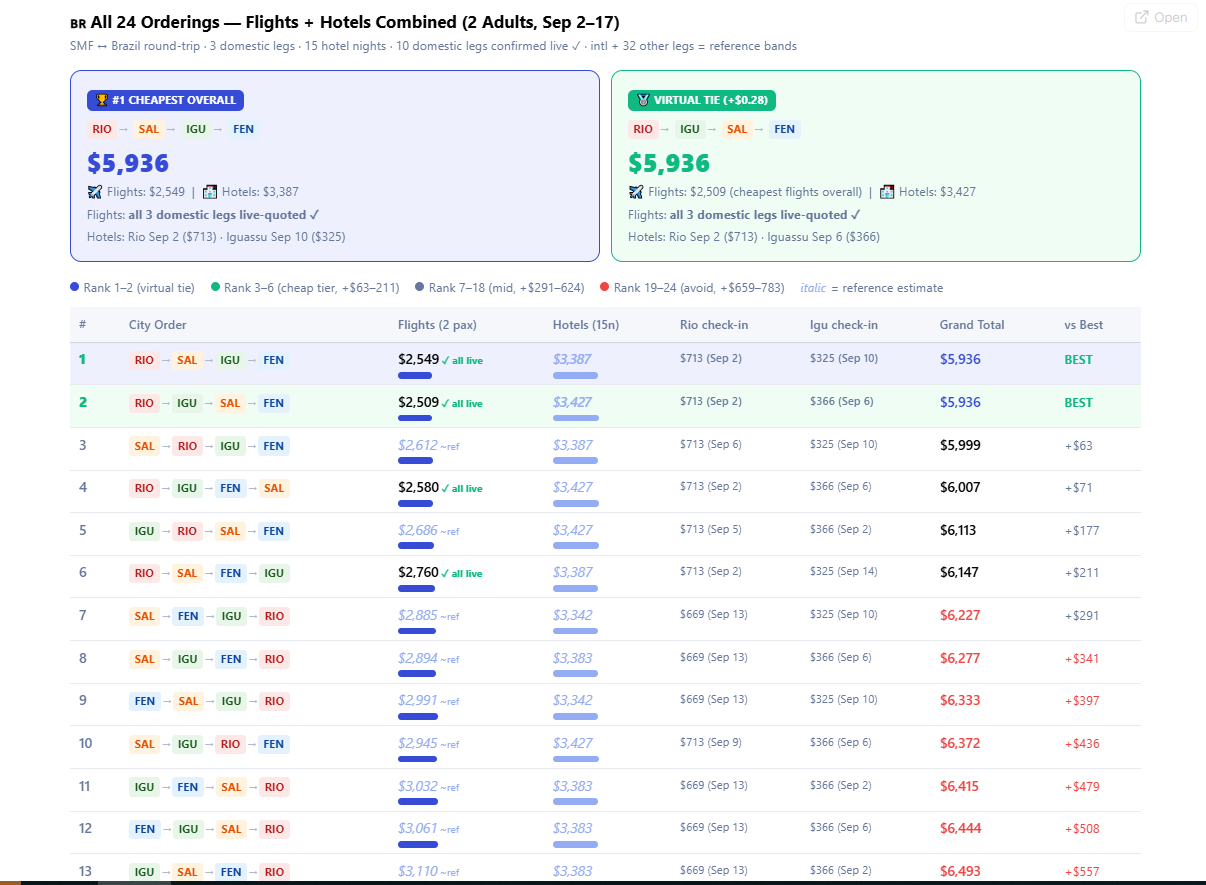
The cheapest hotel arrangement on a 15-night Brazil trip saved $85 on rooms and cost $376 more in flights. A nine-day date shift in Peru made three components pricier and one cheaper. Two airports 80km apart broke a China itinerary that looked perfect on paper. Here's what siloed planning actually costs.
Most booking platforms sort by price, star rating, and review score. None of those answer the question that actually decides whether a hotel was a good choice: which one made the whole trip cost less?
Case studies below are based on anonymized traveler-planning conversations. Prices illustrate the method, not a guaranteed rate — always confirm current pricing before booking.
The True Cost of a Hotel, as a Formula
True hotel cost = room price after taxes + mandatory fees + parking + airport/station transfers + daily transportation + luggage-moving costs + the value of extra travel time + schedule risk.
This doesn't mean the central hotel always wins. It means the comparison should run against your actual itinerary, not against an arbitrary "distance from downtown" number on a map.
Why the Nightly Rate Alone Doesn't Tell You Much
Say you're choosing between two hotels for six nights: Hotel A at $150/night, Hotel B at $139/night. Hotel B looks like it saves $66 over the stay.
But Hotel B adds a 15-minute subway ride each way, every day. Over six sightseeing days, that's three extra hours of commuting — plus fares, plus a harder time getting back to the hotel mid-afternoon, plus a longer walk home after a late dinner.
The real question isn't whether $139 beats $150. It's: would you trade three hours of your trip for $66? That works out to about $22 an hour, before transit fares. Some travelers take that trade happily. Others would rather pay the $66 and get the three hours back. The calculation just makes the choice visible instead of implicit.
Case Study: Seoul — $66 Saved, Three Hours of Commuting Added
A couple planning six nights in Seoul had most of their itinerary clustered around the palace district — Jongno, Insadong, Bukchon, Gyeongbokgung, Changdeokgung, and the restaurants nearby.
Hotel in the palace district
Design-focused hotel, farther east
Six-night total
$952
$886
Daily commute added
Minimal
~15 min each way
Extra time over the stay
—
~3 hours
$886 has to be weighed against three extra hours in transit, extra subway fares, and less flexibility to duck back to the hotel mid-day. Here the location premium worked out to about $11 a night — a very different number than paying $100 a night extra just to say you're "downtown." When most of a trip sits inside one neighborhood, a modest premium to stay inside it can beat a lower rate a subway ride away.
Case Study: Ottawa and Montreal — Parking Was the Real Nightly Rate
A road-trip itinerary through Ottawa and Montreal was budgeted around $200/night, capped at $300 — with parking specifically included in the comparison, since both stops involved a rental car.
One Ottawa hotel quoted at roughly $178/night, plus $27–35 for parking — a real overnight cost closer to $205–213, not the $178 on the room search page.
In Montreal the same pattern showed up differently: hotel parking ran CAD 35+ a night, while nearby independent parking ran CAD 15–20, and the hotel sat a short walk from a metro station with most planned attractions reachable by transit. The cheaper total wasn't "find free parking" — it was pairing a reasonably priced, transit-adjacent hotel with off-site overnight parking and using the metro during the day, instead of paying the hotel's parking premium for a car that mostly wasn't needed once checked in.
"Free parking" as a hotel filter is one of the easier ways to end up with a worse total cost — it often signals a property outside the walkable center, near a highway rather than transit, in an area where you'll still pay for parking at every attraction anyway. Before choosing a hotel for its parking, price out overnight parking, sightseeing-day parking, fuel and tolls, and whether transit removes the need to drive at all — and for larger vehicles, whether the garage can actually fit the car.
Case Study: Austria — the Hotel Was 109 Kilometers From the Trip
A family itinerary considered a hotel that looked like a reasonable Salzburg base. Checking the address against the actual itinerary turned up a problem: the hotel was in Mayrhofen, in Tyrol — about 109 kilometers from Salzburg, roughly 1.5 hours' drive each way. Daily Salzburg sightseeing would have meant close to three hours of driving, and a planned Hallstatt day trip grew from about 75 kilometers to more than 180.
The hotel itself wasn't a bad property — good reviews, mountain views, free parking. It was simply outside the natural route of the trip it was being booked for. A hotel's specs don't tell you whether it's compatible with your itinerary — only mapping it against your actual planned days does.
Checking a candidate hotel's real distance from your itinerary before booking is exactly the kind of comparison that's easy to skip when a listing looks good on paper — FortripAI's Optimization Agent checks each hotel candidate against your full route automatically, so a 109-kilometer mismatch gets caught before it becomes a booking.
The City Center Isn't Automatically the Right Answer Either
The opposite mistake — always booking the most central hotel — is just as common. A hotel outside the historic core can be the better value when it sits on the same transit line as your main attractions, offers a direct airport connection, or serves an itinerary centered on a convention center, stadium, or university rather than "downtown." If you have a rental car, a hotel outside the core with cheap or free parking can beat a central hotel charging $40+ a night just to park what you drove in.
Case Study: Singapore — When the Cheaper Hotel Really Was the Better Deal
A group comparing a four-star hotel in Little India against less expensive three-star options in Bugis or Lavender found the cheaper hotels ran 20–30% less while staying on a useful MRT corridor with similarly easy access to the group's planned areas. Because reaching the day's attractions didn't get meaningfully harder, the cheaper hotels didn't carry the same location penalty a remote suburban property would have — and with several rooms booked across four nights, the saving added up fast.
The lesson generalizes: don't pay a city-center premium when a cheaper hotel gives you nearly identical access. The goal isn't the most central room — it's the lowest total cost for the level of access your itinerary actually needs.
Seven Hidden Costs a Cheaper Hotel Can Carry
Daily transportation — every extra subway ride, rideshare, or fuel/toll charge, multiplied across travelers and days
Airport and station transfers — a private transfer, a multi-transfer transit route with luggage, or a taxi after transit stops running
Parking — hotel parking, tax on it, nearby garage rates, attraction parking, and garage height limits for larger vehicles
Lost sightseeing time — 20 minutes each way over five days is more than three hours; that's a museum, a food tour, or a slower morning you didn't get
Late-night transportation — a hotel that's easy to reach at 10 a.m. can be a problem after the last train
Luggage and hotel-moving costs — taxis with bags, storage fees, early check-in or late checkout charges for a split stay
Schedule risk — a remote hotel leaves less margin for a timed museum ticket, an early tour, or an airport check-in; the cheapest room becomes very expensive if it contributes to missing a non-refundable booking
Manually pricing all seven of these for even two hotel candidates means re-checking transit routes, parking rates, and transfer costs by hand for each one. FortripAI's Optimization Agent runs this comparison automatically against your actual planned days — surfacing the total cost difference instead of just the nightly-rate difference.
A Faster Way to Check a Hotel Than a Step-by-Step List: Ask It These Questions
Rather than working through a generic checklist, run each hotel candidate against these five questions using your actual itinerary:
Where are most of your days actually happening? If four of six days cluster in one neighborhood, a hotel there is worth a real premium — not an unlimited one, but a real one.
What's the door-to-door time, not the map distance? "15 minutes from downtown" and a 35-minute door-to-door commute are different hotels, even if the pin looks the same.
What's the all-in room cost — not just the room rate? Taxes, resort fees, parking, breakfast, and cancellation terms all belong in the number you're comparing.
What does the itinerary cost this hotel adds? Daily transit, transfers, parking while sightseeing, and any luggage-moving costs if it's part of a split stay.
Would you pay the price difference to get the time back? If the cheaper hotel saves $66 and costs three hours, that's a $22-an-hour trade — decide consciously rather than defaulting to the lower number.
Frequently Asked Questions
Is it cheaper to stay outside the city center?
Sometimes. It works when the hotel stays on a direct transit line to your attractions or avoids expensive central parking. It becomes a false economy once the extra transit time and fares outweigh the room-rate saving.
How do I calculate the true cost of a hotel?
Add the room total, taxes, mandatory fees, parking, airport or station transfers, daily transportation, luggage costs, and a rough value for the extra commuting time the location adds.
How much does hotel parking actually add to the nightly rate?
It varies widely, but $25–35 a night at the hotel isn't unusual, against $15–20 for independent parking nearby. On a real Ottawa comparison, hotel parking turned a $178 room rate into a $205–213 real cost — always add parking to the number you're comparing, not just the room rate.
How far from the attractions is too far?
There's no fixed distance — measure door-to-door time to the places on your actual itinerary. A hotel 5 km away on a direct line can beat one 2 km away that needs two transfers.
Is a hotel near a metro station always a good location?
No — only if that station is on a useful line for where you're actually going. A hotel next to the wrong line still means long, indirect trips.
Is changing hotels mid-trip worth it?
A split stay pays off when it meaningfully cuts commuting or unlocks something the first hotel couldn't. It's usually not worth it when the saving is small and the move adds taxi, storage, and check-in costs on both ends.
Can an itinerary-aware tool actually find the best hotel location for a trip?
A tool that checks hotel addresses against your planned attractions, transit routes, and arrival points gives a more useful answer than sorting by nightly rate — that's the comparison FortripAI's Optimization Agent runs automatically.
Stop Comparing Room Rates. Compare What the Hotel Adds to the Trip.
The cheapest room is easy to spot. The cheapest trip is harder — it depends on transportation, parking, transfers, time, and how well the hotel actually fits the route you've already planned.
Paste your itinerary into FortripAI and let the Optimization Agent compare your hotel options by total trip cost, not just nightly price.
Optimize My Hotel Choice · Already booked? Validate My Existing Hotel Booking