Train, Rental Car, or Private Transfer? How to Actually Choose for a Multi-City Trip
A group in Singapore planned a private driver for four days straight — then cut it to single rides and saved a third of the cost. How real multi-city trips actually combine trains, transfers, and transit, and where each one earns its keep.
How real travelers combined trains, transfers, and public transit — and cut a real Singapore itinerary's transport cost by 35% just by dropping a full-day driver they didn't need.
Most people planning a multi-city trip ask one question: which single mode of transport should I use? Train pass, rental car, or book a driver for the whole trip?
That's the wrong question. The trips that actually go smoothly almost never use one mode of transport start to finish. They mix trains between cities, transit inside them, and a car or private transfer only where it earns its cost. Below are three real routing problems — Singapore, Tuscany, and Spain — showing what changed when the plan was broken down segment by segment instead of decided all at once.
Share
Start a trip Fortrip can actually defend.
Sketch a brief. We come back with an itinerary that reads like a recommendation, not a checklist — and tell you what we’d change about it.
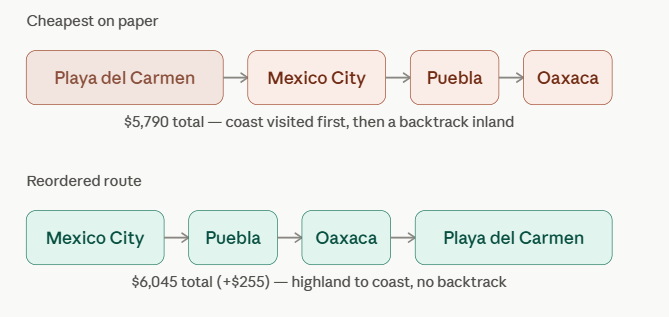
A $45 flight and a $95 train aren't $50 apart once you add the bag fee and the taxi to a distant airport — one real honeymoon route even cost $255 more, on purpose, just to stop backtracking across the country.
A scenic routing request added 228 miles and pushed four driving days to roughly ten hours each. An itinerary with a textbook route landed on the central coast at the peak of flood and typhoon season. A park fee quietly doubled between one half of the year and the other. Rome2Rio answers how to get there — here's the layer that decides whether you should go that way.
Case studies are based on anonymized patterns from real FortripAI travel-planning conversations, with details changed for privacy.
Trains win when your route connects major cities with central stations, the ride is under four hours, and each stop has decent local transit once you arrive. Compare door-to-door time, not scheduled time — a 3-hour train city-center to city-center can beat a 1-hour flight once you add airport transfer, security, and baggage claim on both ends.
Rail works especially well across Italy, Spain, France, Germany, Switzerland, Austria, Japan, South Korea, and China's major city corridors.
It stops being enough once your destination is a rural village, a wine region, a national park, or anywhere that needs several local bus connections after you get off the train. That's where a short rental-car or organized-tour leg picks up the slack — not a car for the whole trip.
Intercity Buses: The Overlooked Budget Option
Buses earn their place when there's no direct train, the train needs multiple changes, or the bus terminal is simply closer to where you're staying. Before booking, check the arrival station's location and safety at night, luggage allowance, and cancellation terms — a fare that's $20 cheaper isn't a deal if it drops you at an isolated terminal at midnight and forces a $40 taxi.
Rental Cars: Best Kept to the Rural Leg
Rental cars pay off in countryside road trips, national parks, mountain regions, and small villages with limited transit — anywhere the attractions themselves are spread out rather than clustered downtown.
The efficient pattern most travelers land on: take the train between major cities, pick up the car only when leaving the last big city, use it for the rural stretch, and return it before entering the next dense city center. That avoids paying for a car that sits in a hotel garage while you walk everywhere.
Before renting, check for a one-way drop-off fee, whether the car can enter historic centers, hotel parking, toll-road frequency, and whether you need an international driving permit.
Not sure whether your route actually needs a car, or just for one stretch of it? FortripAI's Transport Optimization Agent can map your cities and flag exactly which legs benefit from a rental car versus rail or transfer — before you commit to a multi-day rental you don't need.
Private Transfers: Best for the Days That Are Actually Hard
Private transfers make sense for airport arrivals after a long flight, early departures, families with kids, groups splitting the cost, heavy luggage, and travelers with accessibility needs. The mistake is booking a driver for an entire day because the itinerary has several stops — a car idling outside an attraction for five hours often costs more than two separate transfers.
Case study: a Singapore day that didn't need a full-day driver
A group planning four days in Singapore initially assumed a private driver for the whole stay — Marina Bay, a theme park, Sentosa, Chinatown, Gardens by the Bay, Clarke Quay. Once the days were mapped individually, most turned out to be a single hotel-to-destination trip, not a multi-stop circuit. Sentosa needed only a drop-off near the first attraction and a pickup after the evening show — inside the island, cable car, buses, and beach trams covered everything else.
The revised plan: an airport transfer on arrival, point-to-point rides on simple days, drop-off/pickup only for Sentosa, and a full-day vehicle reserved for the one genuinely complicated multi-stop day. Based on typical Singapore private-driver day rates (around SGD 250–350/day) versus point-to-point transfers (roughly SGD 25–45 per ride), cutting three unnecessary full-day bookings down to single rides brought total ground-transport cost down by roughly a third for the trip.
Ask "which hours of this day does a private vehicle actually earn its cost" instead of "do we need a driver today" — most days only need one.
Local Transit: Best Inside Well-Connected Cities
Metro and bus networks usually beat driving in cities with reliable transit, frequent service, and limited or expensive parking — travel times stay predictable even during rush hour. They get harder with heavy luggage, non-step-free stations, young kids or older travelers, or a hotel that's far from the nearest stop. The fix is rarely "transit or taxi" — it's transit for most of the day, with a taxi covering the one difficult first or last leg.
Case study: Tuscany without a rental car
A traveler planning several days based in Tuscany initially treated the whole region as one transport problem — assuming a rental car for the entire stay. Split by destination, the picture changed: Florence as a base, Siena by regional bus, and Pisa and Lucca both directly reachable by train, all without paying for a car, insurance, or parking. Rural Chianti, Val d'Orcia, and the smaller wineries outside town centers were the actual gap — solved with one organized countryside tour rather than a multi-day rental for the whole trip.
Don't pick one transport mode for an entire region based on its single hardest-to-reach destination. Cover the easy cities by rail and transit, and solve the rural gap separately.
Rideshares and Taxis: The Gap-Filler
Rideshares are best for hotel-to-station transfers, late-night returns, short trips with luggage, and reaching a single attraction that's off the transit network. They struggle on long intercity routes, in rural areas with thin driver supply, and anywhere surge pricing is common. If you're weighing a private driver against rideshares, count the actual number of rides you'd need: four or five separate trips in a day can make a private vehicle worth it; one ride out and one back usually don't.
City Order Can Undo Good Transportation Choices
Even the right train or car booking can't fix a route that backtracks. Before booking any transportation, plot your cities on a map and check for repeated hubs, unnecessary returns through the same city, or a stop that's better done as a day trip.
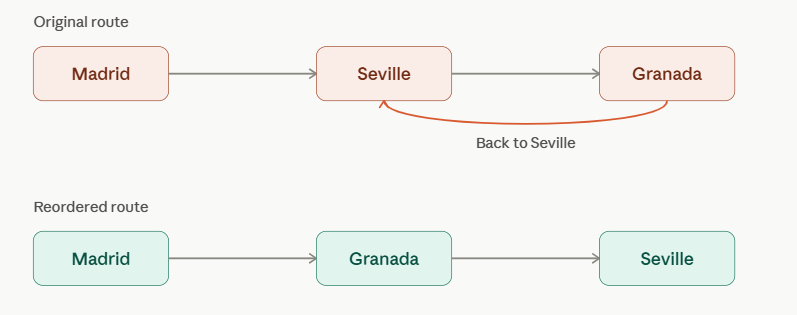
Quick example: a Spain itinerary sequenced Madrid → Seville → Granada → Seville — traveling south, east, then back west through a city already visited. Reordering it to Madrid → Granada → Seville removed the backtrack entirely, with no destination cut.
We've covered city-order optimization in depth separately, including a $187 real-world hotel-cost spread across different Tokyo/Osaka/Kyoto orderings — [read that breakdown here] if sequencing is the part of your plan you're least sure about.
Accessibility Changes the "Best" Option Entirely
There's no universal best transport mode — a route that's simple for one traveler can be exhausting or impossible for another. Before booking, check step-free station access, wheelchair dimensions and ramps, accessible toilets, the distance between the station and your hotel, and whether assistance needs to be booked in advance.
Case study: a wheelchair user traveling with a pet was comparing two destinations from Paris. A compact lakeside town with a central, step-free station made the train a straightforward choice. A more spread-out coastal region, by contrast, had attractions scattered across small towns with no accessible bus network between them — an adapted vehicle was the only option that didn't involve multiple risky transfers.
Measure transport flexibility by whether a traveler can actually complete the journey — not by how many routes a booking site lists.
Building Your Transportation Plan, Step by Step
1. Fix the city order first. List every overnight stop in sequence and check for backtracking, unnecessary returns, or a stop better done as a day trip.
2. Split the trip into segments, not one problem. Airport to first hotel, city-to-city legs, station to hotel, in-city transit, rural excursions, and the final hotel-to-airport run each have their own best answer.
3. Compare door-to-door time. Include getting to the station or airport, security or border checks, waiting, baggage claim, and the final transfer — not just the scheduled travel time.
4. Total the real cost, not the sticker price. For a rental car: fuel, insurance, tolls, parking, one-way fee, extra drivers. For trains and buses: seat reservations, luggage fees, and the transit needed after arrival. For private transfers: waiting-time charges and night supplements.
5. Protect what's already fixed. Flights, timed tickets, and hotel check-in windows come first — transportation should support those bookings, not create tight connections around them.
6. Know your backup. For each critical leg, know the next available departure, whether the ticket is changeable, and whether the hotel can hold luggage if plans shift.
Running this manually across six or more cities is exactly the kind of comparison that's easy to get wrong by hand. FortripAI's Transport Optimization Agent takes your cities, dates, and any fixed bookings, and checks the route for backtracking, flags which legs are worth a rental car versus rail, and compares transfer options against your actual schedule — instead of you rebuilding the same spreadsheet for every city pair.
Frequently Asked Questions
Is it cheaper to rent a car or take the train for a multi-city trip?
For one or two travelers moving between major cities, trains are usually cheaper once you add fuel, tolls, parking, and one-way rental fees to the car option. A rental car tends to win only for groups of three or more, or for regions with weak public transit between stops.
Should I keep one rental car for my entire multi-city trip?
Generally no if the route includes several large cities. The lower-cost pattern is renting only for the rural or countryside leg and using trains or transit for the city-to-city segments.
When is a private transfer actually worth the cost?
When you're covering an airport arrival after a long flight, an early departure, a group splitting the fare, or a route with several difficult connections. A private driver reserved for a full day of scattered single stops is usually the more expensive version of the same trip.
How do I avoid backtracking on a multi-city itinerary?
Map every overnight city in order before booking any transport. Look for a route that returns through a city you've already left — reordering the stops, not changing the transport mode, is usually what fixes it.
Is public transit realistic with luggage?
Yes if the stations have step-free access and your hotel is a short walk from a stop. With heavy luggage, young kids, or a station without an elevator, a short taxi for that one leg is usually worth the cost even if you use transit for the rest of the day.
Can I combine trains, a rental car, and private transfers in the same trip?
Yes — this is the pattern that shows up in most of the itineraries we've reviewed. Using each mode only where it's actually the cheapest or most practical option, rather than picking one for the whole trip, is what keeps total transport cost down.
Plan the Route Before You Book the Ride
The cheapest multi-city transport plan is rarely the one with the fewest bookings — it's the one where each leg uses the mode that actually fits it. Fix the city order first, split the trip into segments, and only then start comparing train fares against rental-car math.
Enter your cities, dates, and any fixed bookings into FortripAI's Transport Optimization Agent — it checks your route for backtracking, flags which legs are worth a rental car, and compares transfer options against your real schedule.