Is My Travel Itinerary Too Rushed? A 10-Point Reality Check Before You Book
Your spreadsheet says three nights here, five nights there — everything fits neatly into a row. Then the trip begins, and by Day 5 you're no longer exploring a country, you're managing a small logistics company. Use this 10-point reality check (plus a full 23-day China itinerary case study) to spot rushed pacing, risky connections, and overplanned days before you book.
Your itinerary looks perfectly reasonable in a spreadsheet.
Three nights here. Five nights there. A flight in the morning, a train after lunch, one "quick" attraction before dinner. Everything fits neatly into a row.
Then the trip begins.
The airport is an hour farther away than expected. The train station has twelve exits. Your hotel room is not ready. Someone needs lunch. That "nearby" attraction takes 90 minutes to reach, and the famous sunset viewpoint apparently requires climbing half a mountain.
By Day 5, you are no longer exploring a country. You are managing a small logistics company.
So,
Share
Start a trip Fortrip can actually defend.
Sketch a brief. We come back with an itinerary that reads like a recommendation, not a checklist — and tell you what we’d change about it.
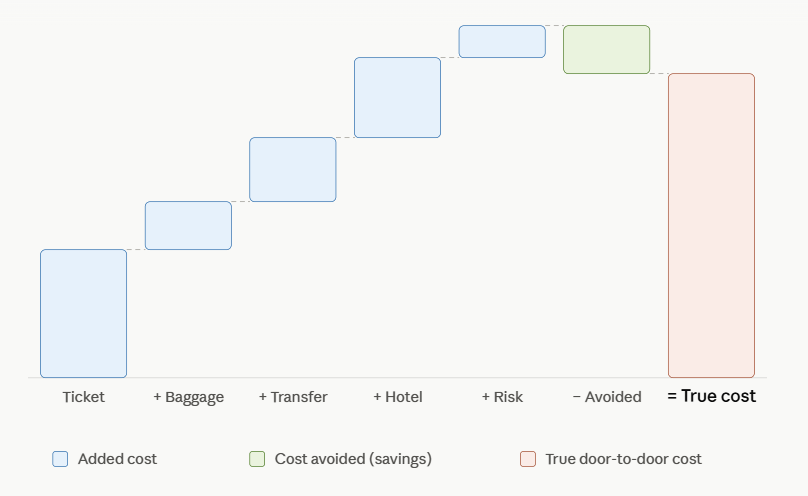
A cheap flight and a pricier train can end up costing the same once you add baggage, transfers, and an extra hotel night. Here's how to compare the full door-to-door cost — with five real routing cases where the obvious choice wasn't actually the cheapest one.
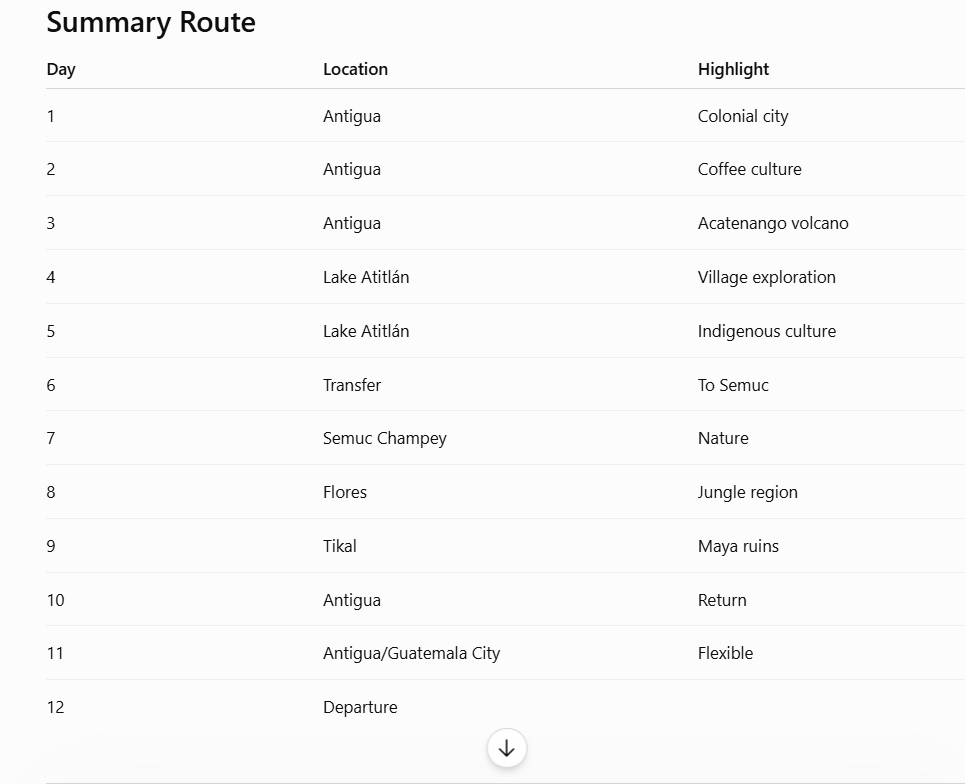
ChatGPT can plan a Guatemala trip in seconds — but a validator caught an altitude risk, two 10+ hour transfer days, and a season the itinerary never accounted for. Here's what to check before you book.
is your travel itinerary too rushed?
The answer cannot be found by counting nights alone. A five-night stay can feel relaxed, while an eight-night stay can be exhausting if every day involves long transfers, timed tickets, early departures, or high-intensity activities.
A rushed itinerary is not simply a trip with many destinations.
It becomes rushed when the amount of movement, sightseeing, physical effort, and schedule risk exceeds what the traveler can comfortably absorb.
That threshold is personal.
A traveler who enjoys 7:00 a.m. starts and does not mind returning to the hotel at 10:00 p.m. may love a schedule that another person would describe as a hostage situation.
That is why a useful itinerary check needs to consider both:
Travel density: How much is scheduled?
Traveler tolerance: How much intensity do you actually enjoy?
Use the questions below to find the gap between the two.
A Simple Travel Pace Score
For each point, give your itinerary:
0 points: No real concern
1 point: Manageable, but worth watching
2 points: Likely to affect the trip
Add up your score at the end.
Score
What It Usually Means
0–5
Relaxed, with plenty of flexibility
6–10
Active but generally balanced
11–15
Busy, with several pressure points
16–20
Your vacation may require a vacation
This is only a first-pass test. A high-energy traveler may be comfortable with a score of 13, while someone who values slow mornings may find a score of 9 unpleasant. (Prefer not to score it by hand? FortripAI Validator does this part automatically once you tell it your travel style.)
1. Are You Counting Stops or Actual Destination Changes?
A trip might appear to include four cities, but the daily reality could involve far more movement.
Consider the difference:
Staying in one hotel in Shanghai for five nights
Staying in Shanghai while taking three separate day trips
Moving between Shanghai, Suzhou, a water town, and Hangzhou with different hotels
All three plans may be described as "five nights around Shanghai." They are not remotely the same trip.
Count every time you must:
Pack your luggage
Check out
Reach a station or airport
Wait for transportation
Navigate a new city
Check in again
Reorganize your plans around a new location
One-night stops deserve particular suspicion.
A night in a destination often means arriving in the afternoon, finding the hotel, exploring for a few hours, sleeping, and leaving the next morning. You may spend more time handling your suitcase than seeing the place.
Seven days for Lima, Cusco, and Puno?
Possible, yes. But decide whether you are going to Peru to admire the scenery or conduct a detailed comparison of bus seats.
2. Are You Treating Travel Days as Full Sightseeing Days?
A flight listed as "two hours" rarely consumes only two hours.
The real calculation includes:
Checking out
Traveling to the airport
Arriving early
Security and boarding
The flight itself
Baggage collection
Transportation into the next city
Hotel check-in
Food, delays, and general human confusion
A two-hour flight can easily remove six or seven usable hours from the day.
Train journeys can be easier, but the same principle applies. A four-hour train is not a four-hour interruption. It is usually most of the day's energy.
Be careful when an itinerary says:
Arrive at noon, check in, visit three attractions, have dinner in another neighborhood, and watch the skyline at night.
Your plane may arrive at noon. Your motivation may arrive tomorrow.
If any day on your trip reads like the line above, that's usually the first thing worth restructuring — Validator flags these automatically when it scans your plan.
3. Does One Day Contain Multiple Types of Transportation?
The more connections you stack into one day, the more fragile the plan becomes.
Examples include:
Flight followed by a long-distance bus
Overnight bus followed by a flight
Train followed by a ferry
Airport transfer followed by a timed attraction
Day tour returning shortly before an evening train
Each connection creates another opportunity for a delay.
Landing in Mexico City at noon and taking a long-distance bus to Guanajuato that afternoon could work. It could also become a very expensive lesson about why airlines do not coordinate with your bus ticket.
An overnight bus arriving before a midday flight is even riskier. A traffic delay, mechanical issue, or road closure can turn "efficient scheduling" into "watching your flight depart without you."
If missing the second connection would seriously damage the trip, add a proper buffer.
4. Have You Scheduled Every Day of the Trip?
A fully assigned calendar may look efficient, but it leaves no room for real life.
Trips are affected by:
Delayed transportation
Bad weather
Temporary closures
Sore feet
Laundry
Jet lag
Unexpectedly good restaurants
Places you enjoy enough to stay longer
Places you enjoy enough to never visit again
A buffer day does not have to mean sitting in the hotel.
It can be a lightly planned day with one neighborhood, one meal reservation, and enough flexibility to absorb anything that went wrong earlier.
Without that space, one disrupted morning can push against every reservation that follows.
An itinerary with no unscheduled time is not necessarily optimized. It may simply be brittle.
5. How Much Time Will You Spend in Vehicles Each Day?
Many travelers count attractions but forget to count the journeys between them.
A resort stay can still be exhausting if every nearby attraction is two or three hours away.
You may have a beautiful room in Cancún, but if you spend several consecutive days making long round trips, the resort becomes a very expensive place to sleep between bus rides.
The same issue appears in destinations such as the Atacama Desert. You may keep the same hotel, but Moon Valley, high-altitude lagoons, geysers, salt flats, and stargazing tours can each consume much of a day.
No hotel change does not automatically mean a slow trip.
Look at your itinerary in door-to-door hours:
Hotel to attraction
Attraction to attraction
Waiting time
Return journey
Early pickup requirements
If a three-hour attraction requires five hours of transportation, call it an eight-hour day.
Your body certainly will.
6. Are High-Intensity Days Scheduled Back to Back?
Not all sightseeing days require the same amount of energy.
Compare:
Visiting a museum and walking through a shopping district
Spending twelve hours at a theme park
Hiking in the mountains
Diving
Climbing at altitude
Taking a sunrise tour after a late-night activity
These should not be counted as equivalent "one-day activities."
A traveler might be able to climb one mountain near Arequipa, or even two. Scheduling strenuous climbs on several consecutive days is a different question.
The same applies to diving in Belize. Multiple days of demanding dives may look attractive when booking, but accumulating fatigue can reduce both enjoyment and safety.
Alternate intensity where possible:
Hard day
Moderate day
Hard day
Flexible day
Putting every physically demanding experience together may save transportation time, but it can also ensure that you enjoy the final one least.
7. Are Your "Two Full Days" Actually Two Full Days?
The phrase "three nights" creates an illusion of spaciousness.
In reality:
Night 1 may follow an evening arrival
Day 2 is the first usable day
Day 3 is the second usable day
Day 4 may begin with an early departure
That gives you two full days, not four.
This matters in large cities.
Two full days in Beijing can cover the Great Wall and the Forbidden City area, but there is little room for delays, slower mornings, additional neighborhoods, long meals, or changing plans.
Four days split between Mexico City and Guanajuato can also be done. You will probably see the most famous sights, take the required photos, and leave with a strong understanding of both cities' bus terminals.
The question is not only whether the plan is possible. It is whether the available time matches what you want from the destination.
8. Does the Plan Depend on Everything Going Right?
Some itineraries are comfortable only under perfect conditions.
That means:
Every flight is on time
Every station transfer goes smoothly
Every attraction is open
Nobody gets tired
The weather cooperates
Every taxi arrives immediately
Luggage never goes missing
Nobody spends 25 minutes looking for the correct train platform
That version of the trip may exist. It is just not the one most people actually take.
Identify the days with the highest consequences.
Ask:
What happens if this flight is two hours late?
What happens if the tour returns late?
Can I move this attraction to another day?
Would I lose a hotel night or expensive ticket?
Is there another train or bus available?
A good itinerary does not need to eliminate uncertainty. It needs to survive it.
This is usually the single highest-leverage fix in any itinerary review — find your highest-risk day before you book anything non-refundable.
9. Have You Accounted for the Season and Terrain?
Four sightseeing days do not always represent the same workload.
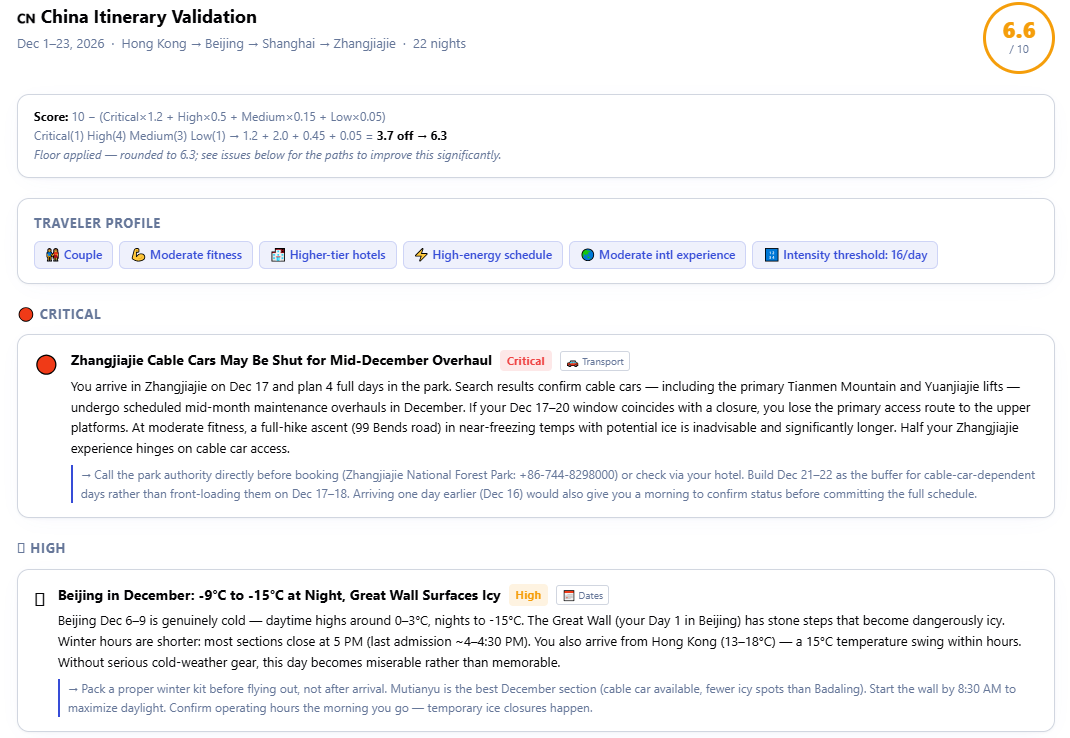
December creates different conditions from May. Mountain destinations create different conditions from flat cities. Heat, rain, snow, altitude, short daylight hours, and slippery paths all affect how much can comfortably fit into a day.
This becomes especially important when combining:
Winter travel and outdoor attractions
Mountain hiking and frequent hotel changes
Early sunsets and long day trips
High altitude and immediate physical activity
Long-haul flights and demanding first-day plans
After a long flight, you might technically be awake enough to begin sightseeing.
That does not mean your jet-lagged brain will form any useful memories of it.
When researching seasonal conditions, check more than average temperature. Look at daylight, transportation schedules, possible maintenance periods, road conditions, and how early tours depart.
10. Was the Itinerary Designed for You?
This is the most important question.
A schedule cannot be judged without knowing:
Do you prefer slow, balanced, or high-energy travel?
How early are you willing to start?
How much walking feels comfortable?
Do you enjoy long day trips?
Are you traveling with children or older relatives?
Do you need time for restaurants, shopping, or photography?
Are theme parks a priority or a side activity?
How do you feel about changing hotels?
Would you rather see more places briefly or fewer places deeply?
Two people can submit the same itinerary and receive different answers.
For a highly active traveler who enjoys early mornings, a packed schedule may be exciting.
For someone who likes late breakfasts, spontaneous cafés, and three-hour dinners, it may be an elaborate plan to generate resentment.
The correct pace is not the slowest possible pace. It is the pace that matches the traveler.
Case Study: Is This 23-Day China Itinerary Too Rushed?
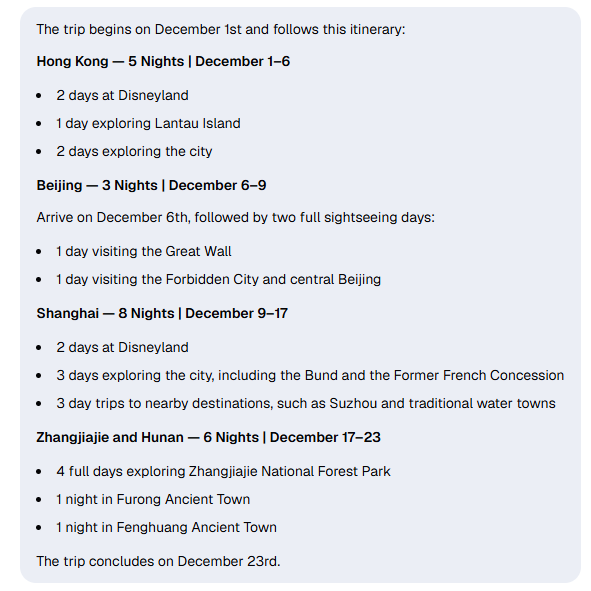
Consider this anonymized December itinerary:
Hong Kong — 5 Nights
Two days at Hong Kong Disneyland
One day on Lantau Island
Two days exploring the city
Beijing — 3 Nights
One full day at the Great Wall
One full day visiting the Forbidden City and central Beijing
Shanghai — 8 Nights
Two days at Shanghai Disneyland
Three days exploring the city
Three day trips to Suzhou and nearby water towns
Zhangjiajie and Hunan — 6 Nights
Four full days in Zhangjiajie National Forest Park
One night in Furong Ancient Town
One night in Fenghuang Ancient Town
At first glance, this does not look extreme.
The traveler has 22 nights, only four major regional bases, and several longer stays. It is much more reasonable than attempting to cover Beijing, Xi'an, Shanghai, Guilin, Chengdu, and Zhangjiajie in the same period.
But the number of nights hides several pressure points.
Hong Kong: Full but Workable
Five nights in Hong Kong is a reasonable amount of time.
The issue is that all five sightseeing days are already assigned:
Two high-energy theme park days
One Lantau day
Two city days
There is no obvious recovery period after arrival, no weather backup, and little flexibility if Disneyland takes more energy than expected.
Two consecutive theme park days are not the same as two relaxed city days. They often involve early starts, extensive walking, queues, and late finishes.
Verdict: Manageable for an energetic traveler, but one city day should remain flexible rather than being divided into a strict attraction list.
Reality-check score: 1/2
Beijing: The Tightest Major-City Segment
Is three nights enough in Beijing? Usually not — three nights gives you two full sightseeing days, and Beijing needs at least three.
Using one for the Great Wall and one for the Forbidden City and central Beijing is possible. It is also unforgiving.
The Great Wall is not a quick stop in the city center. Depending on the section visited, the journey and sightseeing can occupy most of the day.
The second day then has to absorb the Forbidden City, Tiananmen area, central Beijing, meals, local transportation, and anything else the traveler hoped to see.
There is almost no room for:
A delayed arrival from Hong Kong
Winter weather
A slower morning
Hutongs, temples, parks, or additional museums
Discovering that Beijing is larger than it looked on the map
The traveler will probably see the two headline attractions. They may not feel that they experienced much of Beijing beyond them.
Verdict: Possible, but rushed. Four nights would create a much better balance.
Reality-check score: 2/2
Shanghai: Enough Nights, but No Empty Days
Eight nights sounds generous.
However, the itinerary assigns:
Two days to Disneyland
Three days to Shanghai
Three days to day trips
Every available day has a job.
The traveler avoids repeated hotel changes, which helps. The hidden problem is the accumulation of long days. Disneyland requires significant energy, while trips to Suzhou and water towns involve station transfers, walking, and return journeys.
Three day trips should not automatically be treated as three light days just because the traveler sleeps in the same Shanghai hotel.
After two theme park days and several regional excursions, the third day trip may become less "charming ancient water town" and more "I believe I have seen this bridge before."
Verdict: The length is good. The allocation is slightly overplanned.
A better structure would reserve one of the three day-trip slots as a flexible day. The traveler could still use it for another excursion if energy and weather cooperate.
Reality-check score: 1/2
Zhangjiajie and Hunan: The Hidden Rush at the End
Six nights also sounds comfortable until the internal movements are counted.
The plan includes:
Four full days in Zhangjiajie
One night in Furong
One night in Fenghuang
This means the final part of the trip combines mountain sightseeing with two short hotel stays and multiple transfers.
Four days in Zhangjiajie can make sense, especially for travelers who want to explore different areas without forcing the park into one or two exhausting days.
The problem is what follows.
A one-night stay in Furong and another one-night stay in Fenghuang create two rapid transitions at the end of a long trip. Each town may receive only a partial arrival day and a partial departure day.
By this stage, the traveler will already have completed:
Two Disney days in Hong Kong
Two Disney days in Shanghai
Multiple city sightseeing days
Three regional day trips
A Great Wall excursion
Several days of mountain walking
The suitcase may be ready for another ancient town. The traveler may have other opinions.
Verdict: The Zhangjiajie allocation is reasonable, but visiting both ancient towns in two one-night stops is rushed. Choose one, or add more time.
Reality-check score: 2/2
Overall Score: Approximately 13/20
This itinerary falls into the busy, with several pressure points category.
It is not an absurd itinerary. It does not need to be abandoned, and an energetic traveler may enjoy most of it.
The main issue is not the number of regions. It is the lack of recovery space combined with several demanding travel styles:
Four theme park days
Long-distance travel between regions
A tightly compressed Beijing stay
Three Shanghai day trips
Four mountain days
Two consecutive one-night stops
The trip is geographically reasonable but physically more demanding than the night count suggests.
How We Would Adjust It Without Extending the Trip
One possible revision would be:
Hong Kong: 5 nights
Beijing: 4 nights
Shanghai: 7 nights
Zhangjiajie and Hunan: 6 nights
That keeps the total trip length unchanged.
Within those nights:
Give Beijing a third full sightseeing day.
Reduce Shanghai from three fixed day trips to two, keeping one day flexible.
Visit either Furong or Fenghuang, rather than forcing both into one-night stays.
Place a lower-intensity day after each pair of demanding days.
Avoid booking expensive, non-refundable activities immediately after intercity transportation.
Four small changes turned a 13/20 itinerary into something closer to an 8/20 — without cutting a single region. That is the kind of fix that is easy to make before booking and expensive to make after.
Why Generic Itinerary Rules Often Fail
Rules such as "three nights per city" or "two attractions per day" sound useful, but they ignore too much.
Three nights in a compact town are different from three nights in Beijing.
Two museums are different from a mountain hike and a theme park.
A one-hour train from city center to city center is different from a one-hour flight requiring two airport transfers.
Most importantly, travelers want different things.
One person may want to visit every major attraction because this is their only trip to the country. Another may care more about neighborhoods, restaurants, photography, or unplanned time.
That is why FortripAI Validator does not judge an itinerary only by counting cities and days.
Frequently Asked Questions
How many activities should I schedule per day while traveling?
There is no universal number. A better test than counting activities is counting door-to-door hours: add sightseeing time, transportation, waiting, and meals, and see whether the total leaves room for delays. Two "activities" that each involve a long drive can be more tiring than four that are within walking distance of each other.
How many cities should I visit in two weeks?
For most travelers, two to three regional bases in two weeks allows for at least two full days in each without back-to-back travel days. Adding a fourth city usually means either shortening every stop to one or two nights, or accepting several travel-heavy days with little sightseeing.
Is three nights enough in Beijing?
Usually not. Three nights gives you two full sightseeing days once arrival and departure are accounted for, which is typically only enough for the Great Wall and the Forbidden City area — with no buffer for weather, delays, or anything else. Four nights is a more realistic minimum.
Is a 23-day China itinerary across Hong Kong, Beijing, Shanghai, and Zhangjiajie too rushed?
Not inherently — four regional bases over 22–23 nights is a reasonable structure. The risk isn't the number of destinations, it's how many high-intensity days (theme parks, long day trips, mountain hiking) get stacked without recovery time, and how tight the Beijing segment is. See the full case study above for a worked example.
What's the fastest way to check if my own itinerary is too packed?
Paste it into FortripAI Validator — it applies this same 10-point framework automatically and factors in your personal travel style, so you don't have to score it by hand.
Check Your Itinerary Before You Book
A rushed itinerary is much easier to fix before purchasing flights, hotels, and timed tickets.
Once everything is booked, every small change becomes more expensive.
FortripAI Validator runs this same 10-point check on your actual trip. Paste in your itinerary, answer a few quick questions about your travel style, physical comfort, priorities, and preferred pace — it takes about two minutes — and Validator will identify:
Days that are too full
Transfers that are too risky
Destinations that need more time
Sections that may be unnecessarily slow
Activities that should not be placed back to back
Changes that improve the trip without removing everything you care about
It won't just tell you "good" or "bad" — it explains exactly where the pressure is, what might happen during the trip, and what to change.
You have already spent money and time getting there.