How Much Transfer Time Should You Leave Between Flights, Trains, and Hotels?
Fifteen minutes is usually all it takes for a trip to fall apart — a bus schedule that quietly changed, a ferry timed too close to a flight, a checkout that doesn't account for a 6am departure. Here's how much buffer each type of connection actually needs, and where people most often cut it too close.
The moment a trip actually falls apart is rarely the big, dramatic thing. It's usually fifteen minutes. A bus that runs on a schedule that changed last season. A ferry that gets you to the airport with no room left for a security line. A checkout time that assumes you're not catching a 6am flight. Nobody plans the fifteen minutes. That's exactly why it's the part that gets people.
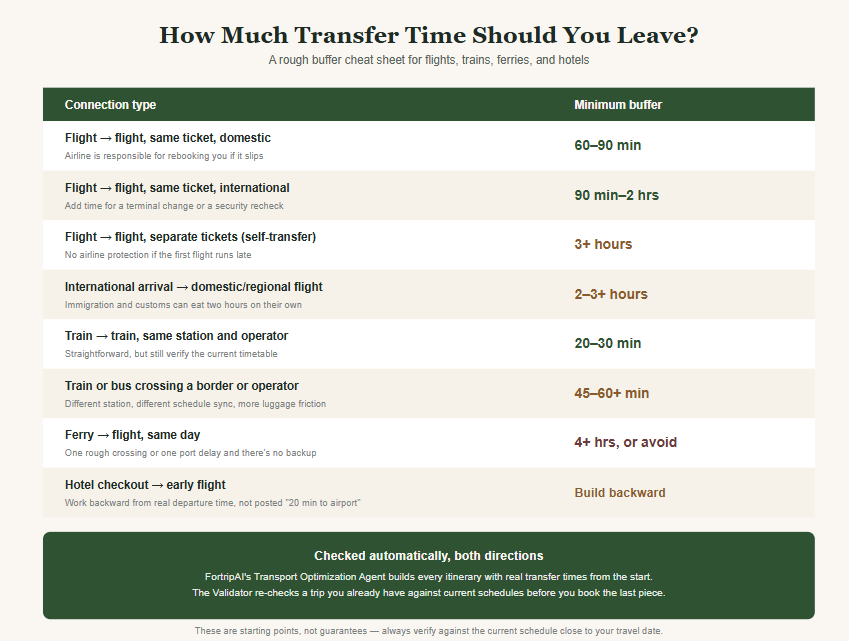
Quick answer, if you're in a hurry: same-ticket flight connections need roughly 60–90 minutes domestic and 90 minutes to 2 hours international. Self-booked connections on separate tickets need 3+ hours, because nobody rebooks you if something slips. International arrivals connecting to a domestic or regional flight need 2–3 hours minimum for immigration and customs. Any ground transport (train, bus, ferry) feeding into a flight on the same day needs at least 3 hours of slack, more if it crosses a border. None of these are hard rules. They're the floor, not the target.
Share
Start a trip Fortrip can actually defend.
Sketch a brief. We come back with an itinerary that reads like a recommendation, not a checklist — and tell you what we’d change about it.
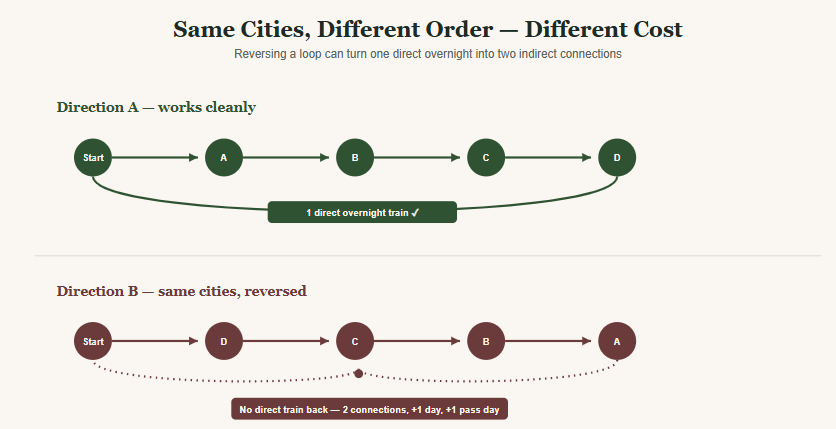
Same six cities, same total distance — one direction wrapped up with a single overnight train home, the other needed two connections and burned an extra day. We tested the same loop multiple ways to find out when reordering actually saves time or money, and when it just moves the cost around.
Most multi-city trips don't fall apart because of too few days — they fall apart because every stop got the same amount of time regardless of what it needed. Here's how many cities actually fit into 7, 10, or 14 days once you count nights instead of days.
Here's where each of those numbers actually comes from, and where they most often go wrong.
Flight-to-flight connections: how much layover is actually enough?
The honest answer is that it depends entirely on whether the airline is responsible for getting you to your next flight, or whether you are.
Same ticket vs. separate tickets changes everything
If both flights are on one itinerary, booked through the same reservation, the airline has to get you there or rebook you if they don't. That's what a "minimum connection time" published by an airport is actually protecting. If you book two one-way tickets separately to save money or build a specific routing, none of that protection exists. A delay on the first flight is just your problem now, and the standard advice of "90 minutes is plenty" stops applying. Self-transfer connections deserve 3 hours or more, especially if the two flights are on different airlines that don't share a baggage agreement.
International arrival, domestic or regional departure
This is the connection that catches people who've flown plenty before but haven't flown into this specific kind of airport. Landing on an international flight and connecting onward, whether to a domestic leg or a smaller regional carrier, usually means clearing immigration and customs before you can even get to the next gate, sometimes with your bags in tow to recheck them. Two hours can evaporate in that process alone, before you've accounted for a shuttle between terminals. A comparison of two possible international routings for the same trip once showed a large price gap explained almost entirely by this: the cheaper option looked identical on paper until you noticed the layover required clearing entry formalities in an unfamiliar airport with less than 90 minutes to do it.
How to check this yourself
Look up the airport's own published minimum connection time for your specific routing, not a general rule of thumb, and add real margin if you're on separate tickets or crossing an immigration checkpoint mid-journey.
Trains, buses, and ferries: why "on the schedule" doesn't mean "on time"
Ground transport connections fail in a different way than flights do. Flights are usually late. Ground transport is sometimes just wrong, in the sense that the schedule you're planning around no longer exists.
When the schedule itself is the problem
A traveler once built a multi-leg return journey around a specific local bus number and departure time to reach a small regional airport. On paper, the timing worked. Run through a itinerary check, it turned out that exact bus departure didn't exist anymore, the route had been adjusted, and the next available departure would have meant missing the connecting international flight home entirely. Nobody had done anything wrong. The plan was built on a schedule that had quietly changed. This is the single most avoidable way a trip goes sideways: trusting a printed or remembered timetable instead of the current one.
Ferries feeding into a flight on the same day
Island-hopping trips regularly end with a ferry back to the mainland timed just tightly enough to make a same-day flight. On a good day, it works. On a day with any wind, any mechanical delay, or any port congestion, it doesn't, and there's no next ferry that saves the booking. If a flight home depends on a ferry earlier that same day, that's the one connection in the whole trip worth deliberately over-buffering, or splitting into two separate days if the schedule allows it at all.
Cross-border rail and bus connections
A connection that looks routine on a single-country rail map can turn into something else entirely once it crosses a border, where the next leg might run on a different operator, a different station, or a schedule that isn't synced with the one you just got off. Same-station, same-operator changes can work with 20-30 minutes. Anything crossing an operator or a border deserves closer to an hour or more, especially with luggage.
How to check this yourself
Verify the actual current schedule close to your travel date, not the one you found when you first planned the trip, and treat any same-day ferry-to-flight or last-connection-of-the-day scenario as the point in the itinerary that needs the most slack, not the least.
Hotels: the transfer time nobody puts on the itinerary
This is the connection type that gets left off itineraries entirely, because a hotel stay doesn't feel like a "connection" the way a flight or a train does. It is one.
Early flights vs. checkout and breakfast timing
A 6am flight sounds simple until you work backward: security lines, the actual drive or transit time to the airport (not the posted "20 minutes," the real one at that hour), checkout, and whatever the hotel's earliest breakfast service is, which usually isn't early enough to matter anyway. The itinerary that lists "Day 5: flight home" and nothing else about the transfer is the itinerary most likely to produce a stressful pre-dawn scramble.
Late arrivals and check-in cutoffs
The reverse problem shows up on arrival days. A delayed flight or a late train can push arrival past a hotel's front-desk hours or automated check-in cutoff, particularly with smaller independent properties that don't have 24-hour staff. This is worth checking before you book, not after you're standing outside a locked door at midnight.
The night before a big departure
The most detailed transfer planning tends to happen the night before an early or complicated departure: confirming a driver or transfer pickup, sorting out a local SIM or eSIM, downloading offline maps in case of no signal, printing or saving any entry forms a destination requires. None of this is about the flight itself. It's about making sure everything between the hotel bed and the departure gate actually connects.
How to check this yourself
Treat the hotel-to-transport link as its own leg of the journey, with its own real transit time, and build backward from your actual departure time rather than forward from checkout time.
A rough buffer cheat sheet
Connection type
Minimum buffer worth planning for
Flight → flight, same ticket, domestic
60–90 minutes
Flight → flight, same ticket, international
90 minutes–2 hours
Flight → flight, separate tickets (self-transfer)
3+ hours
International arrival → domestic/regional flight
2–3+ hours
Train → train, same station/operator
20–30 minutes
Train/bus crossing a border or operator
45–60+ minutes
Ferry → flight, same day
4+ hours, or avoid same-day entirely
Hotel checkout → early flight
Real transit time + security + buffer, worked backward from departure
These are starting points, not guarantees. Weather, port congestion, immigration lines, and schedule changes can all eat into any of them, which is exactly why the connection with the least slack in your itinerary deserves a second look before the connection with the best photos.
How FortripAI's Transport Optimization Agent and Validator handle this
We ended up building two different tools for two different moments in this problem, because "get the timing right" isn't one task, it's two.
The Transport Optimization Agent handles it while a trip is being built. When it sequences flights, trains, ferries, and hotel stays into an itinerary, it's working out real transfer times between each leg, not just checking that the dates line up, so a same-day ferry-to-flight connection or a tight cross-border train change gets flagged and adjusted before it ever reaches you as a finished plan.
The Validator handles it after the fact, for a trip you already built, whether that's one FortripAI generated earlier, one you put together yourself, or one from somewhere else entirely. Paste it in, and it checks the actual current schedules behind every connection, not the schedule you originally planned around, which is exactly the kind of check that would have caught a bus number that no longer exists before it turned into a missed flight instead of after.
How much time should I leave for a flight connection?
Roughly 60–90 minutes for a same-ticket domestic connection, 90 minutes to 2 hours for a same-ticket international one, and 3 or more hours if you booked the two flights separately. International arrivals connecting to a domestic flight need extra time for immigration and customs, often 2-3 hours or more.
Is a 1-hour layover enough?
For a same-ticket domestic connection at a straightforward airport, often yes, if nothing goes wrong. For an international connection, a self-transfer, or an unfamiliar airport with a terminal change, it's cutting it closer than most travelers realize, and it leaves no room for any delay at all.
How much buffer do I need between a train or ferry and a flight?
More than most people plan for. Same-day ground transport connecting to a flight deserves at least 3 hours of slack, and same-day ferry-to-flight connections are worth avoiding altogether if the schedule allows splitting it across two days instead.
What's the most commonly underestimated transfer time?
Two, in practice: self-transfer flight connections on separate tickets, where there's no airline protection if something slips, and the hotel-to-airport leg on an early departure day, where the real transit time and security line rarely match the "20 minutes to the airport" people remember from a daytime trip.
Can an AI itinerary tool actually catch a bad connection before I book it?
It can, if it's checking real, current schedules rather than working from static or outdated data. That's the difference between a tool that generates a plan and one that also validates it: generation alone can produce a connection that looks fine on paper, and only a check against live schedules and realistic transit times catches the ones that aren't.
If you've got a multi-leg trip with a tight connection somewhere in it, run it through FortripAI's Validator before you book the last piece. It's usually the one connection you didn't think to double-check that's worth checking first.
This post is part of our series on evaluating AI travel plans before you book them. See also: